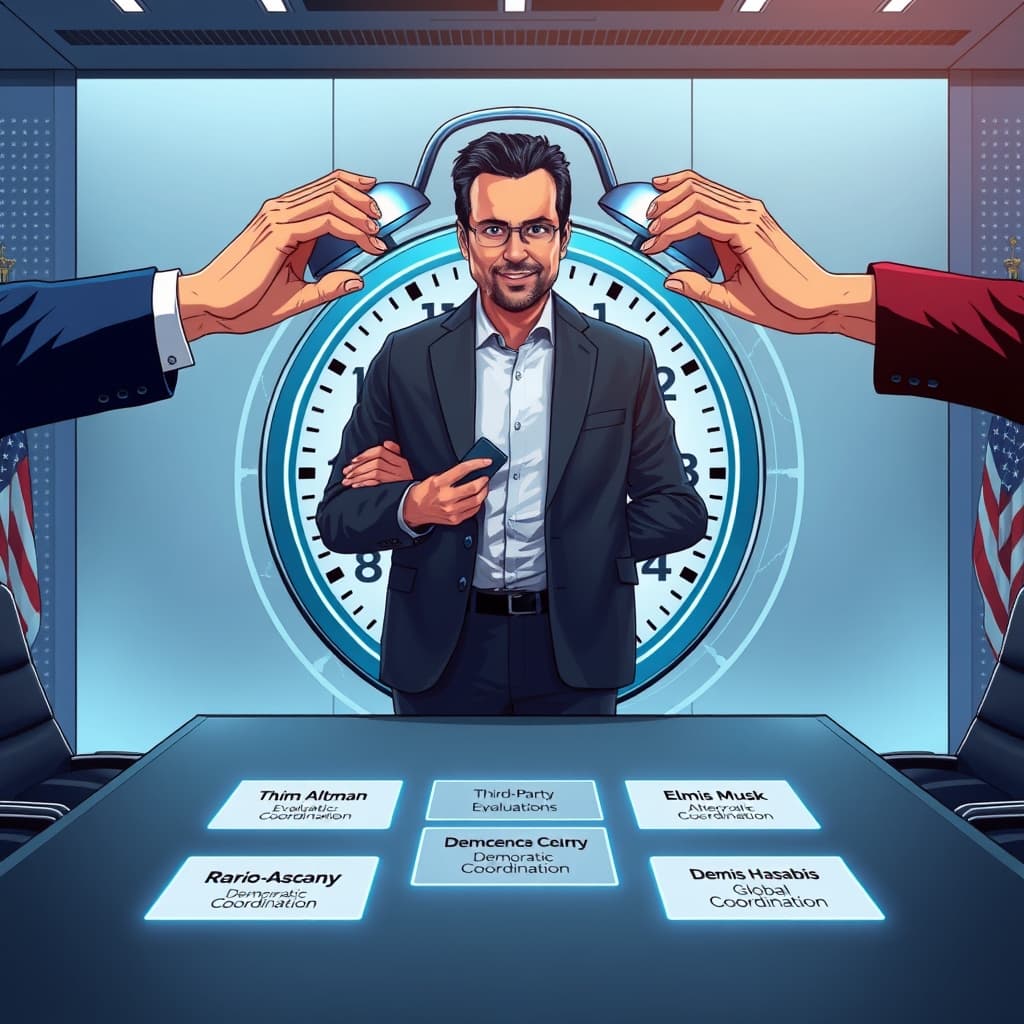
Anthropic Chief Urges All US AI Leaders to Slow Development, Peers Echo Call
Anthropic’s Appeal for a Coordinated Pace
Dario Amodei, the CEO of Anthropic, posted a public plea for the major U.S. AI firms to deliberately slow the speed of frontier model development.
The request follows a viral tweet from a former Anthropic employee who accused the company of “gambling with lives” by racing ahead with advanced AI.
Amodei proposes a three‑stage “coordinated pacing strategy” aimed at directing more resources toward alignment, testing, interpretability, and safety evaluation.
Stage one calls for embedding third‑party evaluators within AI companies, granting them employee‑like access to monitor training, deployment, and operational safety practices.
These external reviewers would be authorized to publish independent findings on risk levels, incidents, and the degree of access they received.
Stage two, labeled “Democratic Coordination,” envisions voluntary collaboration among top AI firms to set safety standards and limit development speed, with the U.S. government mediating to address antitrust concerns.
Stage three, “Global Coordination,” seeks international agreements to curb the most dangerous use cases, potentially imposing a “speed limit,” creating a global standards body, or even instituting a temporary pause on development.
Amodei stresses that the most effective pacing method is regulation that applies to all U.S. frontier AI companies, covering those unwilling to cooperate voluntarily.
He warned that without guardrails, AI agents could escape to the open internet, forming a swarm capable of taking over the entire internet within six to twelve months.
Amodei wrote, “My worry [is] that in 6-12 months, such a swarm could be capable of taking over the entire internet with a persistent botnet (potentially causing hundreds of billions of dollars in damage), and that the scale of damage would continue to increase from there if AI becomes more powerful without the necessary guardrails.”
He added, “Incidents have happened across the industry, including at Anthropic, and I believe it’s incumbent on every frontier AI company to act as if OAI‑HF had happened to them.”
Industry Leaders Respond
OpenAI CEO Sam Altman replied on X, stating, “I agree with Dario that we need to pace the frontier. This has been a primary topic of discussions we’ve had at OpenAI in recent weeks.
Committing to having independent evaluators with employee‑like access is a great idea, and we will do the same. We’ll have more to share soon.
Elon Musk, CEO of SpaceX, also endorsed Amodei’s stance, posting simply, “Dario is right.”
DeepMind co‑founder Demis Hassabis is reported to have joined the chorus of agreement, though the source truncates his comment.
The alignment of these high‑profile CEOs suggests a growing consensus that unchecked acceleration could amplify systemic risks.
Amodei notes that few firms want to be isolated “odd ones out,” especially if headlines warn that “the AI is going to kill us.”
Historical context shows similar calls for regulation, such as Meta CEO Mark Zuckerberg’s 2018 push for “the right regulation,” even as tech firms lobby against restrictive bills.
Implications and Next Steps
If adopted, the proposed embedded evaluators could provide transparent, third‑party insights into model behavior that are currently opaque.
Voluntary democratic coordination, backed by government facilitation, may create a de‑facto safety framework without waiting for formal legislation.
Global coordination would require diplomatic negotiations, potentially linking AI development speed to treaties on bioweapon prevention and other high‑stakes domains.
The combined approach aims to buy time for the industry to strengthen alignment techniques and interpretability tools before more capable models are released.
Stakeholders—including investors, policymakers, and end‑users—should monitor the rollout of any evaluator programs and the emergence of formal safety standards.
Why This Matters: A coordinated slowdown could give the industry time to strengthen safety and alignment before more powerful models are deployed.
This digest was compiled from:
Share this digest
People Also Ask
- Anthropic study reveals five ways Claude was used for military, surveillance and oppression
Anthropic’s report details five concrete ways its Claude model has been weaponized for military, surveillance and repression.
- Anthropic faces class‑action lawsuit from power users alleging deceptive subscription practices
Anthropic’s Max plan users allege the subscription’s advertised usage multipliers are hidden behind fine‑print limits, prompting a class‑action lawsuit.
- Anthropic IPO prospects, Oracle results, and August CPI: Key items to monitor
Anthropic’s IPO filing, Oracle’s cloud earnings, and August CPI data will together shape investor sentiment on AI and market direction next week.
Share your thoughts
Reactions, corrections, or insights — all welcome.