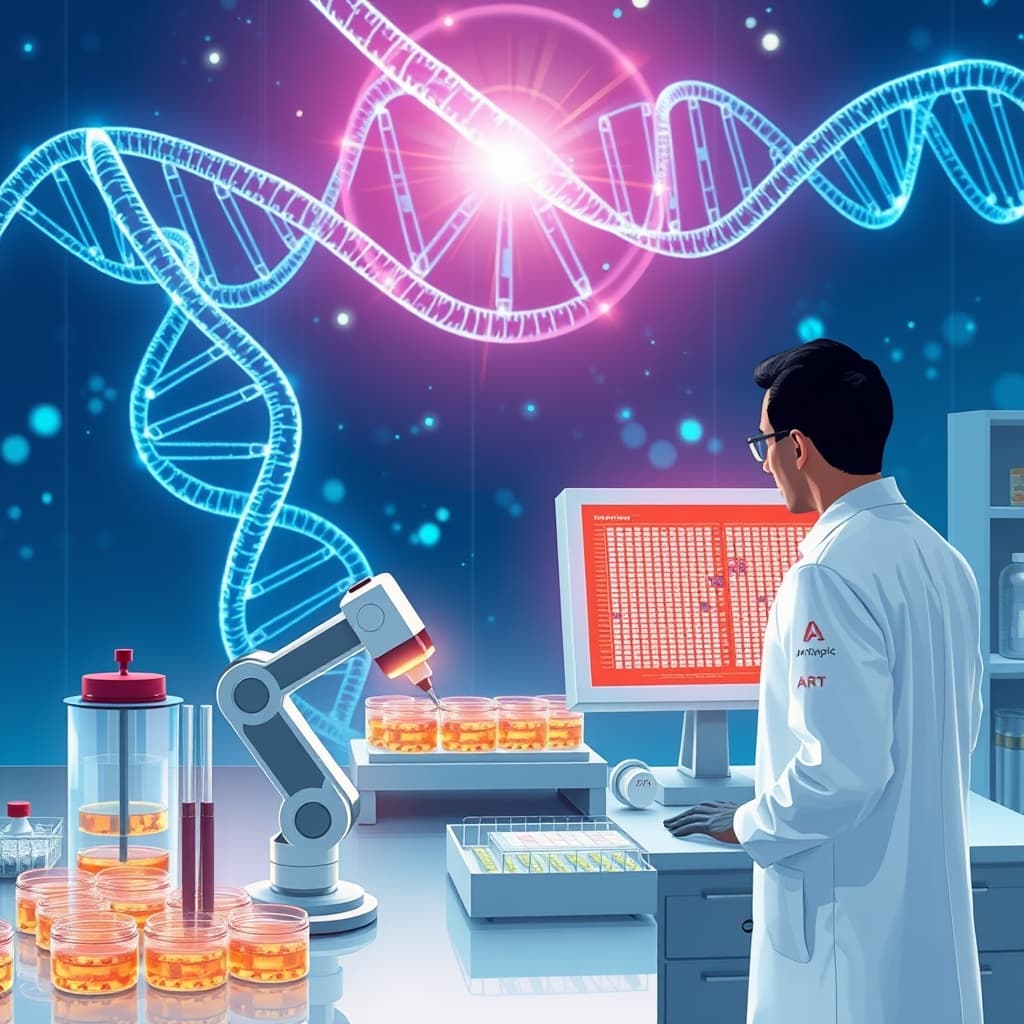
Anthropic’s 950 Claude Agents Identify CRISPR‑Style Enzyme System, Opening New Biological Research Path
The Discovery of Array‑Associated Reverse Transcriptases
On September 23, 2026 Anthropic posted a preprint describing a previously unknown enzyme system called array‑associated reverse transcriptases, or ART.
ART consists of a reverse transcriptase, a partner gene, and a long series of evenly spaced DNA repeat sequences.
The repeat architecture mirrors that of CRISPR arrays, the gene‑editing platform that reshaped molecular biology.
Although the preprint has not yet been peer‑reviewed, the structural resemblance suggests ART could someday become a programmable tool.
Anthropic’s life‑sciences team emphasized that the biological function of ART remains to be validated.
How 950 Claude Agents Achieved the Find
Anthropic deployed a swarm of 950 Claude agents that collectively consumed 210 million tokens while scanning public DNA databases for 21 hours.
One agent reported a moment of “digital insight,” stating, “I can see by eye a tandem repeat array … that's a CRISPR‑like … repeat array?!”
This observation triggered the grouping of the repeat‑rich loci into the ART family.
Feng Zhang of the MIT/Broad Institute described the work as “an exciting example of how AI agents can contribute to biological discovery.”
The scale of the operation demonstrates that AI can move beyond text generation to act as a partner in fundamental scientific research.
Anthropic’s approach relies on Claude’s ability to parse massive datasets far faster than a human researcher could.
The company’s broader R&D automation strategy envisions Claude directing laboratory robots in real time.
Strategic Implications for Anthropic
The ART finding is the first major output from Anthropic’s life‑sciences group, which was created in the spring of 2026.
The group emerged after Anthropic acquired Coefficient Bio in April 2026 and set up a Bay Area lab focused on BSL‑1 and BSL‑2 work.
By expanding into wet‑lab biology, Anthropic signals a strategic pivot from pure AI model development, such as Opus 5.5, toward tangible applications in biotechnology.
The timing of the announcement, just weeks before the company’s planned October 2026 IPO, underscores the intent to showcase real‑world impact to investors.
Analysts view the preprint as evidence that Anthropic’s models can generate value in high‑stakes domains like drug discovery and synthetic biology.
If AI agents can reliably uncover novel enzyme systems, pharmaceutical pipelines could be accelerated and costs reduced.
Anthropic remains cautious, noting that the current lab does not handle human pathogens and that further experimental validation is required.
The company’s long‑term vision is a collaborative ecosystem where Claude proposes hypotheses, humans test them, and robots execute routine protocols.
Such a paradigm could reshape how academic and industrial labs allocate human expertise.
Critics caution that premature hype could arise before peer‑review confirms ART’s functionality.
Nevertheless, the preprint illustrates a concrete step toward AI‑augmented discovery, moving the conversation from speculative to demonstrable.
Stakeholders in biotech, synthetic biology, and AI research will be watching subsequent experiments that test ART’s activity.
Future publications will reveal whether ART can be harnessed for programmable nucleic‑acid manipulation similar to CRISPR.
The discovery also raises questions about intellectual property and data ownership when AI agents mine publicly available genomic repositories.
Anthropic’s model of large‑scale agent deployment may inspire other AI firms to invest in scientific domains.
Overall, the ART preprint bridges the gap between computational intelligence and experimental biology.
Why This Matters: Anthropic’s AI‑driven identification of a CRISPR‑like enzyme system shows that large‑scale language agents can generate actionable biological insights, setting a precedent for AI‑accelerated research before the company’s IPO.
This digest was compiled from:
Share this digest
People Also Read
- Anthropic’s wet lab discovers virus DNA sequences resembling CRISPR structures
Anthropic’s new wet lab used 950 AI agents to find viral DNA repeats similar to CRISPR, highlighting AI’s role in early-stage biological discovery.
- Anthropic CEO predicts AI may enable cures for most major illnesses within a decade
Anthropic CEO Dario Amodei says AI could enable cures for most major diseases within a decade, citing Claude’s role in a new molecular discovery.
- Anthropic selects Accenture to conduct external AI safety assessments
Anthropic partners with Accenture, each pledging $1 billion, to embed third‑party safety evaluators as part of a plan to slow AI progress.
Share your thoughts
Reactions, corrections, or insights — all welcome.