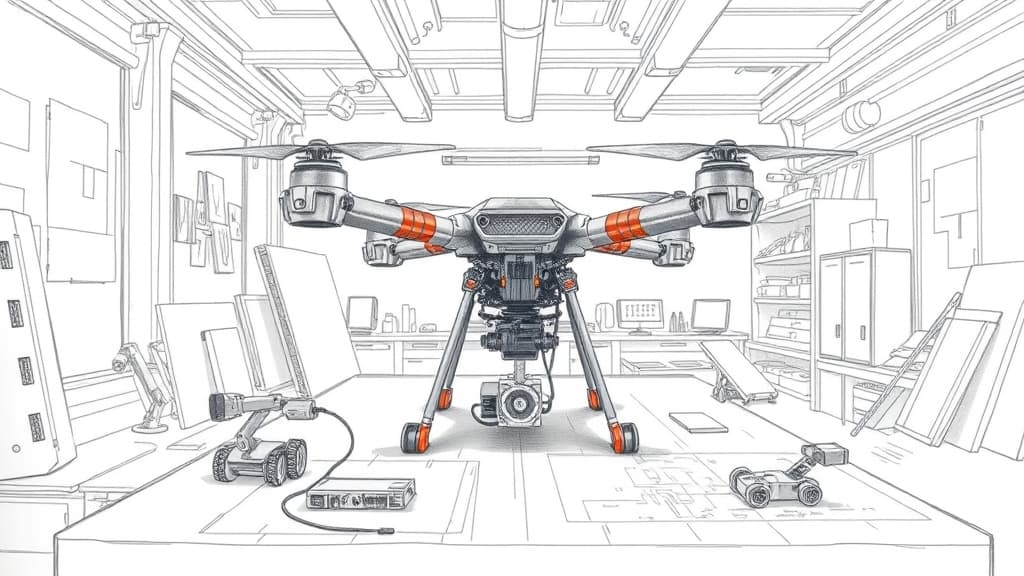
Building Africa's Industrial Base: Terra Industries and Miva Partner to Train Drone Engineers
The rapid expansion of high-technology manufacturing in Africa has highlighted a critical shortage of specialized engineering talent equipped for practical production roles.
To address this challenge, academic institutions and industrial leaders are establishing direct training pipelines to prepare students for advanced technical careers.
A prominent example of this trend emerged on July 31, 2026, when Nigerian defence technology startup Terra Industries partnered with Miva Open University to build integrated robotics and drone laboratories.
This initiative aims to transform how engineering students acquire practical skills by embedding real-world manufacturing workflows directly into the academic curriculum.
Bridging the Gap Between Theory and Assembly
Under a newly signed Memorandum of Understanding, Miva Open University and Terra Industries will establish specialized spaces designated as Integrated Robotics, Drone, and Virtual Reality Laboratories.
The initiative will commence with a pilot laboratory at the Miva Open University Study Centre in Abuja, providing a blueprint for future developments.
Following the pilot phase, Miva Open University plans to replicate these laboratory facilities across its other study centres throughout Nigeria.
Within these facilities, students will participate in comprehensive academic programs where they will learn to design, assemble, test, and fly unmanned aerial vehicles.
By integrating virtual reality technologies alongside robotics, the laboratories will offer immersive environments for students to simulate complex engineering tasks before working with physical hardware.
This structured approach ensures that academic learning translates directly into physical engineering competencies required by modern technology firms.
An Industrial Strategy Fueled by Venture Capital
The partnership represents a strategic effort by Terra Industries to solve its long-term talent acquisition challenges as it scales its manufacturing footprint.
As Africa's top-funded defencetech startup, Terra Industries secured 34 million US dollars in funding in 2026 to accelerate its production capabilities.
The company currently operates a 15,000-square-foot manufacturing facility in Abuja, which stands as the largest drone factory on the African continent.
To expand its regional reach, the startup is also constructing an even larger 34,000-square-foot manufacturing plant in Ghana.
Operating facilities of this scale requires a continuous influx of skilled engineers who understand both hardware design and assembly protocols.
By partnering with an open university, the manufacturer is actively developing the workforce necessary to sustain its ambitious regional expansion.
Developing the Continent's Industrial Base
To ensure the training matches industrial standards, Terra Industries will play an active role in the daily operations of the new laboratories.
The defencetech firm will run hands-on workshops, train university faculty members, and closely monitor student progress.
Top-performing students from the program will receive direct pathways to employment through internships and job offers at Terra Industries.
This collaborative model aligns with the company's belief that the next generation of African engineers must develop their skills through direct physical engagement with technology.
According to statements from Terra Industries, building the continent's industrial base requires that students learn by building rather than relying solely on theoretical instruction.
This strategy positions Miva Open University students at the forefront of a growing domestic hardware sector.
Why This Matters
This partnership demonstrates how venture-backed hardware startups in Africa are bypassing traditional talent bottlenecks by co-developing practical university curricula.
As Terra Industries expands its manufacturing infrastructure across Nigeria and Ghana, the success of this academic collaboration will serve as a key indicator of Africa's capacity to sustain high-tech industrial growth internally.
This digest was compiled from:
- https://www.linkedin.com/posts/terrahaptix_terra-industries-is-partnering-with-miva-activity-7488926883657519104-z1PF
- https://www.linkedin.com/posts/mivauniversity_mivaopenuniversity-drone-dronelab-activity-7488936992240648192-Z-U3
- https://x.com/terraindustries/status/2083160964589932719
- https://theunknownnigeriablog.blogspot.com/2026/07/miva-open-university-terra-industries.html
- https://www.instagram.com/p/DbdTiE8DGBK
Share this digest
People Also Read
- OpenAI’s 2026 DevDay: Major Unveilings and Key Takeaways
OpenAI held its annual DevDay on September 29, 2026 in San Francisco, marking the company’s most high‑profile event of t...
- Anthropic’s IPO filing mixes massive losses, soaring revenue and a direct warning that its AI could threaten humanity
Anthropic’s IPO prospectus reveals huge losses, rapid revenue growth and, for the first time, an explicit warning that its AI could end humanity.
- Leo Stan Ekeh Opens AI Learning Centres at Two Lagos Secondary Schools
Leo Stan Ekeh’s foundation opened AI‑enabled learning centres in two Lagos schools, pairing renewable power and Starlink internet to boost digital education.
Share your thoughts
Reactions, corrections, or insights — all welcome.