Creating a multiplayer game environment using self‑directed Fable‑class AI models
An AI‑powered world‑building platform
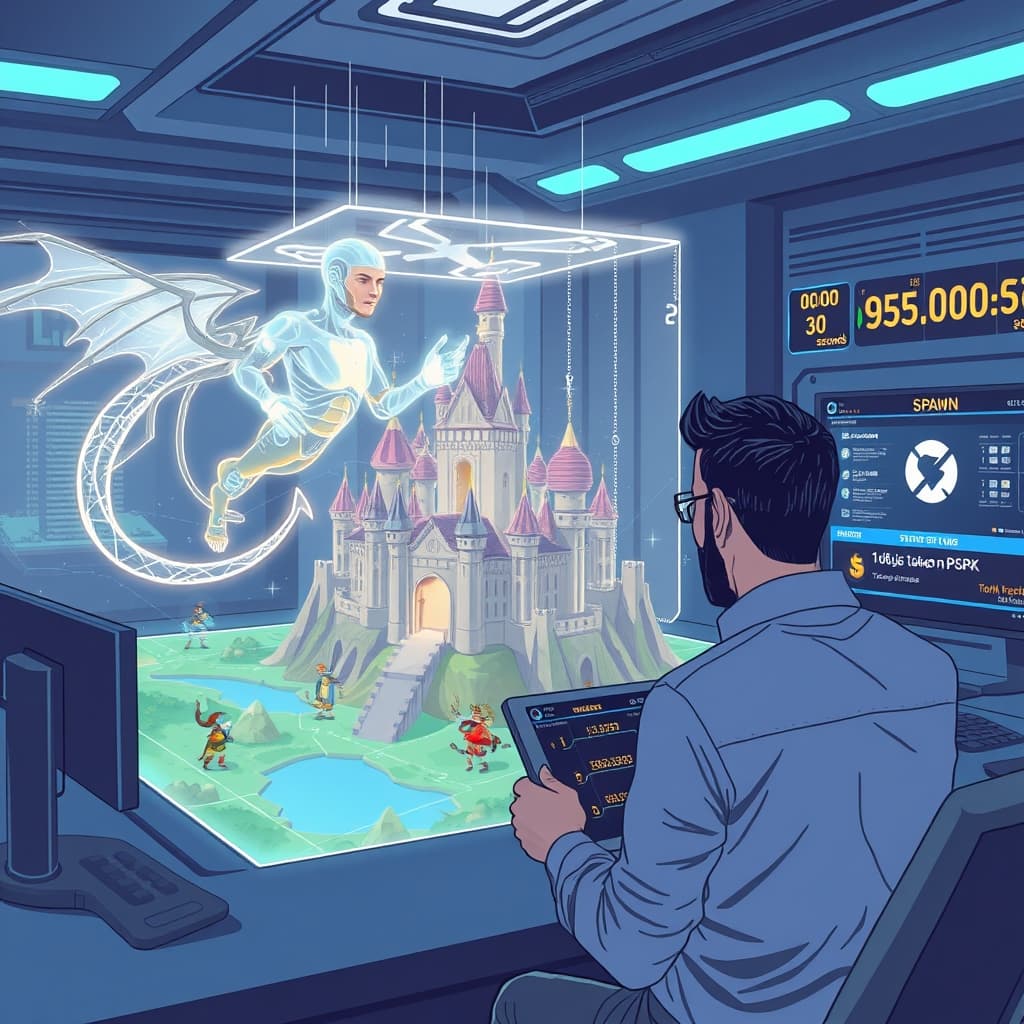
Spawn is a massively multiplayer gaming environment where players shape the world by prompting an in‑game AI agent called Savi.
Jacob Sansbury’s description shows that a user can summon a castle, conjure a dragon, and then ride that dragon around the newly created fortress, all from a phone.
The underlying engine is a swarm of autonomous agents built on the Fable‑class language model, and the swarm consumes more than $3 million in token costs each month.
Sansbury notes the token spend is “30x payroll on AI tokens”, underscoring the scale of the operation.
These agents have the ability to edit live code and push changes to production on an hourly cadence.
Because they read every error, bug report, and metric themselves, roughly 60 % of all work originates from a production‑level incident, a Savi bug report, an odd log entry, or a feature request.
Savi even files her own bugs; when a user encounters one or the system detects one, an agent evaluates whether the issue warrants a fix, a deliberate design choice, or dismissal.
If the agent decides a fix is needed, the change is shipped to the affected user within an hour, accompanied by a chat message that explains the resolution.
This loop is described as “continuous deployment turned up to 11”, meaning that any hour without a deployment is treated as a SEV‑0 incident, the most severe classification.
Unshipped changes accumulate, prolonging the lifespan of bugs in production and slowing feedback, so the system is designed to keep each agent’s “working memory” limited to a few hours.
Shipping faster than the agent’s memory window helps maintain coherence across the autonomous workflow.
How autonomy is achieved with Fable‑class models
The autonomy hinges on the capabilities of Fable 5 and its subsequent 5.1 iteration, which provided the reasoning depth needed for agents to manage code, diagnostics, and deployment without human oversight.
Earlier models such as Opus 5.5 fell short of the required autonomy, prompting the team to adopt the newer Fable releases.
An attempt to use GPT‑6 Astra for security‑review fixes resulted in every feature being disabled, as Astra systematically turned off insecure components across the product.
That experiment demonstrated the delicate balance between aggressive automated remediation and preserving functional features.
When a monitoring alert fires, it either starts a new agent or awakens an existing one that owns the incident, and the system even injects deliberate failures to verify recovery pathways.
Roll‑backs can be executed in about 30 seconds, targeting only the broken change while leaving the rest of the codebase untouched.
Implications for game development and beyond
Sansbury admits his eyebrows rose “at least a dozen times” while reading about the system, reflecting both fascination and skepticism.
He expresses uncertainty about applying this development style to higher‑stakes software, yet acknowledges that for a game, the approach appears to be working surprisingly well.
The experiment positions game development as a fertile substrate for probing the limits of today’s coding agents, offering a real‑time laboratory for agentic engineering.
By treating every production anomaly as a trigger for autonomous remediation, Spawn pushes the envelope of how quickly and reliably AI can close the loop between detection and fix.
The cost of running such a token‑intensive operation highlights the economic trade‑offs of scaling autonomous development, especially when token spend eclipses traditional payroll.
Nevertheless, the ability to ship fixes within an hour and roll back broken changes in half a minute showcases a level of operational agility rarely seen in conventional software pipelines.
As the team continues to refine the balance between model capability, safety, and cost, the broader AI community watches to see whether similar autonomous stacks can be adapted to other domains.
Why This Matters: Spawn demonstrates that autonomous, model‑driven development can sustain a live, multiplayer game environment, proving a high‑speed feedback loop is feasible when AI agents handle code changes directly.This digest was compiled from:
Share this digest
People Also Read
- NVIDIA Introduces NVKE, a Managed Kubernetes Service for On‑Prem GPU Clusters
NVKE enables on‑prem teams to run managed Kubernetes clusters on NVIDIA GPUs, but remains a preview with limited production readiness.
- Ripple-65B Preview Achieves New U.S. Open‑Weight Benchmark in Agentic Coding
Ripple‑65B Preview sets a new U.S. open‑weight coding benchmark while costing just $32 million to train.
- Kyle Kingsbury’s Warning on LLM‑Driven Trust Erosion
Kyle Kingsbury warns that LLMs undermine confidence in software documentation and calls on maintainers to find ways to prove correctness.
Share your thoughts
Reactions, corrections, or insights — all welcome.