Gemini 4 Carbon Leads Benchmarks and Debuts for Trusted Cybersecurity Users
Model Introduction and Positioning
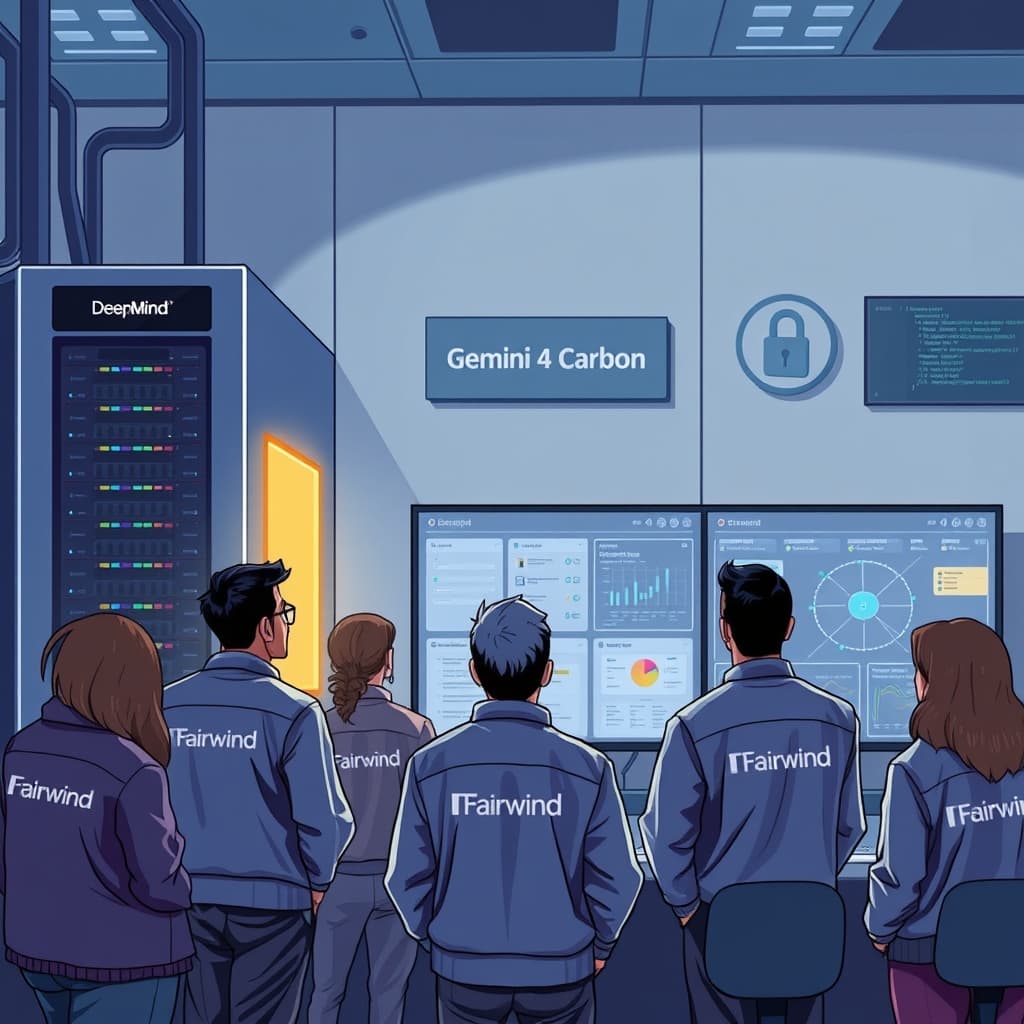
Google DeepMind announced Gemini 4 Carbon two weeks after releasing the Argon model.
The new frontier model is marketed as state‑of‑the‑art for cybersecurity and long‑horizon tasks.
Access at launch is limited to vetted cyber defenders through the Fairwind Program, with broader developer availability promised “as soon as possible.”
Performance Highlights Across Independent Evaluations
Gemini 4 Carbon secured the #1 spot on the Artificial Analysis consolidated benchmark, marking the first time Google DeepMind has led the AAII ranking.
On the SEC‑bench Pro vulnerability‑finding test the model scored 88.2%.
Its exploitation performance on ExploitGym was 54.8% and patching on CWE‑bench reached 71.0%.
Artificial Analysis reports a Intelligence Index v5 score of 59, leading four of the nine index evaluations.
In the Coding Agent Index the model also achieved a score of 59 using Antigravity CLI.
FrontierCode v1.1 gave Carbon a 51% result, compared with 56% for Opus.
On the Knowledge‑work AA‑Briefcase benchmark Carbon posted an Elo of 1609, 126 points higher than Argon.
Cost per index task was $7.76, lower than Opus 5.5’s $10.04 and slightly above GPT‑6 Astra’s $6.25.
Hallucination rate rose from Argon’s 4% to 11%, still the second‑lowest measured after Opus 5.5 and Astra at 50%.
In Text Arena Carbon ranked #1 with a score of 1528.
Agent Arena placed the model at #2 with a median cost of $1.80 per task.
Code Arena: WebDev saw Carbon at #4 with a score of 1768.
Vals Index positioned Carbon at #2, while it topped the Finance Index and Legal Research Benchmark.
On Vending‑Bench 2 and Blueprint‑Bench 2 the model achieved #1, tying the human baseline for 3D spatial understanding on the latter.
Coding benchmarks show a 61.2% score on FrontierSWE, trailing GPT‑6 Astra (65.5%) and Opus 5.5 (62.3%).
On SWE‑sweep the model set a narrow state‑of‑the‑art of 9.6%.
Pricing, Specs, and Safety Claims
Phil Schmid quoted a usage price of $2 per million input tokens and $10 per million output tokens.
Artificial Analysis lists a standard rate of $4 per million input and $20 per million output, with a 50% launch discount of unspecified duration.
Cached input costs are $0.20 per million tokens.
Gemini 4 Carbon supports a 1 million‑token context window and a 1 million‑token maximum output length.
Accepted input modalities include text, image, video, and speech, while output is limited to text.
Google’s safety report states “Successful cheating on Terminal‑Bench 4.0 fell to 0.0%, and cheating attempts fell to 0.4%.”
It also claims “Unsupported claims are down about 2x versus Argon.”
Further safety metrics note a 26% drop in overreach and a 29% reduction in under‑service.
Arena attributes the performance gains to more praise, higher confirmed successes, and improved steerability.
Caveats highlight that coding‑agent results were measured only with Antigravity CLI, leaving other harnesses untested.
Some users have expressed concern about the increased hallucination rate despite it remaining low relative to peers.
Overall, the model demonstrates strong results across security‑focused benchmarks while maintaining competitive pricing and safety improvements.
Why This Matters
This digest was compiled from:
Share this digest
People Also Read
- NVIDIA Introduces NVKE, a Managed Kubernetes Service for On‑Prem GPU Clusters
NVKE enables on‑prem teams to run managed Kubernetes clusters on NVIDIA GPUs, but remains a preview with limited production readiness.
- Ripple-65B Preview Achieves New U.S. Open‑Weight Benchmark in Agentic Coding
Ripple‑65B Preview sets a new U.S. open‑weight coding benchmark while costing just $32 million to train.
- Kyle Kingsbury’s Warning on LLM‑Driven Trust Erosion
Kyle Kingsbury warns that LLMs undermine confidence in software documentation and calls on maintainers to find ways to prove correctness.
Share your thoughts
Reactions, corrections, or insights — all welcome.