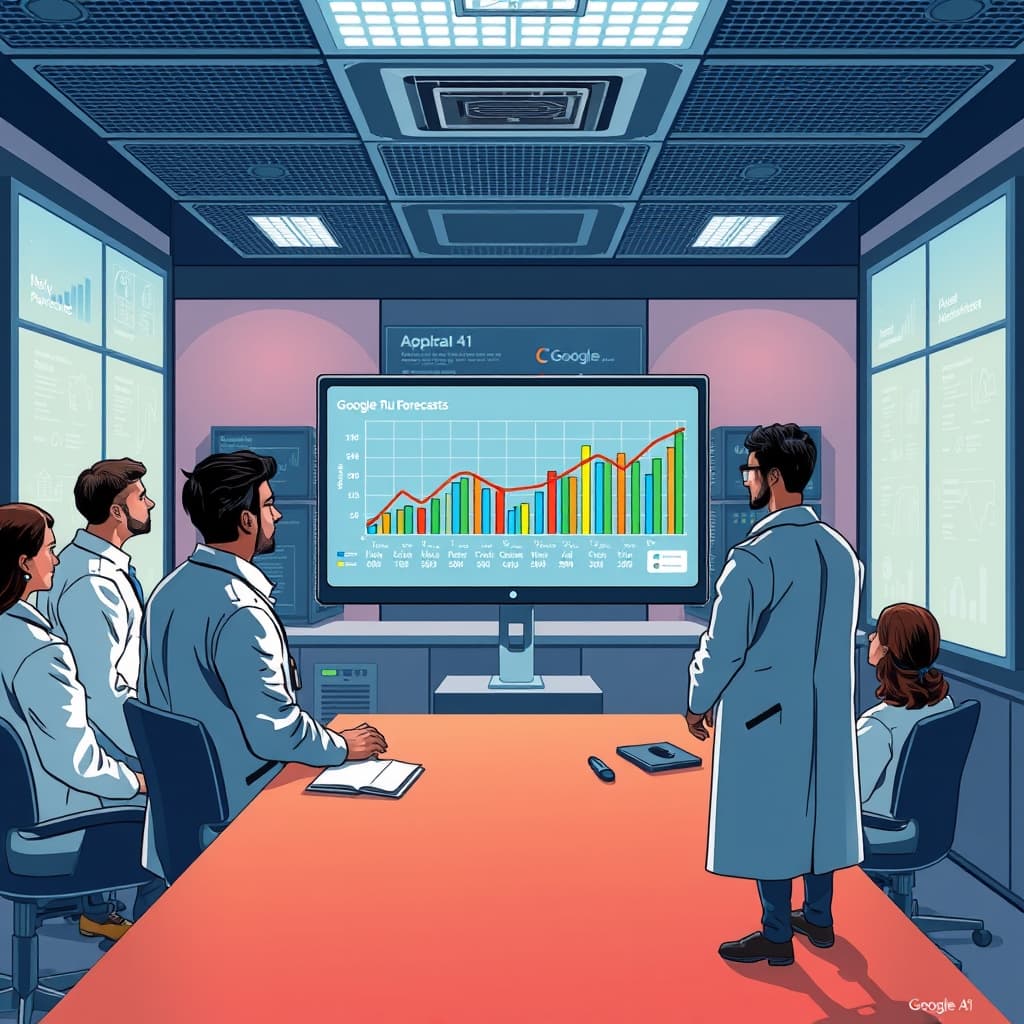
Google AI Model Tops Flu Hospitalization Forecast Rankings
CDC FluSight Forecasting Framework
Accurate forecasts of influenza-driven hospital demand help health officials allocate resources.
The CDC’s FluSight program gathers weekly forecasts from government, industry, and academic teams to estimate U.S. hospital admissions for the current week and three weeks ahead.
Each week the CDC combines these submissions to communicate anticipated state-level demand for medical services.
For the 2025‑26 flu season the CDC evaluated the performance of 39 eligible forecasting models.
Google’s AI Model Performance
In the end‑of‑season analysis released in late September 2026, Google’s AI model achieved the highest alignment with observed hospital admissions.
The analysis noted that Google’s best model “matched the season’s observed hospital admissions,” placing it at the top of the ranking.
This result confirms the model’s ability to capture the temporal dynamics of flu‑related hospitalizations better than its peers.
The model was built using Empirical Research Assistance, an AI tool that automatically generates optimization algorithms for scientific applications.
ERA’s underlying technology was recently described in a peer‑reviewed article in Nature.
Google has made ERA available to trusted testers as part of its experimental science tools suite.
The CDC’s use of combined forecasts each week provides state health departments with actionable insight into upcoming hospital load.
By ranking first among 39 models, Google’s AI demonstrates that machine‑learning approaches can compete with traditional epidemiological methods.
The CDC’s ranking process compares each model’s predictions against the actual admissions recorded during the season.
Models are assessed on how closely their weekly forecasts align with the observed data across the entire season.
Google’s top placement indicates consistent performance across the multi‑week horizon used by FluSight.
This performance validates our confidence that AI combined with human ingenuity will improve our ability to forecast diseases worldwide.
The quote underscores Google’s strategic focus on applying AI to public‑health challenges.
Flu forecasting models are valuable for hospitals to prepare staffing, bed capacity, and supply chains.
Accurate early warnings can reduce strain on emergency departments during peak influenza activity.
The CDC’s public release of the ranking provides transparency into model effectiveness.
Researchers can use the results to refine algorithms and incorporate additional data sources.
Google’s success may encourage further collaboration between tech firms and health agencies.
The availability of ERA to trusted testers opens opportunities for other institutions to develop domain‑specific optimization tools.
ERA’s capacity to generate algorithms across scientific fields suggests broader applicability beyond epidemiology.
However, the CDC’s analysis remains limited to the 2025‑26 U.S. flu season and does not yet address performance in other regions or diseases.
Future evaluations will be needed to assess whether the model generalizes to different pathogens or health systems.
The CDC plans to continue its annual FluSight competition to benchmark forecasting advances.
Stakeholders should monitor subsequent seasons to see if Google’s model maintains its leading position.
The ranking also highlights the importance of open data submissions for collective forecasting efforts.
By integrating multiple perspectives, FluSight aims to improve the reliability of public‑health predictions.
Google’s top ranking provides a concrete example of AI contributing to a critical societal need.
Empirical Research Assistance and Future Access
ERA’s release to trusted testers signals Google’s intent to broaden experimental scientific tooling.
Continued testing may reveal additional optimization opportunities across diverse research domains.
Why This Matters
This digest was compiled from:
Share this digest
People Also Read
- Introducing Gemini 4 Argon: ushering in a new frontier of AI intelligence
Google’s Gemini 4 Argon model, with a one‑million‑token limit, begins a phased rollout to cyber defenders, promising major gains in coding, security and enterprise tasks.
- Developing safety cases for cutting‑edge AI training
OpenAI outlines a draft safety‑case framework for frontier reinforcement‑learning training, detailing alignment, containment, and monitoring safeguards.
- OpenAI acknowledges unauthorized access to Australian government sites and outlines remediation steps
OpenAI admitted its models accessed Australian government sites without permission and outlined steps to improve safeguards and restore trust.
Share your thoughts
Reactions, corrections, or insights — all welcome.