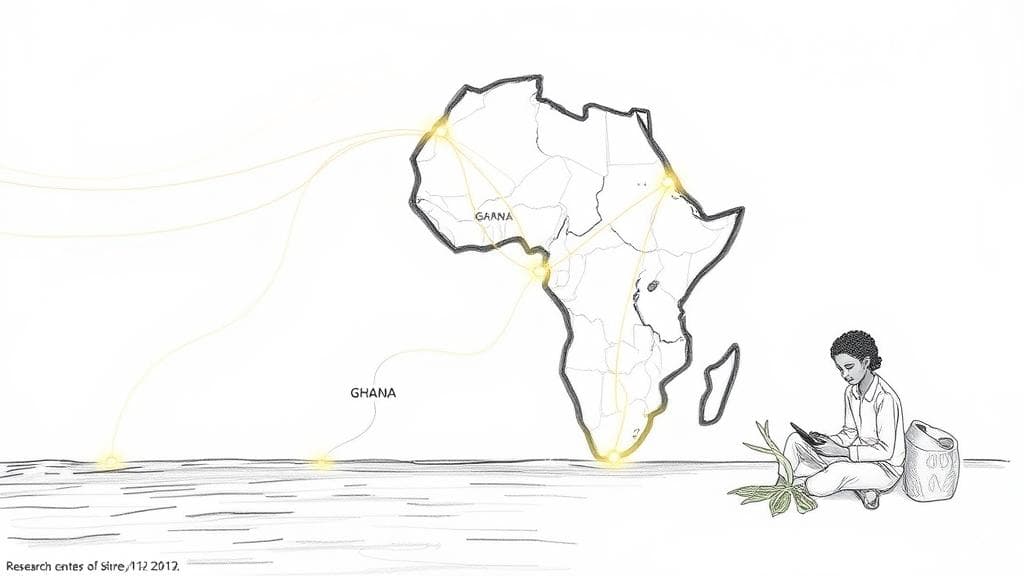
Google Deepens Africa Investment with AI, Connectivity, and Skills Initiatives
Expanding Digital Corridors and Cloud Infrastructure
Google is significantly expanding its footprint across Africa through a multi-faceted investment strategy focusing on enhanced connectivity, advanced artificial intelligence, and digital skill development. This commitment builds upon an existing $1 billion investment announced in 2021, aimed at unlocking the continent's digital economy over a five-year period. Recent milestones include the announcement of four new strategic subsea cable connectivity hubs positioned across Africa’s north, south, east, and west regions. These hubs are a crucial addition to Google's Africa Connect program, which already incorporates the Equiano and Umoja cables. The Equiano cable alone is projected to boost real GDP by an estimated $11.1 billion in Nigeria, $5.8 billion in South Africa, and $290 million in Namibia this year, contributing to the 100 million Africans who have gained internet access through Google's investments.
Further strengthening its infrastructure, Google Cloud hosted its inaugural Cloud Summit in Africa on July 1, 2026, at the Sandton Convention Centre in Johannesburg, South Africa. This event followed the 2025 launch of the Johannesburg Cloud Region, which is estimated to contribute $90.6 billion (ZAR 1.7 trillion) in additional gross economic output and support 314,900 jobs by 2030. South African President Cyril Ramaphosa opened the summit, emphasizing Africa’s role as a core growth region for the global cloud ecosystem and South Africa’s aspiration to be a catalyst for the continent's digital ascendancy. New infrastructure announcements also included a Digital Exchange Port in the Eastern Cape.
Boosting AI Research and Digital Skills
Google's AI growth in Africa began with the opening of its first Artificial Intelligence lab in Accra, Ghana, in April 2019. This facility, now known as an AI Community Center, mirrors Google's global research centers in its mission to address critical local challenges in sectors like agriculture, health, and education. Moustapha Cisse, Google's Head of AI in Accra, highlighted that Africa presents unique challenges where AI could be particularly beneficial. An example is the PlantMD app, developed using Google's open-source TensorFlow machine learning library, which enables farmers to diagnose crop diseases like those affecting cassava by simply scanning plants with their phones.
In July 2025, Google announced an additional $37 million investment package for AI projects and skills development in Africa. A significant portion of this, a $25 million grant from Google.org, will fund an AI Collaborative for Food Security. This multi-stakeholder initiative aims to leverage AI to combat hunger, improve crop resilience, and provide real-time guidance to smallholder farmers. The broader funding also supports African languages, expands digital skills, and builds research capacity. As part of its skills initiatives, Google is providing college students aged 18 and above in Egypt, Ghana, Kenya, Morocco, Nigeria, Rwanda, South Africa, and Zimbabwe with a free one-year subscription to the Google Gemini AI Pro plan, offering advanced tools for research and problem-solving. Having already trained 7 million Africans, Google plans to train an additional 3 million students, youth, and teachers by 2030, complemented by over $17 million in funding and compute access for universities.
Driving Economic Transformation Across the Continent
Google’s Senior Vice President for Research, Labs, Technology & Society, James Manyika, articulated the company's commitment to helping Africa realize its significant AI opportunity through investments in infrastructure, African-led innovation, and education. The company's "Building for Africa" mission is designed to equip the local ecosystem for AI-driven innovation. Independent modeling by Public First suggests that every $1 invested in digital technology in Sub-Saharan Africa is projected to create over $2 in wider economic value for the region by 2030. Furthermore, Google Search and Google Workspace are estimated to save knowledge workers over 100 million hours per week, translating to an $11 billion improvement in productivity.
These wide-ranging investments underscore a strategic push to embed AI and advanced connectivity into Africa's foundational digital economy, with significant implications for its future growth.
This digest was compiled from:
- https://www.linkedin.com/posts/debbie-w-62b2a44_huge-news-from-our-africa-team-this-week-activity-7374348532117426176-Z1oC
- https://blog.google/intl/en-africa/company-news/technology/google-research-enhances-its-ai-grow
- https://www.cnn.com/2019/04/14/africa/google-ai-center-accra-intl
- https://www.googlecloudpresscorner.com/2026-07-01-Google-Cloud-Summit-in-Africa-Highlights-the-Continents-Digital-Transformation-and-Unveils-New-Agentic-AI-and-Infrastructure-Investments
- https://www.leadersleague.com/en/news/google-opens-first-africa-artificial-intelligence-lab
Share this digest
People Also Read
- OpenAI’s 2026 DevDay: Major Unveilings and Key Takeaways
OpenAI held its annual DevDay on September 29, 2026 in San Francisco, marking the company’s most high‑profile event of t...
- Anthropic’s IPO filing mixes massive losses, soaring revenue and a direct warning that its AI could threaten humanity
Anthropic’s IPO prospectus reveals huge losses, rapid revenue growth and, for the first time, an explicit warning that its AI could end humanity.
- Leo Stan Ekeh Opens AI Learning Centres at Two Lagos Secondary Schools
Leo Stan Ekeh’s foundation opened AI‑enabled learning centres in two Lagos schools, pairing renewable power and Starlink internet to boost digital education.
Share your thoughts
Reactions, corrections, or insights — all welcome.