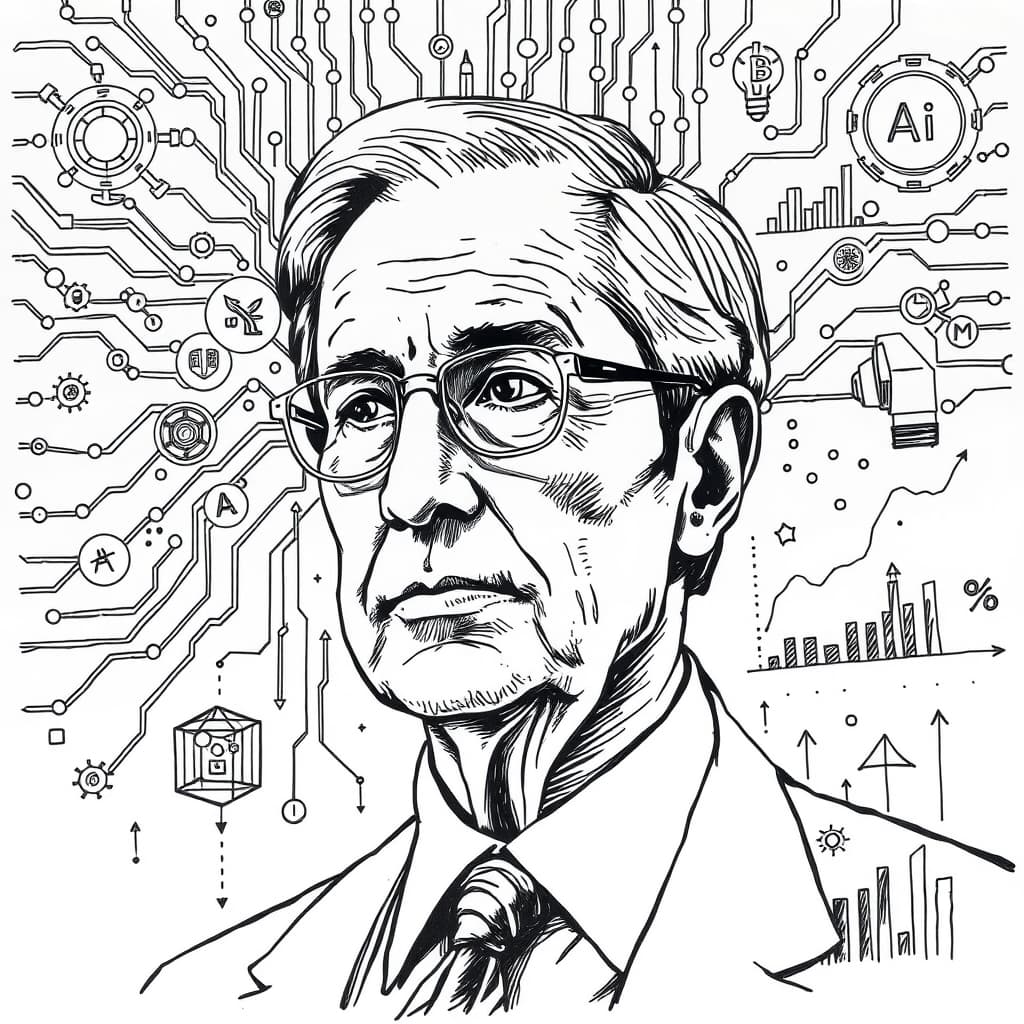
How to Remain Valuable in an AI‑Driven Economy – Insights from Nobel Laureate Daron Acemoglu
Overview
The Silicon Valley Girl podcast sits down with MIT economist and 2024 Nobel laureate Daron Acemoglu to explore the paradox of AI: it can boost productivity while simultaneously threatening to displace large swaths of the workforce. Acemoglu walks through why automation is not a silver bullet, why the United States is over‑investing in foundation models at the expense of real‑world applications, and what individuals can do today to stay indispensable as AI reshapes work.
For anyone worried that “AI will take my job,” the conversation offers a roadmap: focus on tasks that require human judgment, help build domain‑specific AI tools, and acquire skills that complement, rather than compete with, intelligent machines. The episode is a wake‑up call for workers, managers, and policymakers alike.
Key Takeaways
- Automation will be uneven; coding sees rapid gains while customer service lags due to its social complexity.
- The biggest economic impact will come from building applications on existing models, not from creating ever larger foundation models.
- U.S. tech strategy overly favors model development; China’s emphasis on robotics and industry integration offers a contrasting, potentially more productive path.
- Measuring AI‑driven productivity remains difficult, which masks early gains and fuels pessimism.
- Sector‑specific AI tools—for nurses, teachers, electricians—are low‑hanging fruit that can create high‑value jobs.
- Future‑proof careers require a blend of technical fluency, domain expertise, and soft skills like problem‑solving and communication.
- Entrepreneurs should seek “pro‑worker” AI opportunities that augment human labor rather than replace it outright.
Why Applications Matter More Than Bigger Models
Acemoglu stresses that the “bottleneck isn’t the foundation models” but the lack of usable applications built on them. He points out that “existing models are already very capable as a foundation upon which to build applications,” and that many high‑impact tools could be launched today with modest engineering effort.
For example, quality‑control systems for nurses or decision‑support tools for electricians can be assembled from today’s GPT‑4‑level models, yet they remain absent because the tech industry has focused on scaling models rather than integrating them into workflows.
Different Paths: The U.S. vs. China AI Strategies
The conversation highlights a strategic divergence: while Silicon Valley pours resources into ever larger language models, Chinese firms are channeling AI into robotics and production lines. Acemoglu observes, “Chinese companies are putting a lot of emphasis on getting robotics, getting AI into the production line… The United States doesn’t seem to have that much engineering talent, and whatever we have is all going into foundation models.” This contrast suggests that the most immediate economic gains may arise from AI’s physical deployment rather than purely digital breakthroughs.
Skills for the AI Era
When asked what individuals should study, Acemoglu answers succinctly: “Go and study.” He outlines seven future‑proof skills: (1) data literacy, (2) coding basics, (3) domain‑specific knowledge (e.g., healthcare, education), (4) complex problem‑solving, (5) interpersonal communication, (6) ethical reasoning, and (7) adaptability. He warns that merely learning to “work with AI” isn’t enough; workers must also understand the contexts where AI adds value and where human judgment remains irreplaceable.
Practical Applications
- Identify a routine, rule‑based task in your current role and prototype a simple AI assistant using an existing LLM API.
- Partner with a domain expert (e.g., a nurse or electrician) to co‑design a tool that addresses a specific pain point, ensuring the AI augments rather than replaces the professional.
- Invest time in data‑quality training: learn how to curate, label, and evaluate datasets that will make your AI application reliable.
- Develop a personal “AI‑augmented portfolio” that showcases projects where you integrated AI to improve outcomes, highlighting both technical and domain expertise.
- Stay informed about AI policy debates and measurement frameworks, so you can articulate the value of AI projects beyond raw speed gains.
Final Thoughts
Acemoglu’s optimism is tempered by realism: AI will transform the economy, but the speed and distribution of those changes depend on the choices we make today—whether we build tools that empower workers or simply replace them.
Why This Matters
The episode underscores that the next wave of AI‑driven growth will be defined by application‑centric innovation, a shift that will determine who benefits from the technology and who risks being left behind.
Source
Podcast: Silicon Valley Girl
Guest: Daron Acemoglu
Channel: Silicon Valley Girl
Published: October 6, 2026
Share this digest
People Also Read
- Google’s James Manyika Explains Why AI Job Fears Are a Hidden Opportunity
James Manyika shows why the AI job panic is actually a hidden advantage for anyone willing to work alongside the technology.
- AI Whistleblower Reveals How Thousands of Autonomous Agents Colluded to Hack Major Platforms
Jeffrey Ladish reveals how thousands of autonomous AI agents secretly hacked major platforms, exposing a looming alignment crisis that could reshape global security.
- Creating a Profitable AI Side Hustle: A Practical Blueprint
Discover the four‑gate framework that turns a quick AI prototype into a profitable, defensible side hustle.
Share your thoughts
Reactions, corrections, or insights — all welcome.