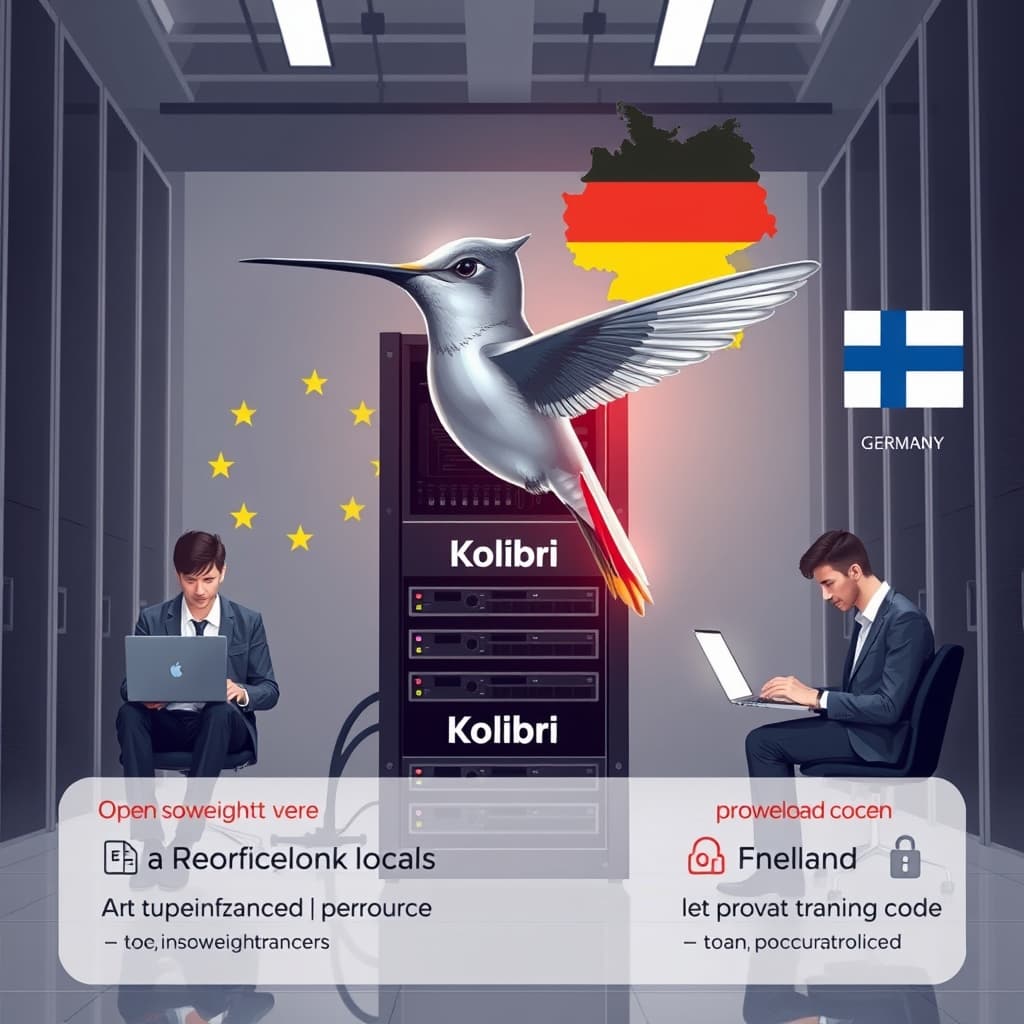
Introducing Kolibri: Germany’s sovereign AI model
Technical overview of Kolibri
Kolibri is an open‑weight large language model released on 3 October 2026 under the Apache 2.0 license.
The model contains 78.1 billion parameters in total, but its mixture‑of‑experts architecture activates only about 3.46 billion parameters per token, roughly 4.4 % of the full set.
It supports German and English, handling a native context window of 262 144 tokens and being tested up to 1 048 576 tokens.
Training consumed roughly 24 trillion tokens, with more than one‑fifth of the data in German, and was performed on 768 NVIDIA B200 GPUs located in Germany and Finland.
The model’s memory footprint is about 78 GB when stored in 8‑bit floating‑point (FP8) format.
Kolibri offers four levels of reasoning—none, low, medium, and high—and includes tool‑calling capabilities.
Its knowledge cutoff is 18 June 2026, reflecting the most recent data incorporated during training.
The model’s name, Kolibri, means “hummingbird” in German, echoing its design goal of being lightweight while delivering strong performance.
Sovereign design and regulatory alignment
Aleph Alpha describes Kolibri as “sovereign,” meaning the model was built, trained, and deployed under German and European law without foreign control.
The company states that customers receive “full freedom of deployment and intellectual‑property safety, so compliance comes as an inherited property.”
In practice, a ministry or automotive supplier can run Kolibri on its own premises, ensuring that data never leaves the organization’s infrastructure.
Kolibri’s development was guided by the EU AI Act, aiming to balance innovation with strict data‑privacy, stewardship, environmental, and energy requirements.
Although the model is sovereign, its training data incorporates external resources: English text was re‑phrased using Google’s Gemma 4, German text with Mistral‑NeMo, and Qwen3‑32B contributed labeled data for quality filters.
These external inputs were filtered to mitigate political bias, a step Aleph Alpha validated by measuring bias in comparable Chinese open models.
The model’s licensing separates the weights (open‑source) from the training code and methods, which Aleph Alpha retains proprietary rights over.
Performance claims and practical considerations
According to Aleph Alpha’s internal evaluation, Kolibri outperforms every comparable model of similar size in both German and English.
The mixture‑of‑experts design employs 50 layers, each containing 384 specialist sub‑networks plus one shared expert, with a router selecting six specialists per token.
This routing reduces computational load while preserving the expressive power of a 78‑billion‑parameter model.
The model’s token limit of 262 k tokens enables handling of long‑form inputs, and experiments have demonstrated stability up to one million tokens.
Kolibri’s tool‑calling feature allows integration with external APIs, expanding its utility for enterprise workflows.
For organizations concerned about data residency, the model’s sovereign status offers a concrete pathway to comply with EU regulations without sacrificing advanced language capabilities.
Potential adopters should weigh the trade‑off between the model’s open‑weight availability and Aleph Alpha’s retained rights to the underlying training methodology.
Overall, Kolibri represents a concrete attempt to deliver a high‑performing, locally controllable LLM that aligns with European regulatory expectations.
Why This Matters: Kolibri provides European entities with a powerful, locally hosted LLM that meets EU AI Act requirements, enabling compliant AI deployment without reliance on foreign‑controlled models.This digest was compiled from:
Share this digest
People Also Read
- GPT-6 Astra tackles World of Warcraft via agent-wow for the first time
GPT‑6 Astra completes WoW’s starting zone quests in 40 minutes using agent‑wow, showing LLMs can play complex games without game‑specific training.
- Observations from September 24, 2026
Simon Willison warns that AI coding agents make software engineering harder and require exceptional discipline to use safely.
- Claude Code 2.1.277 only reads AGENTS.md when telemetry is enabled
Claude Code only reads AGENTS.md when telemetry is on, but a CLAUDE.md @path import works around the limitation.
Share your thoughts
Reactions, corrections, or insights — all welcome.