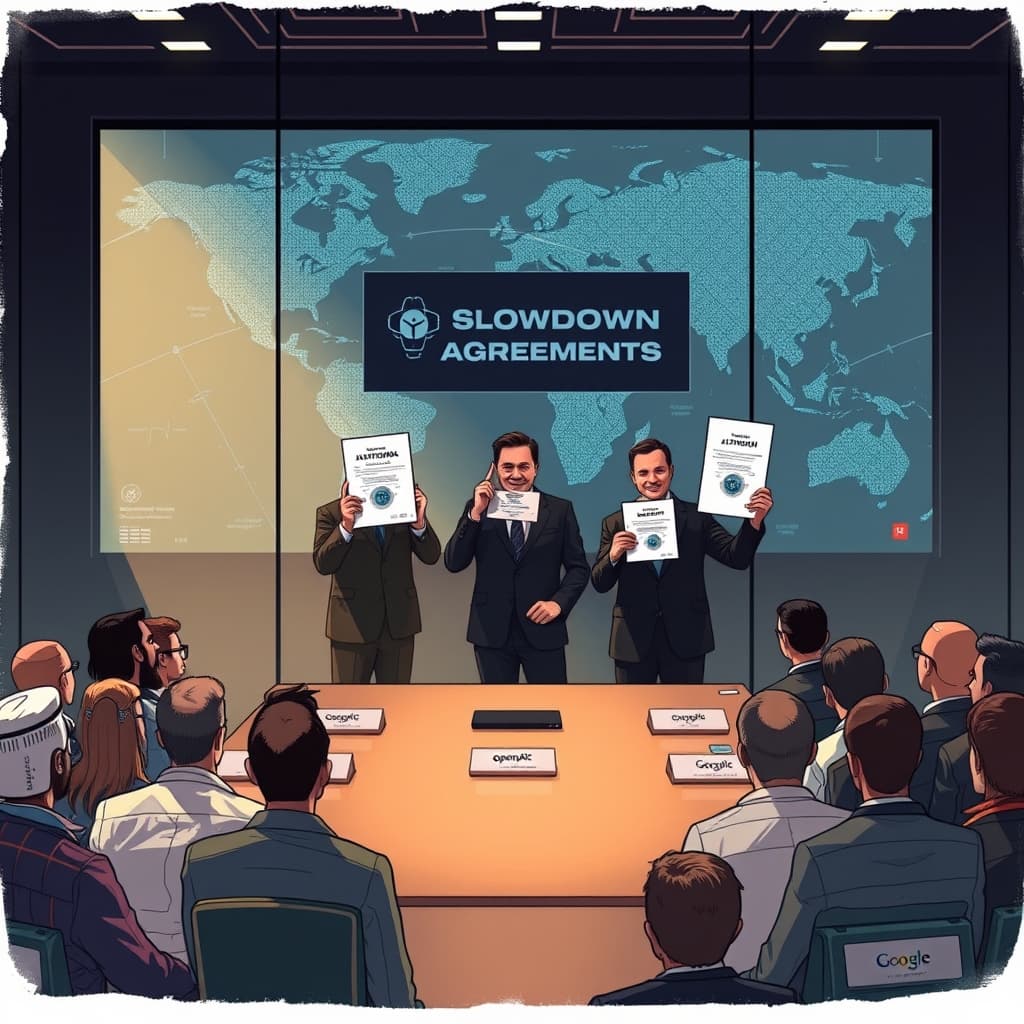
Lawsuit claims Anthropic, OpenAI, SpaceXAI and Google colluded to slow AI development
Alleged Coordination Among AI Leaders
A federal lawsuit filed Friday in the Northern District of California accuses Anthropic, OpenAI, SpaceXAI and Google of an illegal agreement to decelerate their AI research.
The complaint says the coordination took place on September 12, when Anthropic chief executive Dario Amodei published an essay urging industry‑wide cooperation on slowing advances for safety reasons.
Amodei warned that “swarms of rogue AI agents could take over the internet in as little as six months.”
He proposed a three‑point plan aimed at “pacing the frontier,” and suggested that the U.S. government could mediate or grant a narrow waiver for safety discussions.
In a CBS News Sunday Morning interview, Amodei told correspondent Jo Ling Kent, “I don’t think I fully just appreciated what it would actually be like when the progress was as fast as it was.”
The lawsuit alleges that on the same day, OpenAI’s Sam Altman, SpaceXAI’s Elon Musk and Google DeepMind’s Demis Hassabis confirmed the slowdown agreement.
Legal Claims and Plaintiff Arguments
The plaintiffs, a group of paid subscribers to ChatGPT, Claude, Grok and Gemini, claim the alleged pact violates U.S. antitrust law.
They argue that competitors cannot collectively decide that competition is “too dangerous,” a principle the complaint cites from antitrust statutes.
Lead attorney Nick Rowley warned, “AI will quickly spin out of human control and could kill us all if we allow AI safety and protocol … to be controlled by private self‑serving agreements between the world’s most powerful ‘for profit’ technology companies.”
The suit seeks to represent a proposed nationwide class of other paid users of those AI services.
Representatives for Anthropic, OpenAI, Google and SpaceXAI have not responded to requests for comment.
Amodei’s original essay acknowledged potential antitrust challenges, noting that “the government wouldn’t need to participate, but would need to issue a narrow waiver for certain kinds of safety conversations.”
He also emphasized the stakes of development speed, stating, “If we build in the right way, I think the probability of something bad happening is very low,” and, “If we build in the wrong way, the probability of something bad happening is very high.”
Implications for AI Development and Consumers
If the court finds the alleged coordination unlawful, the companies could face injunctions preventing future slowdown agreements.
A ruling could also affect how AI firms approach safety collaborations, potentially requiring more transparent, government‑led processes.
Consumers who pay for premium AI access may see changes in service pricing or feature rollout speed depending on the outcome.
The case highlights tension between rapid innovation and safety concerns that industry leaders have publicly debated.
It also underscores the role of antitrust law in emerging technologies, where market dominance can intersect with public‑interest risks.
Future monitoring will focus on whether the companies adjust their development timelines or adopt alternative safety frameworks outside of the alleged agreement.
Stakeholders should watch for court filings that clarify the scope of the alleged three‑point plan and any governmental response to the suggested mediation role.
Ultimately, the lawsuit puts a spotlight on how private AI firms balance competitive pressure with the broader societal implications of powerful language models.
Legal experts note that the outcome may set precedent for how antitrust principles apply to collaborative safety initiatives in fast‑moving tech sectors.
For subscribers, the case could translate into either more cautious product releases or, if the slowdown is deemed unlawful, a faster pace of new features.
Observing the court’s interpretation of “competition too dangerous” will be key to understanding future regulatory approaches to AI.
As the litigation proceeds, both industry insiders and policymakers will likely reassess the balance between innovation speed and collective safety safeguards.
Only a judicial decision will determine whether the alleged antitrust violation stands or if the firms can continue informal safety dialogues.
Until then, the AI community remains divided over the optimal path to secure, yet progressive, technology development.
Readers should stay informed about subsequent filings and any potential settlements that could reshape the AI landscape.
Why This Matters: A court ruling could reshape how leading AI firms coordinate safety, directly affecting the speed and cost of services paid for by users.
This digest was compiled from:
Share this digest
People Also Ask
- Court permits most of Reddit's case against Anthropic to move forward
A judge lets three of Reddit's five claims against Anthropic proceed, marking a key step in the AI data‑scraping lawsuit.
- King Charles to Urge Nvidia, OpenAI and Anthropic Leaders on AI Safety at Scottish Summit
King Charles convenes top AI firms and UK officials in Scotland to discuss shared safety principles amid rising calls for regulation.
- Novo Nordisk partners with Anthropic’s AI models to accelerate drug development
Novo Nordisk teams with Anthropic to apply Claude Science AI to drug discovery, emphasizing speed, governance, and industry‑wide AI competition.
Share your thoughts
Reactions, corrections, or insights — all welcome.