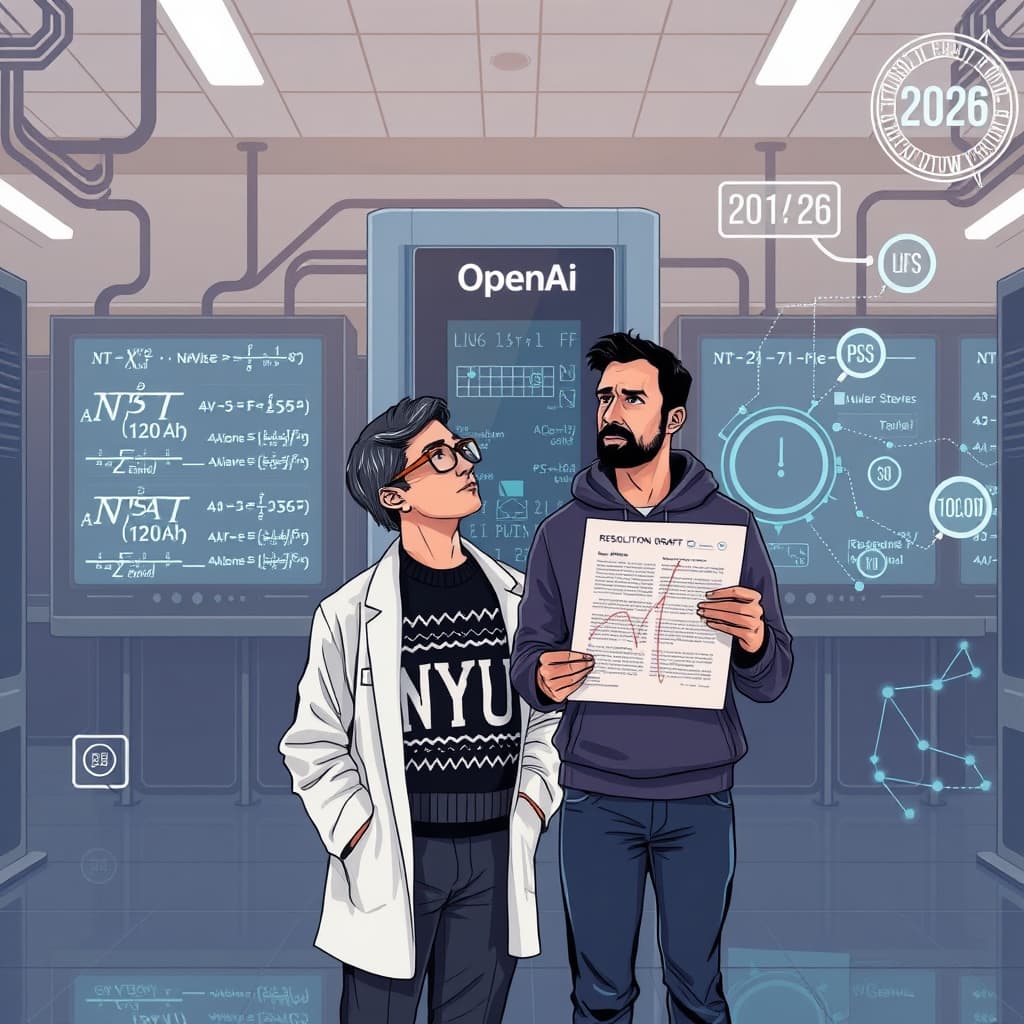
OpenAI Claims Resolution of the Navier–Stokes Millennium Prize Problem
Background and Significance
The Navier–Stokes existence and smoothness problem, one of the seven Clay Millennium Prize Problems carrying a $1 million reward, has long resisted proof.
OpenAI recently announced that an unreleased internal model produced a resolution to this problem.
The claim arrives amid accusations from NYU mathematician Tristan Buckmaster, who had been collaborating with Anthropic researcher Levent Alpöge on a related approach.
Buckmaster and Alpöge spent nearly a year employing Anthropic’s Claude and OpenAI’s Codex (primarily GPT‑5.6 Sol) before reporting a breakthrough on 15 August.
OpenAI’s AI‑Driven Attempt
Rumors that Anthropic was close to solving a “major open problem” prompted OpenAI to reach out to the duo.
Buckmaster recalled asking OpenAI when the first prompt had been sent, noting that “I asked when the first prompt had been sent by them,” and that OpenAI delayed answering.
He further reported that OpenAI declined to confirm whether the model had been trained on or accessed their Codex session data, stating “I was told the model did not look up user data,” and that subsequent inquiries received no answer.
OpenAI later offered to delay their own publication until Buckmaster could publish, but insisted that Alpöge would not be listed as a co‑author because of Anthropic’s competitive relationship with OpenAI.
According to OpenAI’s timeline, rumors of two Millennium Prize problems being solved surfaced on 1 September, prompting an internal effort to test their model on all such problems.
The agents produced a resolution to Navier–Stokes on 5 September, roughly 88 hours after the first agents were launched, and completed lean formal verification on 6 September using GPT‑6 Astra in an additional 17 hours.
Across all attempted problems the agents exchanged 4.9 million messages and generated about 300 billion output tokens; for Navier–Stokes alone they sent 2.7 million messages and used approximately 130 billion tokens.
At public API pricing for GPT‑6 Astra, the token usage would translate to an estimated $15 million cost, although OpenAI did not disclose the internal model’s cost structure.
Dispute and Broader Implications
OpenAI emphasized that they did not view any of Buckmaster and Alpöge’s work until it was publicly released, asserting “no specific user data was accessed in order to solve this problem,” while conceding that “while unlikely, we cannot rule out that de‑identified data derived from their usage of our p”.
The episode highlights the emerging tension between large‑scale AI research teams and academic mathematicians over data provenance, credit attribution, and the competitive dynamics of solving high‑profile scientific challenges.
Why This Matters: OpenAI’s claim and the surrounding dispute illustrate how AI‑driven theorem proving could reshape mathematical research, while raising questions about data use and scholarly credit.
This digest was compiled from:
Share this digest
People Also Ask
- vLLM Enables Speculative Decoding on AMD Instinct GPUs
Speculative decoding adds a draft‑and‑verify step to vLLM, enabling multiple token commits per GPU pass on AMD Instinct MI300X/MI355X, with performance varying by method and workload.
- How to Run Blender via Coding Agents on macOS
Coding agents on macOS can now generate and render Blender scenes, exemplified by a pelican riding a bicycle.
- AI‑driven incident response risks distancing engineers from their infrastructure
AI-driven incident response tools cut routine downtime but risk leaving engineers unpracticed for rare, high‑severity failures.
Share your thoughts
Reactions, corrections, or insights — all welcome.