Overcoming the 100 Billion Dollar Deficit: The Blueprint for Nigeria's Modern Transport Infrastructure
The Scale of Nigeria's Infrastructure Challenge
Nigeria's economic progress is currently hindered by an estimated 100 billion dollar infrastructure deficit. The country's transport and storage sector was valued at 2.6 trillion Naira (6.9 billion dollars) in 2020, down from 3 trillion Naira (8 billion dollars) in 2019, according to the National Bureau of Statistics. This decline was reflected in its gross domestic product contribution, which fell to 1.8 percent in the fourth quarter of 2020. Road transport remains the dominant mode of travel, accounting for approximately 90 percent of the movement of people, agricultural produce, merchandise, and mobile services such as clinics and libraries. However, researchers Alaba Adetola, Jack Goulding, and Champika Liyanage note that many urban road networks remain unpaved, poorly maintained, and overused, frequently isolating rural communities during the rainy season.
To address these critical gaps, the Federal Government allocated 4.06 trillion Naira (2.7 billion dollars) for infrastructure in the 2025 Federal Budget, representing 7.4 percent of total spending. Under the National Integrated Infrastructure Master Plan, Nigeria aims to scale its total infrastructure stock to 70 percent of GDP by 2043. Institutional funding is also rising, with pension funds investing 262.567 billion Naira into infrastructure during the first ten months of 2025, representing a 48.1 percent year-on-year increase. Key major highway projects, such as the Lagos-Calabar Coastal Highway and the Sokoto-Badagry Superhighway, have been initiated to improve interstate connectivity.
Steel and Rails: Connecting Megacities and Trade Corridors
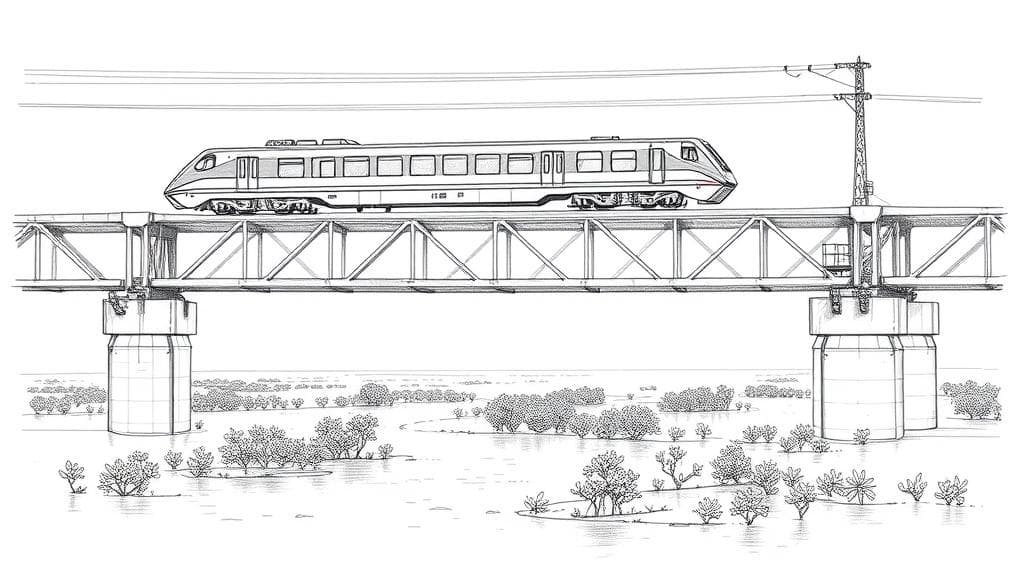
In Lagos, Africa's largest metropolis, the population reached 15.946 million in 2023, doubling its size from the year 2000. To combat severe traffic congestion, the city is developing the Lagos Mass Transit System, which integrates buses, ferries, and a growing rail network. The 27-kilometer Blue Line railway, which opened in September 2023, runs from Okokomaiko to the Lagos Marina and transports 250,000 commuters daily. Because Lagos is built over saltwater lagoons and mangrove swamps, engineers have utilized corrosion-resistant steel coatings to construct durable transit bridges across the water.
On a national scale, the Nigerian Railway Corporation is expanding routes to build a multi-modal transport network linked to ports and airports. Key industrial developments like the Lekki Port in Lagos and the Kano-Maradi rail line in the north are designed to connect rural agricultural and mining hubs directly to commercial ports. To support this, the 2021 federal budget earmarked 71.2 billion Naira (3.2 million dollars) for railway construction and 11.6 billion Naira (31 million dollars) for rail rehabilitation. According to official data, the rail system carried 3 million passengers in 2018, generating 1.9 billion Naira in passenger ticket revenue, while cargo freight grew by 132 percent in the same year.
Transitioning to Electric Buses and Green Mass Transit
Decarbonizing public transport has also become a priority. A strategic roadmap developed by Sustainable Energy for All, in line with Nigeria's Energy Transition Investment Plan, outlines a transition to electric buses. Fully endorsed by Mr. Oluwaseun Osiyemi, the Lagos State Commissioner for Transportation, the report recommends utilizing the Gross Cost Contract model to support sustainable public-private partnerships. Successful deployment will require policy reforms, including revisions to the Nigerian Automotive Industry Development Plan and the National Renewable and Energy Efficiency Policy.
Prominent figures, including former Finance Minister Ngozi Okonjo-Iweala and economist Dr. Justin Yifu Lin, emphasize that high-quality infrastructure is the ultimate driver of national competitiveness. By utilizing Public-Private Partnerships, Nigeria can leverage private sector capital, technical expertise, and operational efficiency to execute large-scale transport projects, ultimately connecting underserved rural communities to bustling coastal trade hubs.
This digest was compiled from:
- https://en.wikipedia.org/wiki/Transport_in_Nigeria
- https://www.afdb.org/fileadmin/uploads/afdb/Documents/Project-and-Operations/An_Infrastructure_Action_Plan_for_Nigeria_-_Closing_the_Infrastructure_Gap_and_Accelerating_Economic_Transformation.pdf
- https://www.seforall.org/publications/nigeria-transitioning-to-a-sustainable-mass-transportation-system
- https://www.irbnet.de/daten/iconda/CIB_DC29838.pdf
- https://worldsteel.org/media/steel-stories/infrastructure/transforming-transport-in-nigerias-megacity
Share this digest
People Also Read
- OpenAI’s 2026 DevDay: Major Unveilings and Key Takeaways
OpenAI held its annual DevDay on September 29, 2026 in San Francisco, marking the company’s most high‑profile event of t...
- Anthropic’s IPO filing mixes massive losses, soaring revenue and a direct warning that its AI could threaten humanity
Anthropic’s IPO prospectus reveals huge losses, rapid revenue growth and, for the first time, an explicit warning that its AI could end humanity.
- Leo Stan Ekeh Opens AI Learning Centres at Two Lagos Secondary Schools
Leo Stan Ekeh’s foundation opened AI‑enabled learning centres in two Lagos schools, pairing renewable power and Starlink internet to boost digital education.
Share your thoughts
Reactions, corrections, or insights — all welcome.