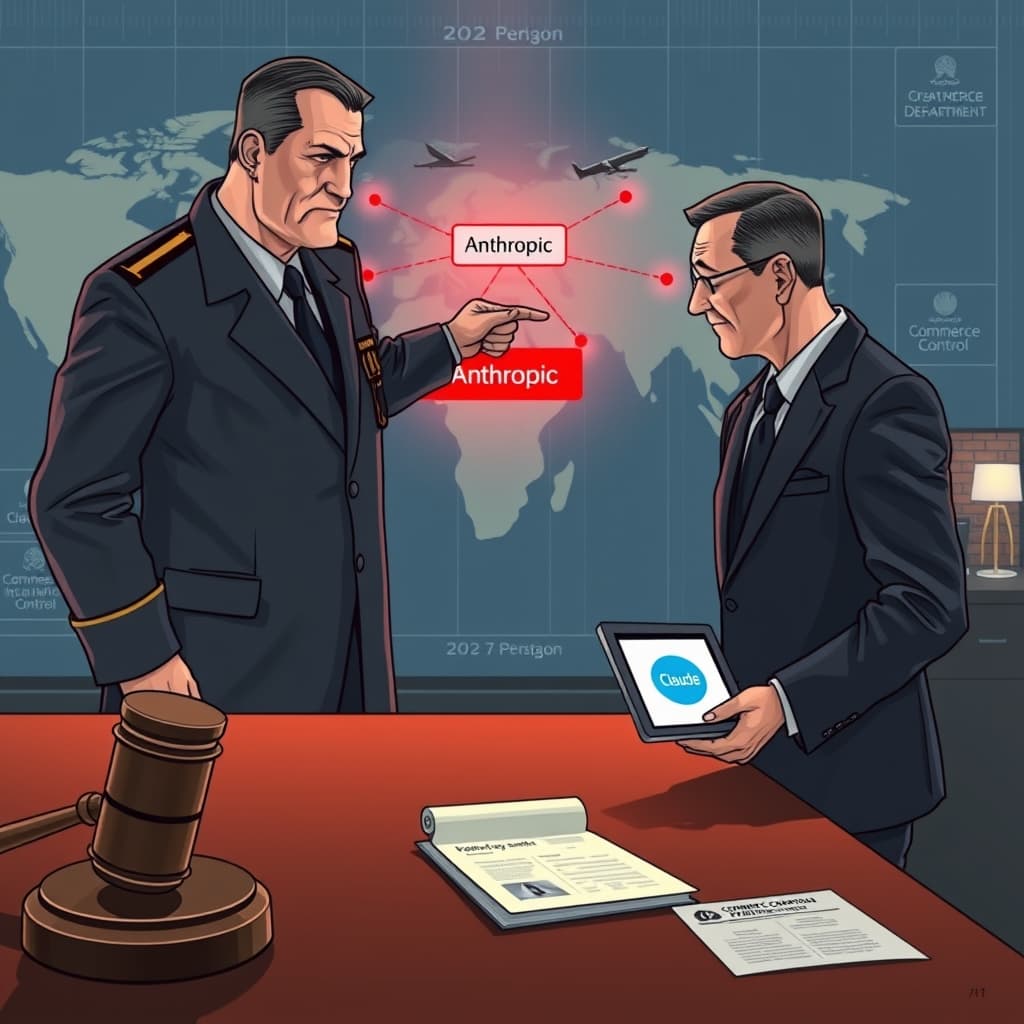
Pentagon confirms Anthropic remains designated as a supply‑chain risk
Background of the Pentagon‑Anthropic dispute
The Department of Defense labeled Anthropic a supply‑chain risk after a $200 million contract disagreement stalled.
Anthropic wanted contractual limits that would bar its Claude AI models from use in autonomous lethal weapons or domestic mass‑surveillance systems.
The Pentagon rejected those limits, arguing that contractors cannot dictate how the military employs technology.
When negotiations collapsed, Defense Secretary Pete Hegseth applied the supply‑chain risk status, a designation traditionally reserved for foreign entities deemed national‑security threats.
This designation effectively barred all Pentagon contractors and suppliers from doing business with Anthropic.
Legal challenges and recent rulings
Anthropic responded with two lawsuits: one in a California federal district court and another before the D.C. Circuit Court of Appeals.
On August 27, U.S. District Judge Rita Lin ruled in Anthropic’s favor, finding the Pentagon’s action violated the First Amendment and stripped the company of liberty interests without adequate notice.
Judge Lin set aside the supply‑chain risk designation and issued a permanent injunction ordering the Defense Department and other named agencies to withdraw all directives related to the designation.
The injunction does not compel the Pentagon to adopt Anthropic’s models, nor does it prevent the government from selecting other AI providers, provided those choices comply with the law.
Separately, the Commerce Department’s export‑control dispute was resolved after Commerce Secretary Howard Lutnick and Anthropic executive Tom Brown worked together to lift restrictions on two Claude models in late June.
Lutnick later told Bloomberg Television that Anthropic had “gotten religion” and that the company had patched up its differences with the administration.
Current status and implications
Despite Lutnick’s comments, a senior Defense Department official reiterated on X that “Anthropic is still a designated Supply Chain Risk at @DeptofWar and for the Defense Industrial Base.”
The statement was posted by Under Secretary of Defense for Research and Engineering Emil Michael, one day after Lutnick’s interview.
Michael’s post did not mention the ongoing litigation, and the Defense Department declined to comment when Reuters sought clarification.
The lingering designation means that, for now, any Pentagon contractor wishing to work with Anthropic must obtain a waiver or risk violating the supply‑chain risk rules.
Companies that rely on Anthropic’s Claude models for classified projects may need to seek alternative providers or await further policy guidance.
The situation highlights the tension between national‑security concerns and corporate attempts to set ethical use boundaries for advanced AI.
Stakeholders in the defense AI ecosystem are watching the case for signs of how future contracts might balance operational flexibility with ethical constraints.
Future developments could include revised procurement language, additional legal challenges, or new executive actions that redefine the scope of supply‑chain risk designations.
For now, the Pentagon’s stance remains unchanged, keeping Anthropic on the restricted list.
Why This Matters: The Pentagon’s continued restriction limits Anthropic’s access to U.S. defense contracts despite a court injunction, shaping the AI supplier landscape for national‑security projects.
This digest was compiled from:
Share this digest
People Also Ask
- Anthropic forces automatic sign‑outs of Claude accounts after malware steals session data
Anthropic forced sign‑outs, removed payment data and refunded charges after infostealer malware stole Claude session cookies from Windows and macOS users.
- Anthropic’s Upcoming IPO: Timeline and Unusual Deal Structure Revealed
Anthropic is set to launch an IPO in September‑October with a unique structure that may allow existing shareholders to sell and impose longer lockup periods.
- Anthropic Unveils Claude Fable 5.1 and Mythos 5.1, Detailing Their Features
Anthropic releases Claude Fable 5.1 for everyone and a restricted Claude Mythos 5.1 for vetted cyber and life‑science firms, highlighting cost cuts and stronger benchmarks.
Share your thoughts
Reactions, corrections, or insights — all welcome.