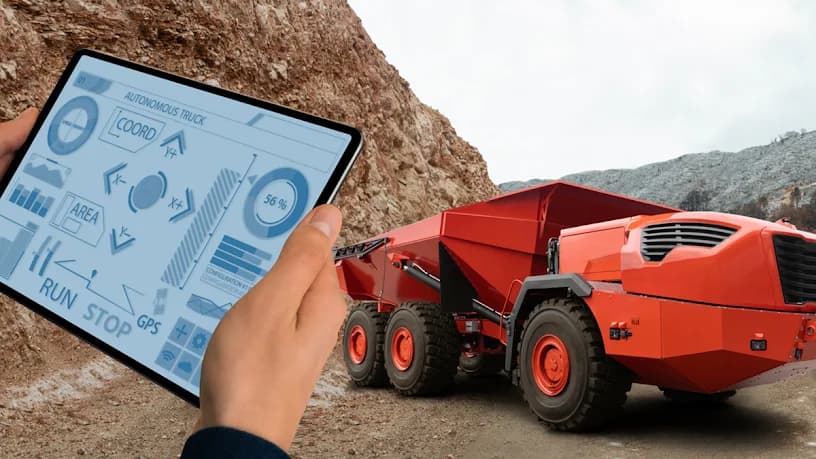
South African Mining Confronts the Digital Divide as Two Thirds of CEOs Hold Back on AI
The Paradox of Growth and Tech Stagnation
South Africa's mining sector remains a cornerstone of the national economy, contributing 6 percent to the gross domestic product in 2025.
During this same period, the industry experienced an 8 percent rise in market capitalization, driven largely by gold and platinum group metals, alongside a broader financial turnaround from the price lows of 2015 and 2016.
Yet, underneath these positive financial indicators lies a significant technological bottleneck that threatens long-term competitiveness.
According to the newly released 2026 PwC report, which analyzed industry strategy sessions and interviews with ten mining chief executives conducted in 2025, two-thirds of South African mining CEOs have not yet deployed artificial intelligence.
This slow adoption persists despite the industry facing complex challenges, including the escalation of illegal mining operations that affect most commodities and cost billions of rands.
Skills and Data Governance Gaps Block Scale
The primary obstacles preventing mining operations from adopting artificial intelligence at scale are a severe shortage of digital skills and weak organizational readiness.
While global data from PwC's 29th Global CEO Survey reveals that 30 percent of 4,454 chief executives across 95 countries have already realized tangible revenues from AI over the past 12 months, South African mining leaders are still struggling with foundational data.
Only 23 percent of the surveyed South African mining CEOs believe their artificial intelligence strategy is well-defined, while 46 percent rate their current strategy as merely average.
This strategic hesitancy is directly tied to the quality of organizational data and the absence of robust governance structures required to feed complex algorithmic models.
Mining leaders do not view these technologies as a replacement for human workers, but rather as tools to strengthen human capability, improve safety, and enable faster responses in complex environments.
Without addressing the underlying skills deficit and establishing stronger data governance, local operations risk falling behind global competitors who are actively using technology to improve equipment reliability and decision-making.
Leadership Transitions and the Long Term Outlook
Navigating this technological transition will require sustained strategic focus, a commodity that is currently in short supply among global business leaders.
PwC's global research indicates that chief executives spend nearly half of their time on short-term issues with horizons of less than one year, compared to just 16 percent on long-term strategies spanning more than five years.
For South Africa, this leadership challenge coincides with a major transition at PwC South Africa, a key advisory firm to the local mining, metals, energy, and utilities sectors.
Anastacia Tshesane, who has spent 19 years at the firm and became Chairman of the PwC South Africa Governing Board in 2021, will take over as CEO on July 1, 2026.
Tshesane succeeds Shirley Machaba, who is retiring after a 24-year career at PwC, having led the South African practice as CEO since 2019.
Additionally, Alsue du Preez, who brings 18 years of partner experience, will step in as Chairman of the PwC South Africa Governing Board and the PwC Africa Governance Board, working alongside PwC Africa CEO Dion Shango.
This new leadership team will need to guide clients through both technological modernization and evolving Environmental, Social, and Governance strategies as the industry adapts to modern regulatory frameworks.
Balancing Immediate Pressures with Future Readiness
To successfully deploy artificial intelligence, mining operations must balance immediate operational demands with the structural reforms needed for digital tools.
The legacy of the Mineral and Petroleum Resources Development Act of 2002 and ongoing market volatility mean that local mines must constantly optimize their cost structures while maintaining safety standards.
Implementing artificial intelligence offers a clear opportunity to achieve these goals by predicting equipment failures before they occur and reducing human exposure to hazardous underground conditions.
However, building the necessary technical infrastructure requires mining companies to invest in dedicated training programs and data engineering talent rather than relying on off-the-shelf software.
As the industry seeks to maintain its return to profitability, the gap between those who proactively build these digital foundations and those who delay will likely determine the next generation of market leaders.
Why This Matters: South African mining companies must urgently resolve their internal data and skills deficits or risk losing global competitiveness as international peers successfully monetize artificial intelligence. Readers should watch how the newly appointed leadership at advisory firms like PwC guides local operations through this critical infrastructure transition.
This digest was compiled from:
- https://iafrica.com/pwc-two-thirds-of-south-african-mining-ceos-have-not-deployed-ai-with-skills-and-data-gaps-the-main-brake
- https://www.itweb.co.za/article/sa-mining-not-yet-ready-to-deploy-ai-at-scale/5yONPvEronO7XWrb
- https://www.pwc.co.za/en/industries/mining.html
- https://africanminingmarket.com/wp-content/uploads/2025/10/pwc_samine202510_report.pdf
- https://pricewaterhousecoopers-pwc.africa-newsroom.com/press/sa-mining-industry-sees-a-turnaround-in-financial-performance-amid-a-challenging-operating-environment-pwc-sa-mine-report?lang=en
Share this digest
People Also Read
- OpenAI’s 2026 DevDay: Major Unveilings and Key Takeaways
OpenAI held its annual DevDay on September 29, 2026 in San Francisco, marking the company’s most high‑profile event of t...
- Anthropic’s IPO filing mixes massive losses, soaring revenue and a direct warning that its AI could threaten humanity
Anthropic’s IPO prospectus reveals huge losses, rapid revenue growth and, for the first time, an explicit warning that its AI could end humanity.
- Leo Stan Ekeh Opens AI Learning Centres at Two Lagos Secondary Schools
Leo Stan Ekeh’s foundation opened AI‑enabled learning centres in two Lagos schools, pairing renewable power and Starlink internet to boost digital education.
Share your thoughts
Reactions, corrections, or insights — all welcome.