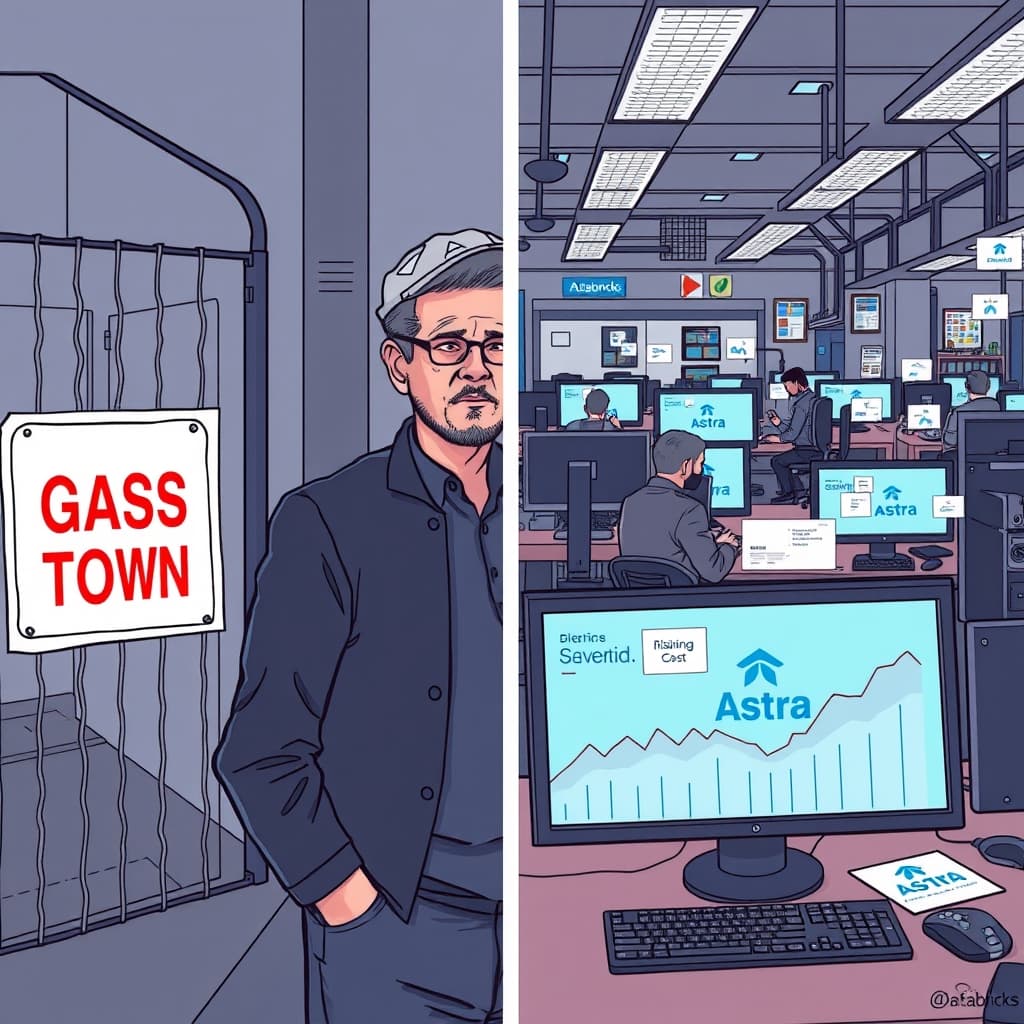
Steve Yegge Closes Gas Town While Databricks Reports a 60% Spend Rise After Deploying Astra
The AI‑focused newsletter AINews compiled a week of notable developments across coding agents, large‑model deployments, and transparency initiatives.
Yegge’s Gas Town Shutdown
Steve Yegge announced that he is shutting down the Gas Town coding‑agent service after months of heavy subscription spending.
In his statement, Yegge admitted that despite spending “many thousands a month on coding agent subscriptions… he only ever built Gas Town with it.”
Dan Luu reacted on Twitter, noting “Interesting to see Yegge say he never successfully built anything with Gas Town. In danluu.
com/ai‑coding/, I mentioned not finding these ultra vibed orchestrators useful b/c reliability (w. r.
t. completing tasks).
Luu’s comment underscores a broader concern about the reliability of “ultra vibed orchestrators” that promise high productivity but often falter on task completion.
The public admission from a well‑known advocate highlights the gap between hype around AI‑driven coding assistants and the practical outcomes users experience.
Databricks’ Astra Rollout and Cost Spike
Databricks rolled out its GPT‑6‑based model Astra to roughly 3,500 engineers, as reported by Patrick Wendell.
Wendell tweeted, “Today we rolled out Astra to every engineer at Databricks (N=~3500). Some notes that may be helpful to others: 1.
Astra unambiguously out performs our previous highest‑end models (Opus 5, Sol 5.
Benchmarks had previously suggested Astra would be cheaper per task than the Sol family because of its token efficiency.
However, Databricks now reports an overall spend increase of about 60 % after the switch, indicating that higher per‑task efficiency did not translate into lower total costs at scale.
The rise in spend appears tied to the model’s superior capabilities prompting engineers to tackle more ambitious, longer‑horizon projects that consume additional compute.
This development cautions enterprises that model performance gains can be offset by broader usage patterns and budget impacts.
Broader AI Community Reactions
OpenAI introduced a formal misalignment‑incident disclosure framework, publishing six case reports from the prior six months.
The move was widely interpreted as a response to criticism over earlier agent‑related incidents that raised transparency concerns.
Xiaomi’s MiMo‑V2.6 reinforcement‑learning run was shared with live training statistics, cost telemetry, and reward details, with analysts estimating daily operational costs of roughly $493 k for the 1‑trillion‑parameter Pro run and $247 k for the Flash variant.
A U.S. Federal Register search mode was reported to employ distilled Qwen models, illustrating governmental adoption of compact, efficient language models.
The DeepMind Institute was launched by Demis Hassabis and Shane Legg to foster interdisciplinary research on AGI governance, economics, transparency, and human flourishing.
Union Alpha entered the coding‑workflow space as a free offering, claiming performance near GPT‑6 Astra/Opus 5 while operating at a substantially lower cost, sparking speculation about its underlying technology.
Collectively, these announcements reflect a maturing ecosystem where model capabilities, cost structures, and governance practices are being scrutinized in real time.
Stakeholders across startups, enterprises, and regulators are watching how performance improvements intersect with fiscal realities and safety transparency.
Why This Matters: The juxtaposition of Yegge’s shutdown and Databricks’ cost surge reveals that superior AI models do not automatically deliver economic efficiency, prompting organizations to reassess deployment strategies and oversight mechanisms.
This digest was compiled from:
Share this digest
People Also Ask
- Claude Merges Cowork and Chat Functions into a Single Agent
Anthropic merges Claude Cowork and chat into a single Claude, rolling out first to Pro and Max users across web, desktop, and mobile.
- Jev: a System One model that only decides, classifies, routes and scores, delivering over 100× speed and 200× cost advantage over small frontier LLMs
TypeSafe’s Jev, a “System One” model trained with RLCD, claims over 100× speed and 200× lower cost than small frontier LLMs, sparking strong community interest.
- Learning to Code in the Era of Large Language Models
A programmer’s letter reveals how LLMs can speed development but also create comprehension gaps, prompting expert reflection on future skill demands.
Share your thoughts
Reactions, corrections, or insights — all welcome.