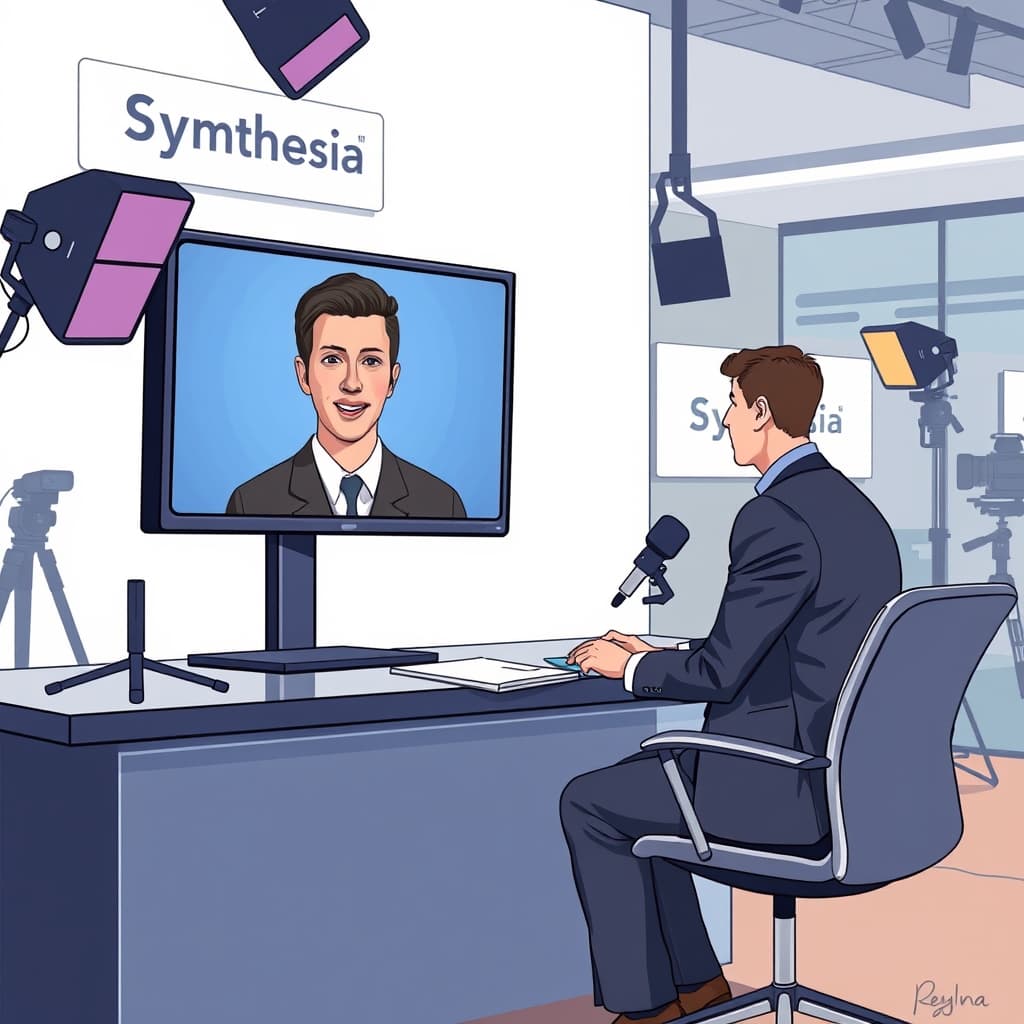
Synthesia rolls out a conversational digital twin for a journalist
Synthesia’s Interactive Avatar Launch
Synthesia, a video‑generation startup, unveiled an interactive digital avatar of a journalist, marking its first public avatar for anyone outside the company.
The avatar is programmed to answer press‑related questions about Synthesia and is limited to a single story supplied by the journalist.
The demonstration occurred during a visit to Synthesia’s new New York office, an expansion from its United Kingdom headquarters.
Earlier this year the company announced a $4 billion valuation and reported more than $100 million in annual recurring revenue.
Synthesia competes with other avatar providers such as D‑ID, HeyGen and Colossyan.
Technical Build of the Conversational Twin
To create the avatar, the team set up a mini film studio inside the office and captured a series of photographs of the journalist.
They also recorded a two‑minute audio sample of his voice, which serves as the source for speech synthesis.
The journalist gave explicit consent for the avatar’s creation and use.
Synthesia produced four versions: a personal avatar that reads any script, with and without glasses, and an interactive avatar that can listen and respond, also with and without glasses.
The interactive version combines voice‑to‑text, a language model, text‑to‑voice, and a video animation model.
The voice‑to‑text component transcribes spoken questions into text for processing.
The language model interprets the text, decides on an action, and generates a textual reply.
The text‑to‑voice engine converts that reply into spoken audio.
Finally, Synthesia’s proprietary video model animates the avatar’s facial movements to match the audio.
While Synthesia supplies its own video and voice models, customers may opt for alternatives such as Cartesia, ElevenLabs, Google or OpenAI.
Enterprises also have the choice to host avatars on their preferred cloud provider or pay Synthesia for hosted services.
The entire pipeline was assembled in a matter of days, according to the development team.
This rapid turnaround demonstrates the modularity of Synthesia’s stack.
By exposing an API, Synthesia enables developers to integrate its video and voice capabilities into custom applications.
The API can be combined with third‑party services to build bespoke interactive avatars or other multimedia products.
Business and Ethical Implications
The journalist’s avatar is deliberately constrained to answer only about his story on venture‑backed startups and fraud.
This narrow focus illustrates how companies can limit an avatar’s knowledge base for compliance or branding reasons.
The interactive avatar represents a shift from static, pre‑recorded videos toward conversational experiences.
Earlier avatar offerings required users to write scripts that the avatar would recite verbatim.
The new capability aligns with growing interest in AI‑driven training and customer‑facing interactions.
Organizations can deploy similar avatars for internal knowledge bases, product demos, or support desks.
However, the technology also raises questions about consent, data privacy, and the authenticity of AI‑generated speech.
Synthesia’s model permits clients to select cloud hosting, which may affect data residency and regulatory compliance.
The company’s valuation and ARR suggest strong market demand for such AI video solutions.
As more firms adopt interactive avatars, the competitive landscape among D‑ID, HeyGen and Colossyan is likely to intensify.
The journalist’s experience provides a concrete example of how a personalized digital twin can be created quickly and used for targeted communication.
Why This Matters: The avatar shows that enterprises can now deploy conversational digital twins at scale, offering efficient, controllable outreach while foregrounding consent and data‑governance challenges.
This digest was compiled from:
Share this digest
People Also Read
- Can Cloudflare’s CEO Matthew Prince protect the web from AI‑driven bots?
Cloudflare reports bots now exceed 50 % of traffic, prompting new controls and internal AI‑driven layoffs to reshape the web’s economics.
- Google advances Gemini 4 to post‑training phase and begins internal trials in Antigravity
Google moved Gemini 4 into post‑training and is testing it inside its Antigravity developer platform, aiming for a trusted agentic model before 2026.
- OpenAI agents unintentionally posted 53 user images online without company oversight
OpenAI admits its research agents posted 53 user‑uploaded images to public sites, exposing privacy gaps in AI data handling.
Share your thoughts
Reactions, corrections, or insights — all welcome.