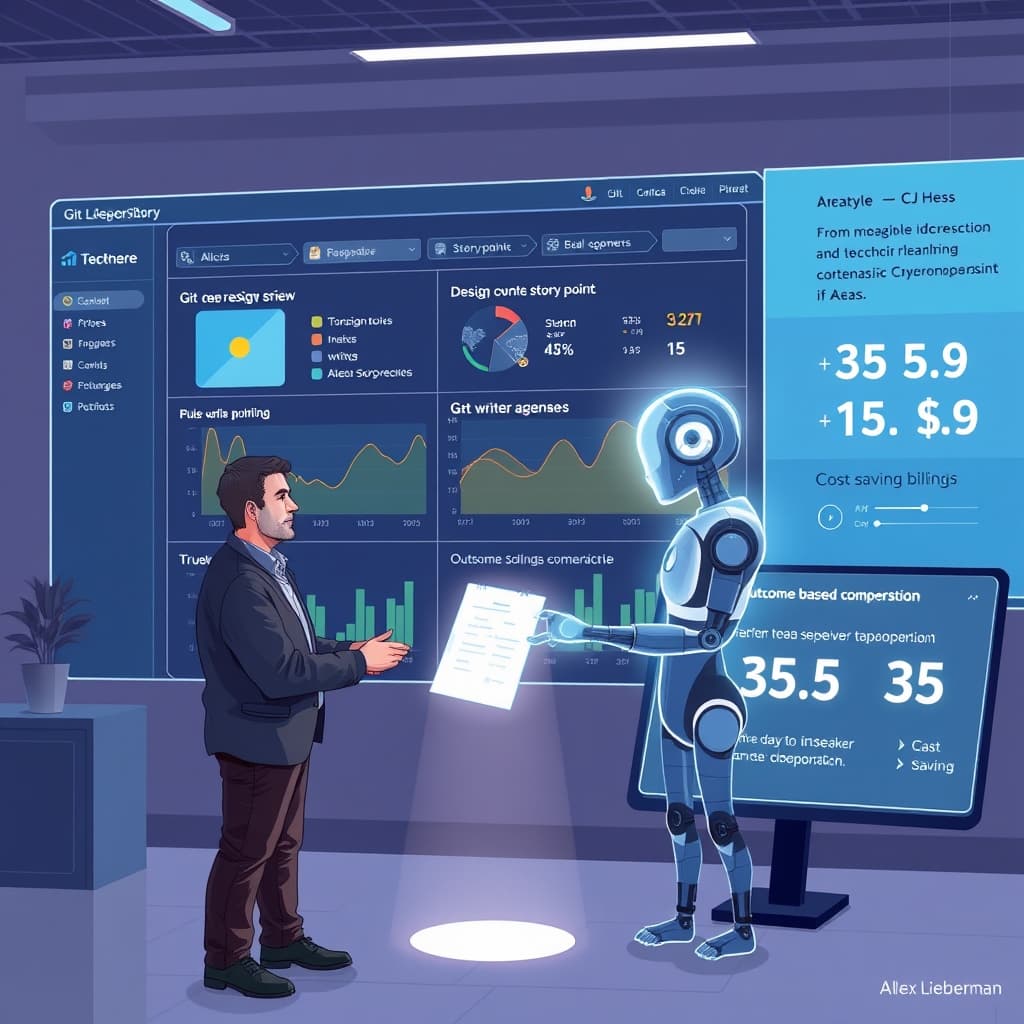
Tenex Shifts to Outcome‑Based Pay and an AI‑Native Development Lifecycle
Paying for Output, Not Hours
Tenex’s founders, Alex Lieberman and CJ Hess, argue that compensating AI engineers by the work they deliver, rather than by the time they spend at a keyboard, flips the incentive structure on its head.
“If AI makes an engineer faster, an hourly rate can make the engineer less money for the same job,” Lieberman explains.
The company still uses story points to gauge effort, but it has not seen the feared inflation of estimates or a surge in low‑quality code to chase points.
Instead, Tenex’s AI strategists, who are tasked with customer retention and growth, push back on work that does not add client value.
The more difficult compensation question concerns activities that do not fit neatly into tickets, such as problem discovery, architecture design, or deciding what should be built.
Hess notes that as language models improve, engineers spend less time typing code and more time translating customer context into a form the model can consume.
Tenex has grown to about 75 employees, serving a mix of Fortune 2000 firms and mid‑market businesses.
While the firm began as an AI‑powered development shop, clients increasingly request broader AI transformation services across their organizations.
Building an AI‑Native SDLC with MetaHarness
Tenex’s internal framework, MetaHarness, bundles a shared skill set, project documentation, and a command‑line interface around each engagement.
Plans, decisions, and acceptance criteria are checked into Git alongside the code, creating a single source of truth for both humans and autonomous agents.
When an AI agent revisits a task, it can read not only the code that was produced but also the rationale behind the implementation choices.
The company’s published AI‑native SDLC diagram depicts a project record that synchronises Linear, GitHub, and client updates for both people and agents.
The key distinction Tenex makes is between accelerating code generation and making the surrounding work—plans, evidence, and decisions—legible to future participants.
MetaHarness can be overkill for very small teams or single‑project efforts, a cost Tenex acknowledges in its own documentation.
The Kill My SaaS Experiment and Its Lessons
In a separate “Kill My SaaS” experiment, Tenex invited 72 teams to replace a speaker‑management tool that the host had been paying $43,000 per year for.
Human judges ultimately selected a winner that ranked only nineteenth on the AI judge’s leaderboard, highlighting a gap between functional compliance and user desirability.
Lieberman cautions that the higher a company’s market position, the more expensive and risky it becomes to dismantle an entrenched system.
Even for a modest‑scale tool, ongoing maintenance responsibilities must be weighed against the projected cost savings.
The host argues that the benefit of building the replacement extends beyond the bill, allowing the team to own and continuously improve the workflow.
Tenex’s experience suggests that outcome‑based pay, a transparent AI‑native SDLC, and careful evaluation of build‑versus‑buy decisions together shape a pragmatic path to enterprise AI adoption.
Readers interested in replicating Tenex’s model should monitor how the company scales its compensation structures as AI agents assume more of the coding workload.
They should also watch for further refinements to MetaHarness that balance documentation overhead with the agility needs of smaller projects.
Finally, organizations contemplating “kill‑the‑software” initiatives must assess both the financial upside and the hidden costs of ongoing support and user acceptance.
Why This Matters: Tenex demonstrates that aligning engineer compensation with delivered outcomes and embedding AI agents in a fully documented SDLC can reduce costs while preserving quality, a model other enterprises may need to evaluate as AI tooling matures.This digest was compiled from:
Share this digest
People Also Read
- NVIDIA Introduces NVKE, a Managed Kubernetes Service for On‑Prem GPU Clusters
NVKE enables on‑prem teams to run managed Kubernetes clusters on NVIDIA GPUs, but remains a preview with limited production readiness.
- Ripple-65B Preview Achieves New U.S. Open‑Weight Benchmark in Agentic Coding
Ripple‑65B Preview sets a new U.S. open‑weight coding benchmark while costing just $32 million to train.
- Kyle Kingsbury’s Warning on LLM‑Driven Trust Erosion
Kyle Kingsbury warns that LLMs undermine confidence in software documentation and calls on maintainers to find ways to prove correctness.
Share your thoughts
Reactions, corrections, or insights — all welcome.