AI Won’t Replace Doctors: Specialist Calls for African Health AI Built on Indigenous Data
The looming health workforce gap
At a forum organized by the African Healthcare Association, health‑technology expert Franck Tchafa warned that artificial intelligence should augment, not replace, physicians across the continent.
He highlighted a projected shortfall of 11.8 million health workers by 2030, a figure that threatens to outpace the capacity of already stretched health systems.
Tchafa also noted that Africa’s population is expected to rise from roughly 1.5 billion today to 2.5 billion by 2050, intensifying demand for medical services.
Compounding the staffing crisis is a growing burden of non‑communicable diseases, which requires timely diagnosis and sustained management.
Building AI solutions that fit Africa
Tchafa urged African institutions to begin by pinpointing concrete healthcare challenges rather than importing generic AI tools.
He said the first step is to map clinical workflows, assess the data that are already collected, and define the evidence needed to deem AI outputs trustworthy.
“AI is not there to replace a physician. It is a force multiplier,” he told the audience, emphasizing that technology should expand clinicians’ capacity.
He further stressed that “AI in medicine is a team sport, so we have to build it together,” calling for collaboration among clinicians, data scientists, engineers, policymakers and operations staff.
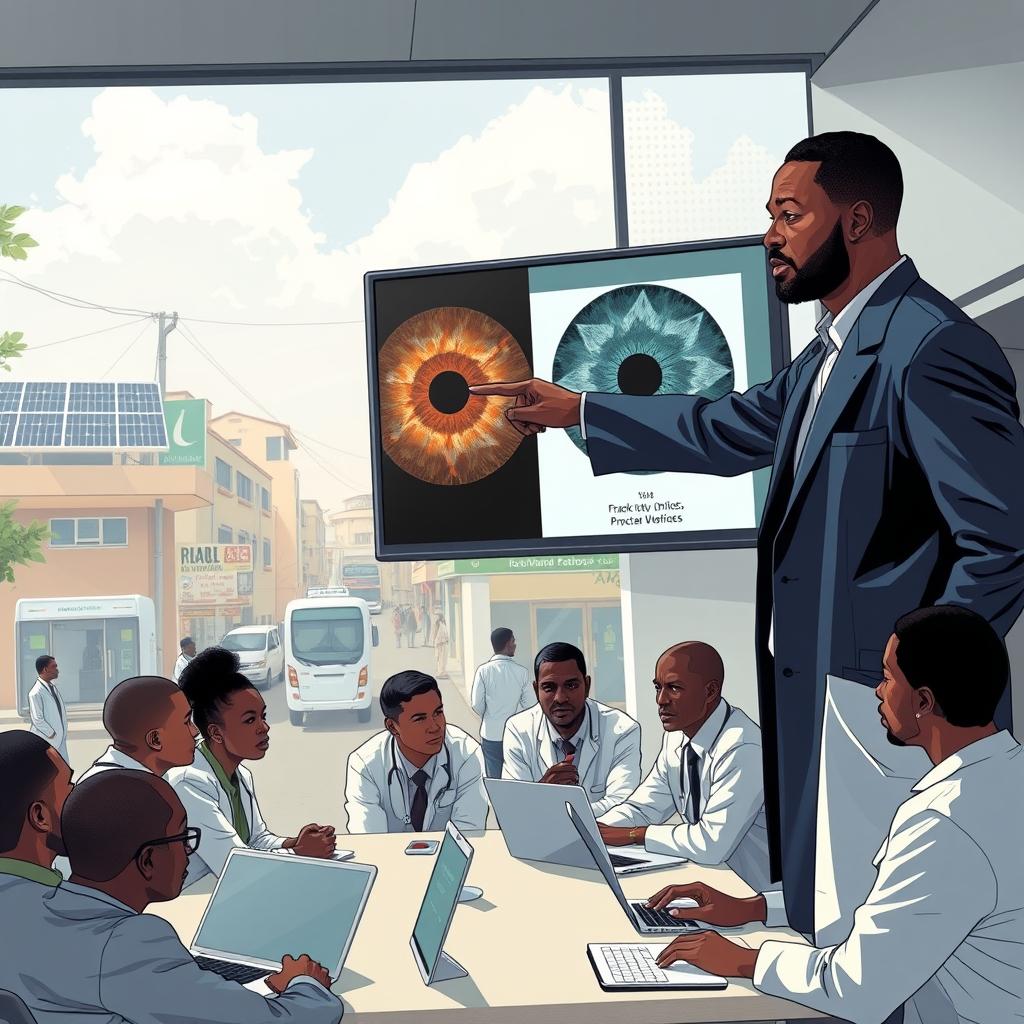
Among the use‑cases he cited, rapid analysis of medical images—particularly for eye diseases such as cataracts, glaucoma and diabetic retinopathy—offers a clear path to preventing avoidable blindness.
In such scenarios, AI can flag disease indicators, draft preliminary reports and prioritize urgent cases, freeing doctors to focus on complex diagnoses.
Tchafa warned that AI models trained primarily on non‑African populations risk misreading local patients because of differences in demographics, disease presentation, equipment and clinical settings.
He illustrated this risk with his own retinal examination, noting that doctors unfamiliar with the pigmentation characteristics common in his region could misinterpret the images.
This anecdote underscores his broader point that representation in medical datasets is essential for accurate AI performance.
Barriers and the path forward
Fragmented, paper‑based health records and inconsistent data standards impede the creation of robust training datasets.
Unreliable electricity and connectivity further limit the deployment of cloud‑based AI services in many clinics.
High costs, a shortage of local AI specialists and regulatory uncertainty add additional layers of complexity.
To overcome these hurdles, Tchafa advocated for a leapfrogging approach similar to Africa’s success with mobile money and off‑grid solar solutions.
He called for sustained investment in local research institutions, data infrastructure and talent development to keep skilled professionals from emigrating.
Tchafa also raised ethical concerns, including patient privacy, informed consent, algorithmic bias and the danger of over‑reliance on automated decisions.
He insisted that clinicians must remain actively involved in AI‑supported decision‑making because technology cannot fully capture a patient’s context, history or non‑verbal cues.
The African Healthcare Association plans to convene its inaugural conference in Ghana on 18–19 December, providing a platform for stakeholders to discuss these issues.
By aligning AI development with locally identified health priorities, validating models on African patient data and ensuring clinician oversight, the continent can harness AI as a true force multiplier.
Why This Matters: Deploying AI without local validation could compromise patient safety, making indigenous data‑driven solutions essential for reliable healthcare augmentation.
This digest was compiled from:
Share this digest
People Also Read
- Nvidia launches probe into CEO Jensen Huang’s ties to alleged Chinese spy
Nvidia’s board has opened an independent investigation into CEO Jensen Huang’s alleged ties to a Chinese intelligence‑linked Megaspeed executive.
- AI is shattering cybersecurity; the industry faces a looming dark age
Alex Stamos warns AI‑enabled attacks are chaining breaches across the tech industry, ushering a dark age for cybersecurity.
- OpenAI secures $11 billion in funding, pushing valuation to $1.25 trillion
OpenAI raised $11 billion, valuing it at $1.25 trillion, amid a funding round that may total $20 billion and a shifting AI market.
Share your thoughts
Reactions, corrections, or insights — all welcome.