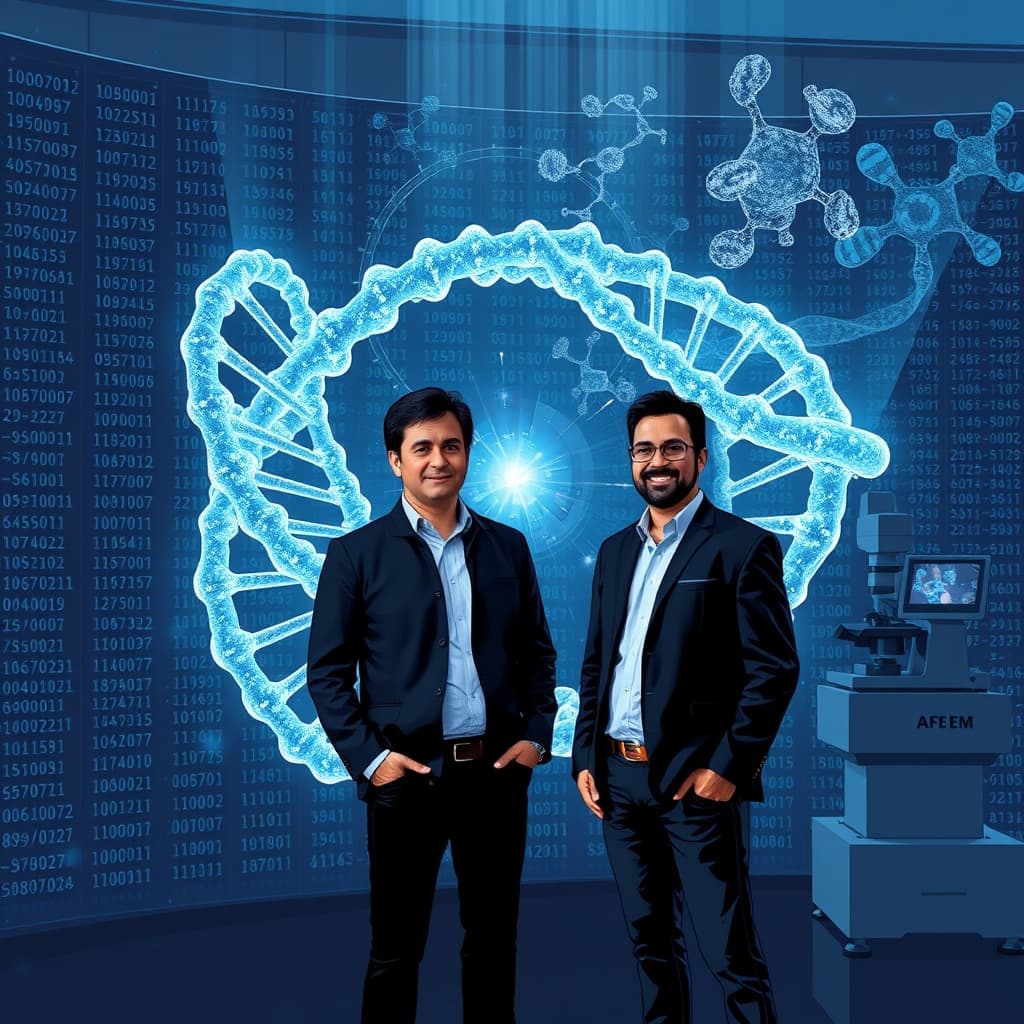
AlphaFold’s Limits Highlight Why Protein Folding Remains Unsolved, Say DeepMind and Biohub Experts
Why AlphaFold Was Only a First Step
When DeepMind’s AlphaFold announced atomic‑level predictions of protein structures, the scientific community celebrated a milestone that seemed to close a decades‑long puzzle.
Pushmeet Kohli of Google DeepMind cautions that the achievement, while impressive, addressed only a narrow slice of the broader protein‑folding problem.
AlphaFold’s success relied on a handcrafted architecture that combined deep learning with extensive domain knowledge, rather than emerging purely from scale.
The system predicts static three‑dimensional shapes but does not capture how proteins move, change shape, or interact in the messy environment of a living cell.
Consequently, many biologically relevant phenomena—such as disorder, conformational dynamics, and transient complexes—remain beyond its reach.
The Limits of Scaling and the Need for Better Data
Kohli and Sal Candido of the Biohub argue that simply throwing more compute and larger datasets at the problem will not automatically yield a complete understanding of biology.
They point to the “Bitter Lesson” in AI: history shows that progress often comes from leveraging the right inductive biases, not just from bigger models.
Finding the correct scaling law for biological data, they say, matters more than blind model enlargement.
Low‑quality metagenomic sequences, for example, can surprisingly improve protein language models by exposing them to a broader evolutionary spectrum.
However, good, curated data still outweighs sheer quantity, because noisy inputs can embed misleading patterns that hinder scientific insight.
The panel highlights that many AI researchers optimize for datasets that are readily available rather than those that are most scientifically valuable.
DeepMind’s own experience balancing model development, data generation, and expert biological input illustrates the trade‑off between speed and relevance.
Beyond transformers, the speakers foresee new architectures that embed biological priors more directly, moving past the current dominance of generic attention mechanisms.
Such specialized designs could encode physical constraints, evolutionary relationships, or cellular context in ways that generic models cannot.
Path Toward Whole‑Cell Modeling
Candido stresses that the next frontier is to model entire biological systems rather than isolated proteins.
He notes that protein language models already contain latent scientific knowledge that has not yet been decoded.
Unlocking this hidden information could accelerate the creation of “virtual cells” that simulate how thousands of proteins interact in real time.
Cryo‑EM micrographs, which capture proteins in their native environments, may provide richer representations needed for such comprehensive models.
The panel also discusses Feynman’s principle that AI can now generate artifacts we do not fully understand, underscoring the importance of trustworthiness and calibrated uncertainty.
Rather than demanding full interpretability, researchers should ensure that model predictions come with reliable confidence estimates.
Kohli speculates that future frontier AI systems might even interpret the behavior of other AI models better than human scientists can.
If realized, this capability could enable rapid iteration on drug‑discovery pipelines, delivering ten‑fold to hundred‑fold speedups.
Nevertheless, Candido warns that achieving the Biohub mission of curing all disease will require thinking in terms of ten‑times breakthroughs, not incremental percent improvements.
In summary, AlphaFold opened the door, but the journey toward truly understanding proteins, cells, and disease will demand better data, smarter architectures, and a willingness to rethink how AI and biology intersect.
Why This Matters: Without new scaling laws, higher‑quality data, and models that capture dynamics, AI will fall short of delivering the comprehensive biological insights needed for transformative drug discovery.This digest was compiled from:
Share this digest
People Also Read
- Modal hits $1 billion ARR and $16 billion Series D valuation, becoming NYC’s newest AI infrastructure decacorn after three‑fold usage surge
Modal reaches $1 billion ARR and a $15.75 billion valuation, driven by a three‑fold usage surge and billions of sandboxes.
- Creating AI Systems for Consistent Performance: Insights from Industrial Robotics
Standard Bots uses modest AI models and high‑quality data to deliver reliable industrial robot performance for clients like NASA and Amazon.
- Anthropic launches Claude Haiku 5.5, outperforms GPT‑6 Luna while matching its price
Anthropic’s Claude Haiku 5.5 launches with higher performance, lower cost and pricing that directly matches OpenAI’s GPT‑6 Luna.
Share your thoughts
Reactions, corrections, or insights — all welcome.