Creating AI Systems for Consistent Performance: Insights from Industrial Robotics
Industrial Robots as the AI Testing Ground
Standard Bots describes itself as “America’s largest AI‑native industrial robot manufacturer.”
The company recently secured $200 million in a Series C round that valued it at $1 billion.
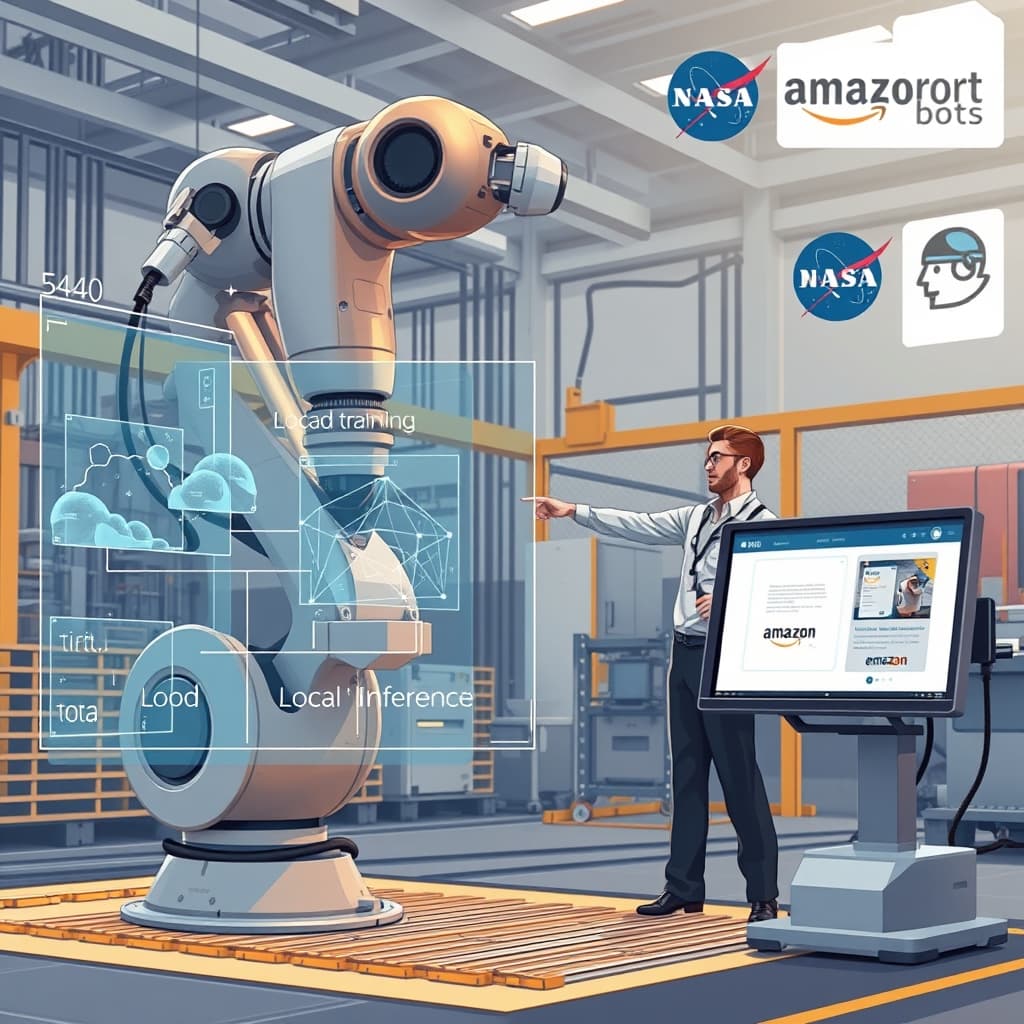
General Catalyst and RoboStrategy led the financing, and the roster of customers now includes NASA, Amazon and Lockheed Martin.
In conversation with CEO Evan Beard and Head of AI Leif Jentoft, the firm explained how its robots differ from popular humanoid concepts.
Standard Bots’ arms are built for short‑horizon industrial tasks such as machine tending, welding and assembly.
Standard Bots’ AI Stack and Data Strategy
The company relies on a shared base model that each client tailors through demonstrations and fine‑tuning.
According to Beard, the largest model in the stack contains only a few billion parameters, far smaller than frontier‑lab systems.
Jentoft emphasized that “We believe data quality matters far more than raw volume,” and the firm prioritises targeted data over massive datasets.
He added, “Our market access gives us unique access to the highest value data. In‑situ interventions can fix an edge case with a few dozen examples.”
Standard Bots combines learned perception with conventional programming for workflow elements that do not require AI.
Model training is performed in the cloud, while inference runs locally on the robot hardware.
For machine‑tending in high‑mix manufacturing, the firm offers a zero‑shot perception system that lets a user specify which parts to locate.
The model handles the visual identification, and traditional code controls the robot’s motion and cell logic.
Jentoft noted that the perception backbone is trained on over a billion images, enabling discrimination across lighting conditions, material types and background clutter.
Co‑Optimizing Hardware and Models
Physical AI, as discussed on the Applied Intuition podcast, is constrained not only by model intelligence but also by safety, latency, power, cost and reliability requirements.
Standard Bots’ ownership of the full stack—from the robotic arm and end‑effector to the control system and AI—allows it to co‑optimize models with low‑level control policies.
Jentoft asserted, “Despite claims elsewhere, no model today is truly hardware‑agnostic, and co‑optimizing low‑level control and higher‑level functions is a major advantage for both performance and iteration speed.”
This integrated approach lets the company iterate quickly, because adjustments to perception can be reflected in motion control without a separate integration step.
Other firms, such as Skild, aim for general‑purpose robotic intelligence, but Standard Bots focuses on delivering reliable execution for specific industrial use cases.
By keeping the AI models modest in size and leveraging high‑quality, task‑specific data, the company demonstrates that reliable robot performance does not require the largest possible compute.
Why This Matters: Fine‑tuning compact, data‑rich AI models enables manufacturers to achieve dependable robot operation without the expense and complexity of massive, compute‑heavy systems.
This digest was compiled from:
Share this digest
People Also Read
- Modal hits $1 billion ARR and $16 billion Series D valuation, becoming NYC’s newest AI infrastructure decacorn after three‑fold usage surge
Modal reaches $1 billion ARR and a $15.75 billion valuation, driven by a three‑fold usage surge and billions of sandboxes.
- AlphaFold’s Limits Highlight Why Protein Folding Remains Unsolved, Say DeepMind and Biohub Experts
AlphaFold’s breakthrough is a stepping stone; experts say scaling alone won’t solve protein folding without better data and new model designs.
- Anthropic launches Claude Haiku 5.5, outperforms GPT‑6 Luna while matching its price
Anthropic’s Claude Haiku 5.5 launches with higher performance, lower cost and pricing that directly matches OpenAI’s GPT‑6 Luna.
Share your thoughts
Reactions, corrections, or insights — all welcome.