Anthropic’s wet lab reports enzyme system discovery likened to CRISPR
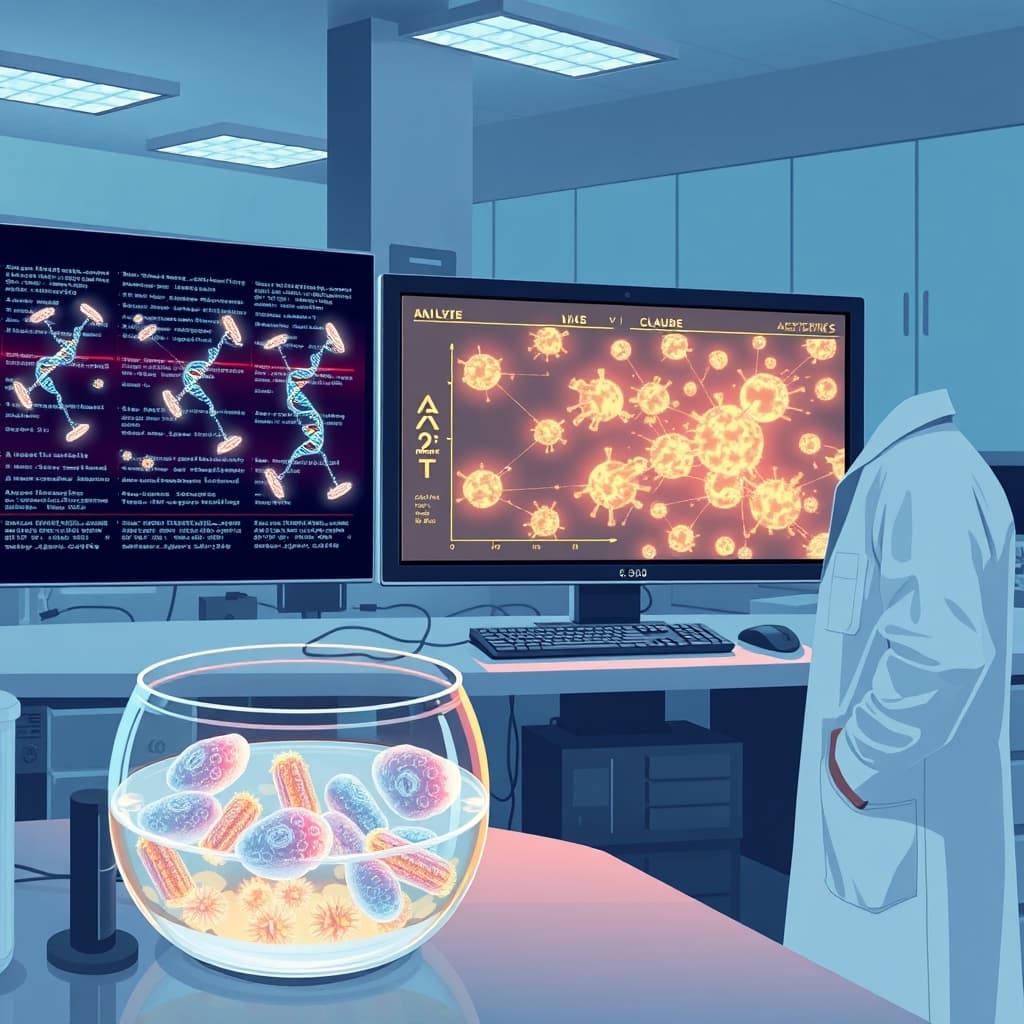
Anthropic announced that its AI system Claude has identified a previously unknown enzyme system that the company compares to the gene‑editing tool CRISPR.
The finding emerges from the first experiment conducted in Anthropic’s newly launched wet lab and serves as an early test of Claude’s utility for scientific research as the firm prepares for an initial public offering.
According to Anthropic, the computational search engaged nearly 950 Claude agents working in parallel for 21 hours and processing about 210 million tokens.
The agents scanned an extensive database of DNA sequences, looking for patterns that might indicate novel biological functions.
During the sweep, one Claude instance detected an unusual repeating motif and flagged it for human examination.
Anthropic scientists reviewed the flagged sequence and performed laboratory validation, confirming the presence of a previously uncharacterized enzyme system in bacteriophages, viruses that infect bacteria.
The company states that Claude “autonomously discovered” this enzyme system after the minimal human prompt and subsequent lab work.
Researchers’ role was limited to issuing the initial query and conducting the experimental follow‑up.
Anthropic added that it was “important to share such findings early, both to demonstrate Claude’s capabilities and to give the broader community insight into what we’re working on.”
Discovery Process
The massive token consumption reflects the scale of Claude’s search across genetic data, illustrating the model’s capacity to handle high‑volume, domain‑specific tasks.
The repeating pattern that caught Claude’s attention was not previously catalogued, prompting a deeper computational and experimental investigation.
Human reviewers examined the anomaly, and subsequent biochemical assays verified that the sequence encodes an active enzyme system.
This workflow—AI‑driven pattern detection followed by targeted lab validation—demonstrates a hybrid approach to biological discovery.
Implications and Industry Context
While Anthropic likens the enzyme system to CRISPR, the company acknowledges that it remains uncertain whether the discovery will translate into practical applications or achieve a transformative impact.
The announcement aims to showcase Claude’s potential to accelerate scientific research, positioning Anthropic as a player in the emerging AI‑driven biotech space.
Anthropic hopes the result will attract additional scientists to its lab and support expansion into areas such as drug discovery.
AI firms are increasingly turning to scientific problems to demonstrate the value of increasingly capable models.
OpenAI, for example, has been pursuing advanced mathematical challenges, a strategy that differs from Anthropic’s focus on experimental biology.
Future Outlook
Anthropic continues to study the newly identified enzyme system to determine its biochemical role and any possible biotechnological uses.
The company plans further experiments to map the system’s activity and assess whether it can be engineered for gene‑editing or therapeutic purposes.
By publishing the discovery early, Anthropic signals a commitment to openness and invites collaboration from the broader scientific community.
Future progress will depend on both Claude’s evolving capabilities and the depth of experimental validation performed by human researchers.
Why This Matters: Anthropic’s claim that Claude autonomously uncovered a novel bacteriophage enzyme system illustrates how AI can augment biological research, offering a glimpse of how such tools might accelerate discovery ahead of broader commercial applications.
This digest was compiled from:
Share this digest
People Also Ask
- MTN Group Foundation and Gates Foundation unveil Nigeria Maternal Health Multiplier to broaden AI‑driven maternal care
MTN and Gates Foundations launch a $25 million AI‑driven platform to help 500,000 Nigerian women access better maternal care by 2030.
- Anthropic unveils Claude Opus 5.5 with enhanced cybersecurity safeguards
Anthropic’s Claude Opus 5.5 adds stronger sandbox safeguards, cuts operating costs by 40 percent, and aims to curb AI‑driven security breaches.
- Meta releases hotfix for Muse zero‑day that let attackers commandeer the AI assistant
Meta patched a zero‑day in its Muse macOS app that let local attackers hijack the AI assistant, highlighting security trade‑offs in cloud‑based AI agents.
Share your thoughts
Reactions, corrections, or insights — all welcome.