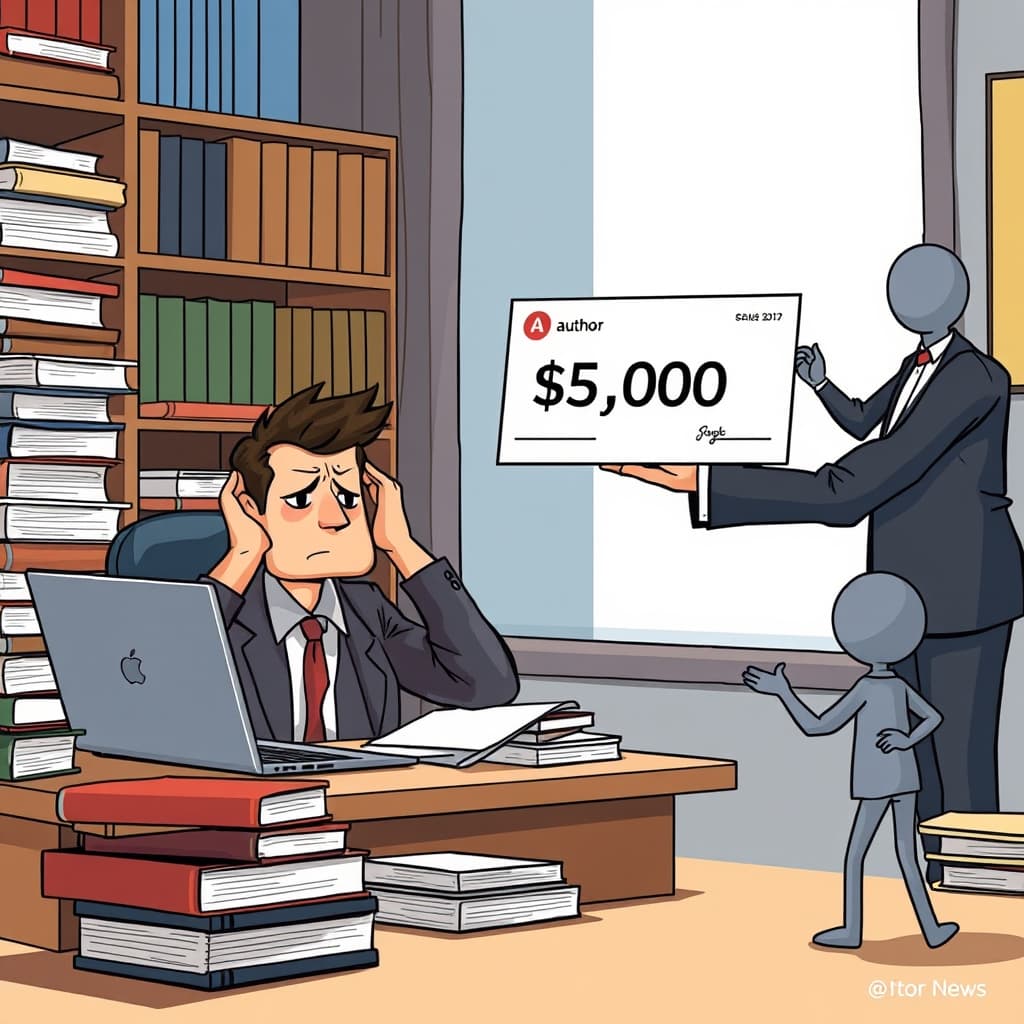
Authors contest publisher and agent claims on Anthropic’s $1.5 billion settlement
Anthropic’s $1.5 billion copyright settlement, approved in July 2024, is now triggering payment disputes.
The settlement follows a 2023 court ruling that training AI on copyrighted works is permissible under fair use, while unauthorized copying is not.
Under the agreement, authors of roughly 500,000 titles will receive $3,000 for each work deemed pirated by the AI.
If a book remains in‑print with a traditional publisher, the payment is divided equally between author and publisher.
For self‑published titles or works whose rights have reverted, the author is entitled to the full amount.
Settlement mechanics and payment eligibility
The payment formula is straightforward: $3,000 per infringing title, with a 50‑50 split when a publisher still holds rights.
Rights reversion must be documented before the settlement’s “download date” of 10 August 2022 for an author to claim the entire $3,000.
Authors who have not received a payment alert are advised to verify the status of their rights against the settlement timeline.
Publishers, agents and the surge of claim challenges
Authors began reporting unexpected emails indicating that third parties, often publishers, were asserting a claim on their payouts.
Thriller writer April Henry posted, “WTF is HarperCollins playing at? They claimed one of my books on the Anthropic Settlement that reverted back at least 17 years ago AND on the same day I got a credit alert saying they had been added as my employer! (which they never were).”
Victoria Strauss, founder of Writers Beware, noted two recurring complaint categories: publishers seeking payment for works whose rights have already reverted, and publishers demanding the full 100 % share instead of the contractual 50 %.
Strauß wrote, “I’m reluctant to attribute to malice what can be plausibly explained by poor recordkeeping.”
She added that some publishers have already acknowledged the error and asked Anthropic to correct the allocations.
Authors Guild CEO Mary Rasenberger told The New York Times that she does not view the situation as “a grab by the publishers” nor believes they are “specifically trying to screw any author over.”
Rasenberger framed the issue as a predictable outcome of inadequate record‑keeping and a complex settlement process.
Strauß also warned that the volume of reports—“the unusually large number of reports I’ve received over the last two days”—suggests a systemic problem rather than isolated glitches.
Beyond publishers, literary agencies are also entering the fray, despite agents not being rights holders.
Courteney Milan, writing under her pen name, bluntly declared on Bluesky, “Apparently some agents are trying to claim percentages on the Anthropic settlement, and I do not REMOTELY think they should do this, what the fuck, stop that shit!”
Both the Authors Guild and Milan have published guidance on how authors can dispute erroneous payment allocations.
Implications for the publishing ecosystem
The disputes highlight the challenges of reconciling legacy publishing contracts with modern AI‑related settlements.
Accurate rights tracking, especially for titles that have reverted to authors, emerges as a critical operational need.
Publishers that misinterpret or misapply settlement terms risk eroding trust with authors and may face reputational fallout.
Agents asserting claims could prompt legal clarification on the extent of their entitlement in AI‑related compensation schemes.
Anthropic’s willingness to address identified errors will influence how future AI copyright settlements are structured.
Authors are advised to review their rights status, monitor payment alerts, and, if necessary, file disputes through the channels outlined by the Authors Guild.
Stakeholders should watch for Anthropic’s forthcoming response to the surge of claims, which may include revised payment processes or additional transparency measures.
Why This Matters
This digest was compiled from:
Share this digest
People Also Ask
- Engrim expands local SQLite memory to four AI coding assistants
Engrim 1.3.0 adds a local SQLite memory layer for Claude Code, Cursor, Windsurf and Google Antigravity, preserving project decisions across sessions.
- The Download: Ukraine’s Drone Data Marketplace and AI’s Effect on Language
Ukraine’s release of battlefield drone data creates a new commercial market while AI narratives explore how technology may alter language.
- AI Redefines Border Security Operations
AI‑native platforms let customs assess risk on every low‑value parcel, balancing trade facilitation with fraud prevention.
Share your thoughts
Reactions, corrections, or insights — all welcome.