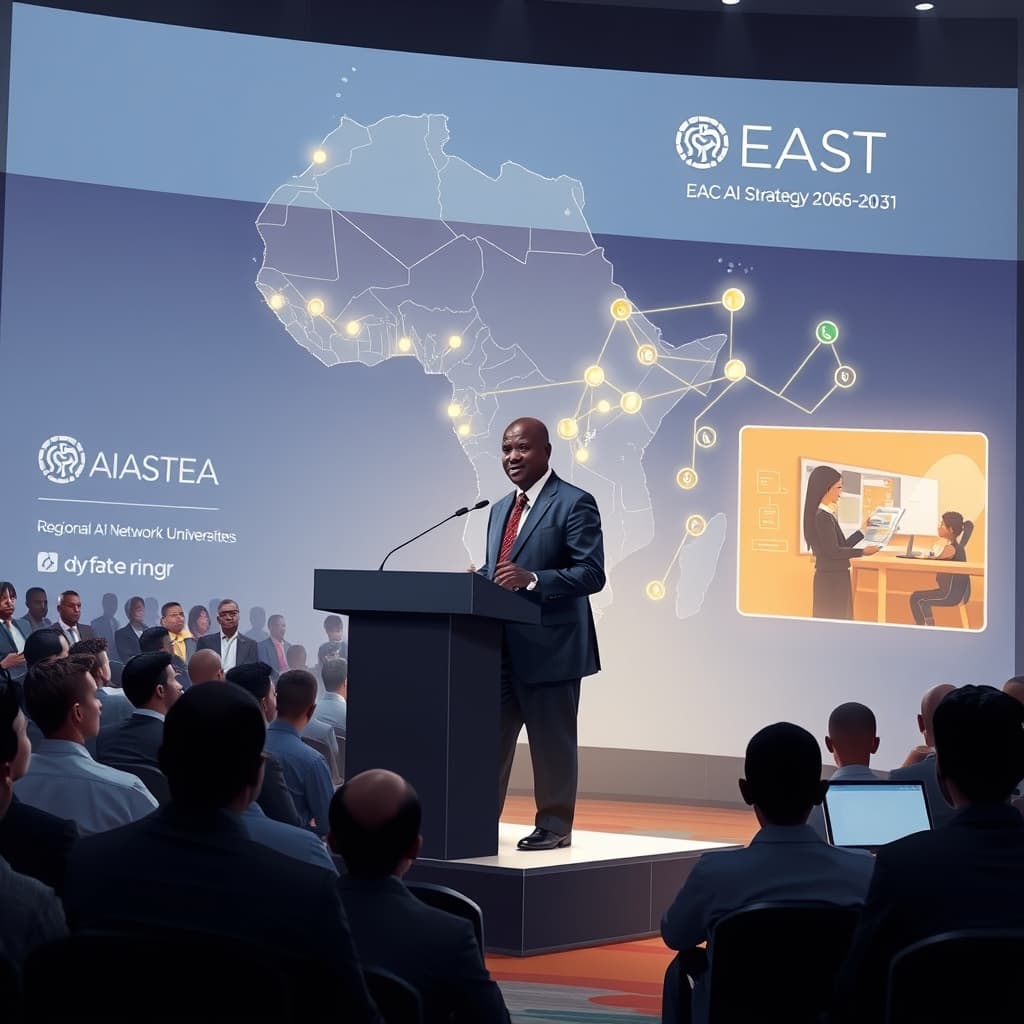
East African bloc called to speed up AI implementation plan
Key Recommendations from EASTECO
Dr Fortunate Muyambi, deputy executive secretary and head of programmes and projects at the East African Science and Technology Commission, addressed delegates at the East African Community Regional Education Conference in Nairobi.
He urged member states to turn the EAC AI Strategy (2026–2031) into nationally owned implementation roadmaps.
He also called for the operationalisation of the Regional AI Network of Universities launched by the Inter‑University Council for East Africa.
Among his proposals was the creation of common regional AI competency and credential frameworks.
He highlighted the need to strengthen pathways that move learners from education to employment and practical AI applications.
Coordinating investment in enabling infrastructure was presented as a priority to support AI deployment in schools and universities.
He advocated for deeper regional research and data collaboration to accelerate AI‑driven solutions.
Establishing shared results and monitoring indicators was recommended to track progress across the bloc.
Regional Context and Next Steps
The EAC validated its regional AI Strategy in May 2026 to harmonise technology policies, build digital skills and drive innovation across member states.
The Regional AI Network of Universities aims to link higher‑education institutions into a distributed network of specialised AI nodes.
The four‑day conference has gathered more than 600 education leaders, policymakers and stakeholders from the eight EAC partner states.
Participants are confronting persistent learning gaps, unequal access to education, skills mismatches and mounting pressure on education systems.
Partner states have committed to strengthening education systems, improving learning outcomes and increasing investment in teachers, skills and equity.
The EAC membership includes Burundi, the Democratic Republic of Congo, Kenya, Rwanda, South Sudan, Tanzania and Uganda.
EASTECO’s mandate is to coordinate and promote the development, management and application of science, technology and innovation across these countries.
By translating the regional AI strategy into national plans, each country can tailor investments to local needs while maintaining regional coherence.
The university network is expected to foster joint research projects, shared curricula and pooled AI resources that individual institutions could not sustain alone.
Monitoring indicators will enable policymakers to assess whether AI initiatives are narrowing learning gaps or merely adding complexity.
Stakeholders see the alignment of academia, industry and government as essential for turning AI concepts into tangible educational improvements.
As the conference concludes on Friday, the momentum generated is intended to translate into concrete policy drafts and budget allocations in the coming months.
Observers note that the coordinated approach mirrors earlier regional efforts in ICT integration, suggesting a pattern of collective capacity building.
Successful implementation could position East Africa as a hub for AI‑enhanced education in the broader African context.
Why This Matters
This digest was compiled from:
Share this digest
People Also Ask
- ChatGPT, Grok, and Claude experience simultaneous outages
Three leading AI chatbots—ChatGPT, Grok, and Claude—experienced simultaneous outages on Thursday, affecting millions of users before being restored within hours.
- Google Introduces AI‑Powered Voice Tools for Gmail, Docs and Keep
Google adds AI‑powered voice commands to Gmail, Docs, and Keep, enabling hands‑free email, document creation, and note‑taking.
- Google unveils a sharper, hourly AI weather model
Google announced an updated AI‑driven weather model that promises sharper forecasts and faster updates. The new system,...
Share your thoughts
Reactions, corrections, or insights — all welcome.