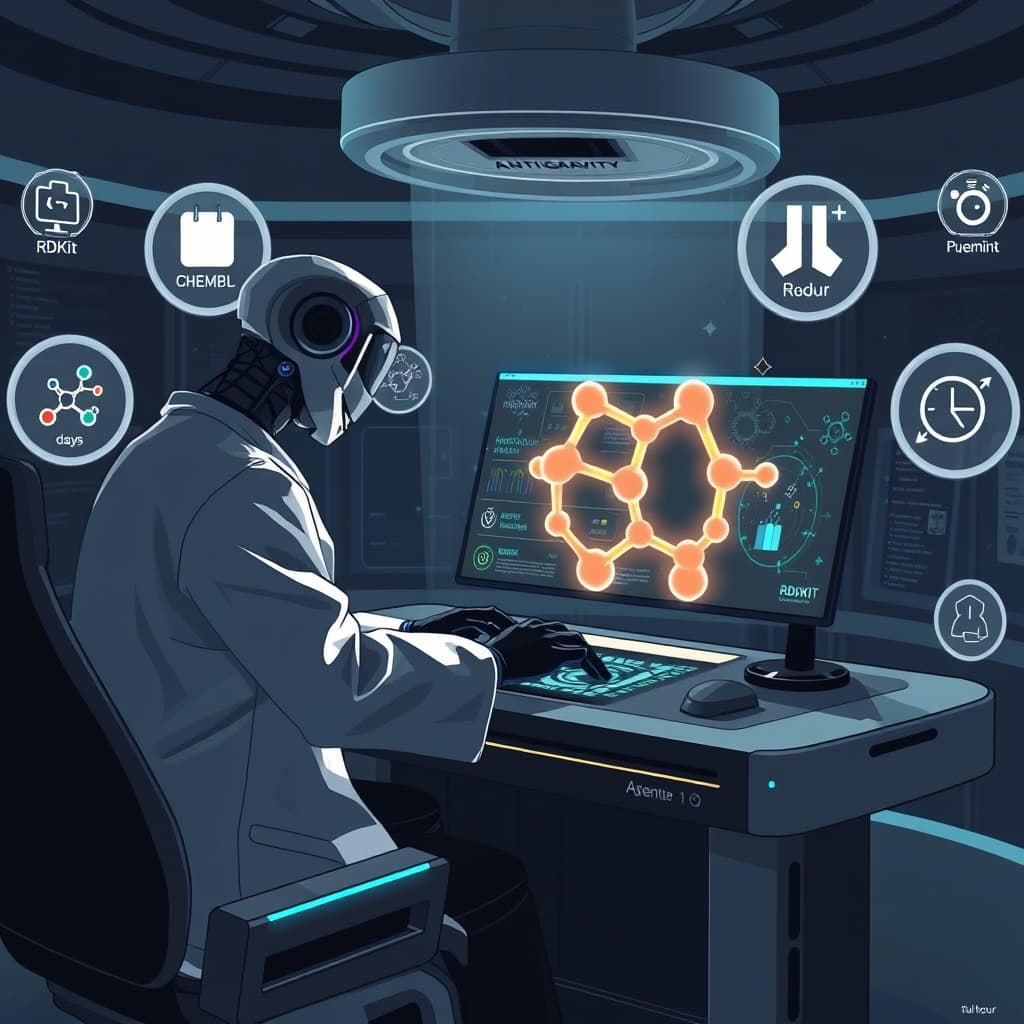
Google Antigravity Enables Agentic Cheminformatics
Accelerating Drug Discovery with Agentic Workflows
Designing new medicines traditionally involves gathering data from charts, figures, and literature, training predictive models, and proposing candidate molecules for synthesis.
This multi‑step workflow often consumes several days for a single iteration.
Google DeepMind now demonstrates that Google Antigravity, combined with new Cheminformatics Skills, can compress the same cycle to roughly one hour.
In a real‑world lung‑cancer case study, an autonomous agent searched thousands of compounds, performed matched molecular pair analysis, and suggested novel rigidified macrocycles together with synthetic routes within sixty minutes.
The speedup stems from delegating workflow orchestration and scientific reasoning to a language model while deterministic chemistry tools execute the underlying calculations.
Cheminformatics Skills Built on Open‑Source Tools
Chemistry represents one of the most extensive public scientific records, spanning millions of structures across journal articles, patents, and vendor catalogs.
Molecules appear in many formats, from IUPAC names in papers to Markush structures in patents and structure‑data files in catalogs.
Because a single atom or bond change creates a different compound, any data‑wrangling error can invalidate a potential inhibitor or catalyst.
To reduce this error‑prone step, the team created a suite of Cheminformatics Skills that turn the Antigravity surface into a collaborative workbench.
The skills give both computational and experimental chemists full access to local tooling while preserving a clear division of labour.
The language model handles database navigation, workflow sequencing, and scientific reasoning.
Deterministic chemistry tools, grounded in the open‑source RDKit toolkit, perform molecular calculations such as property prediction and reaction enumeration.
Connectors to curated resources from ChEMBL and PubChem embed domain best practices directly into the agent’s operations.
By unifying disparate data sources and automating routine transformations, the system lets scientists focus on hypothesis generation rather than manual data cleaning.
Rigidifying Molecules: From Crizotinib to Lorlatinib
A classic medicinal‑chemistry strategy to boost potency is rigidification, which reduces the number of rotatable bonds in a molecule.
Rotatable bonds allow a compound to adopt many three‑dimensional conformations, creating an entropic penalty when the molecule must lock into a single active shape to bind its target.
Adding a second bond to tie two substructures together restricts this freedom and pre‑pays the entropic cost.
The result is often a dramatic increase in binding affinity and overall potency.
A well‑known example is the progression from crizotinib, a first‑generation tyrosine‑kinase inhibitor for non‑small‑cell lung carcinoma, to lorlatinib, a third‑generation inhibitor.
Crizotinib contains five major rotatable bonds, whereas lorlatinib incorporates a cyclized end that reduces conformational flexibility.
The Antigravity agent reproduced this rigidification pattern by proposing macrocyclic analogues that mimic lorlatinib’s constrained geometry.
Each proposed analogue included a plausible synthetic route generated from the integrated chemistry tools.
By delivering candidate structures and routes in an hour, the system shortens the feedback loop between computational design and laboratory validation.
The demonstration illustrates how agentic cheminformatics can transform drug‑discovery timelines without compromising chemical accuracy.
Overall, the integration of language‑model orchestration with deterministic RDKit‑based calculations creates a reproducible, error‑aware pipeline for medicinal chemistry.
Future extensions may incorporate additional experimental data streams, but the current workflow already showcases a viable path toward faster, more reliable small‑molecule development.
Researchers can now allocate more time to creative hypothesis testing while the system handles the labor‑intensive data wrangling and synthesis planning.
This shift promises to accelerate early‑stage drug discovery across therapeutic areas.
Google Antigravity’s Cheminformatics Skills thus represent a concrete step toward more efficient, agent‑driven scientific research.
Why This Matters
The development proves that autonomous agents can reliably execute complex medicinal‑chemistry tasks, cutting iteration time from days to hours and enabling faster exploration of therapeutic candidates.
This digest was compiled from:
Share this digest
People Also Read
- Google unveils TPU 8tx and 8i Max for secure inference and large context
Google adds two new TPUs—8tx for encrypted inference and 8i Max for massive context windows—targeting secure, agentic AI workloads.
- Establishing a higher benchmark for accountable AI infrastructure
Why U.S. Compute Capacity Matters The promise of artificial intelligence is to give individuals more power over their o...
- OpenAI launches Daybreak Red on AWS GovCloud (US‑East)
OpenAI’s Daybreak Red, featuring GPT‑5.6 Cyber, is now usable by approved users in AWS GovCloud (US‑East) for secure government cybersecurity work.
Share your thoughts
Reactions, corrections, or insights — all welcome.