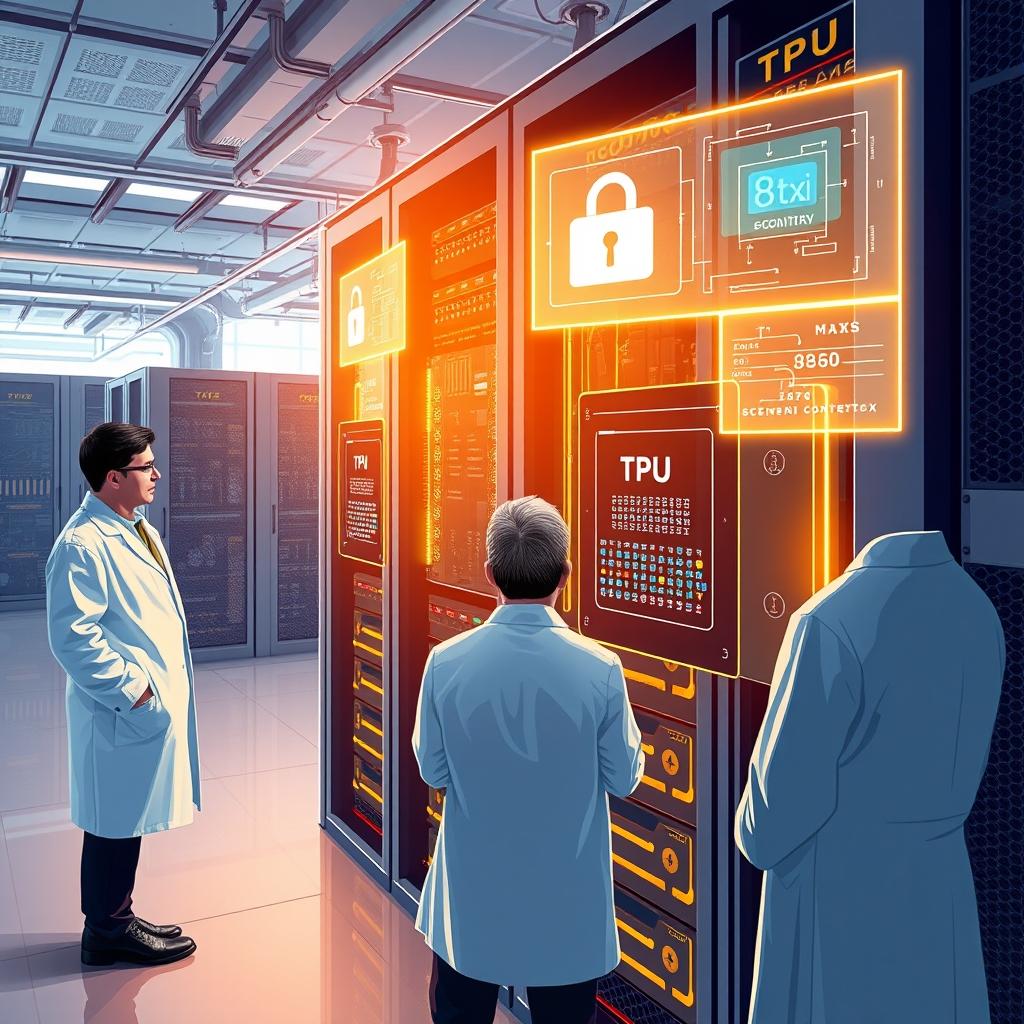
Google unveils TPU 8tx and 8i Max for secure inference and large context
Expanding the eighth‑generation TPU lineup
Google announced two new eighth‑generation Tensor Processing Units, the 8tx and the 8i Max, extending its TPU family.
The 8tx focuses on hardware‑level encryption to protect confidential inference workloads.
The 8i Max is engineered to handle massive context windows, enabling more extensive reasoning across AI models.
These additions bring the total to four distinct TPU systems released in a single year, a first for the company.
Earlier in 2026, Google introduced the TPU 8t for large‑scale training and the TPU 8i for real‑time reasoning at Google Cloud Next.
Both the 8t and 8i demonstrated up to 2.7 times better training performance and 80 percent better inference price performance compared with the previous generation.
By adding the 8tx and 8i Max, Google completes a portfolio that covers every stage of the AI lifecycle.
Hardware designed for agentic workloads
Customers are increasingly moving from human‑scale to agent‑scale computing, demanding accelerators that can reason over longer contexts.
Businesses in regulated sectors also require specialized encryption capabilities for sensitive data processing.
The 8tx addresses the latter need with built‑in secure inference that keeps data encrypted throughout the computation.
The 8i Max addresses the former need by offering the highest compute density per rack and support for context windows far larger than previous TPUs.
Google co‑designs its TPUs with DeepMind, but it now incorporates feedback from external organizations to tailor hardware to these emerging requirements.
Nearly 100 customers—including frontier labs, trading firms, retailers, and universities—already deploy Google’s TPUs, illustrating rapid market adoption.
Both new systems are compatible with Google’s open‑source software stack and the recently announced PyTorch support, lowering barriers for developers.
Implications for developers and enterprises
Developers can now access specialized silicon that accelerates both secure inference and large‑context reasoning without leaving the familiar PyTorch ecosystem.
The modular design of the TPUs enables Google to ship new hardware configurations at the pace of AI innovation.
Enterprises seeking to run agentic AI workloads can deploy the 8i Max on Google Cloud or install the hardware directly in their own data centers.
Organizations handling regulated data can choose the 8tx to ensure that confidential information never leaves encrypted memory.
These options broaden the range of AI applications—from autonomous agents that need extensive memory to financial models that must protect proprietary data.
Google’s strategy of pairing custom silicon with an open, easy‑to‑use software stack aims to make high‑performance AI more accessible across industries.
Why This Matters
The launch of TPU 8tx and 8i Max gives enterprises a concrete hardware path to run secure, large‑context AI agents at scale, directly addressing the emerging demand for trusted, high‑density inference in regulated and data‑intensive environments.
This digest was compiled from:
Share this digest
People Also Read
- Establishing a higher benchmark for accountable AI infrastructure
Why U.S. Compute Capacity Matters The promise of artificial intelligence is to give individuals more power over their o...
- OpenAI launches Daybreak Red on AWS GovCloud (US‑East)
OpenAI’s Daybreak Red, featuring GPT‑5.6 Cyber, is now usable by approved users in AWS GovCloud (US‑East) for secure government cybersecurity work.
- Google Antigravity Enables Agentic Cheminformatics
Google Antigravity’s new Cheminformatics Skills let an AI agent generate and plan synthesis of rigidified drug candidates in about an hour.
Share your thoughts
Reactions, corrections, or insights — all welcome.