Google Highlights AI’s Role in Addressing Global Challenges
For more than ten years, artificial intelligence has moved from academic labs into practical scientific breakthroughs.
Google now says the technology’s impact is no longer theoretical but measurable across a range of societal problems.
The company emphasizes collaborations with local communities and research teams that are applying AI to health, disaster mitigation, education, and economic inclusion.
Health Innovations Powered by AI
Google’s AI tools are being used to make diseases easier to detect, treat, and prevent.
By analysing large medical datasets, the models can identify early signs of illness that might be missed by conventional methods.
These capabilities are intended to reach underserved regions where specialist doctors are scarce.
Predicting and Responding to Natural Disasters
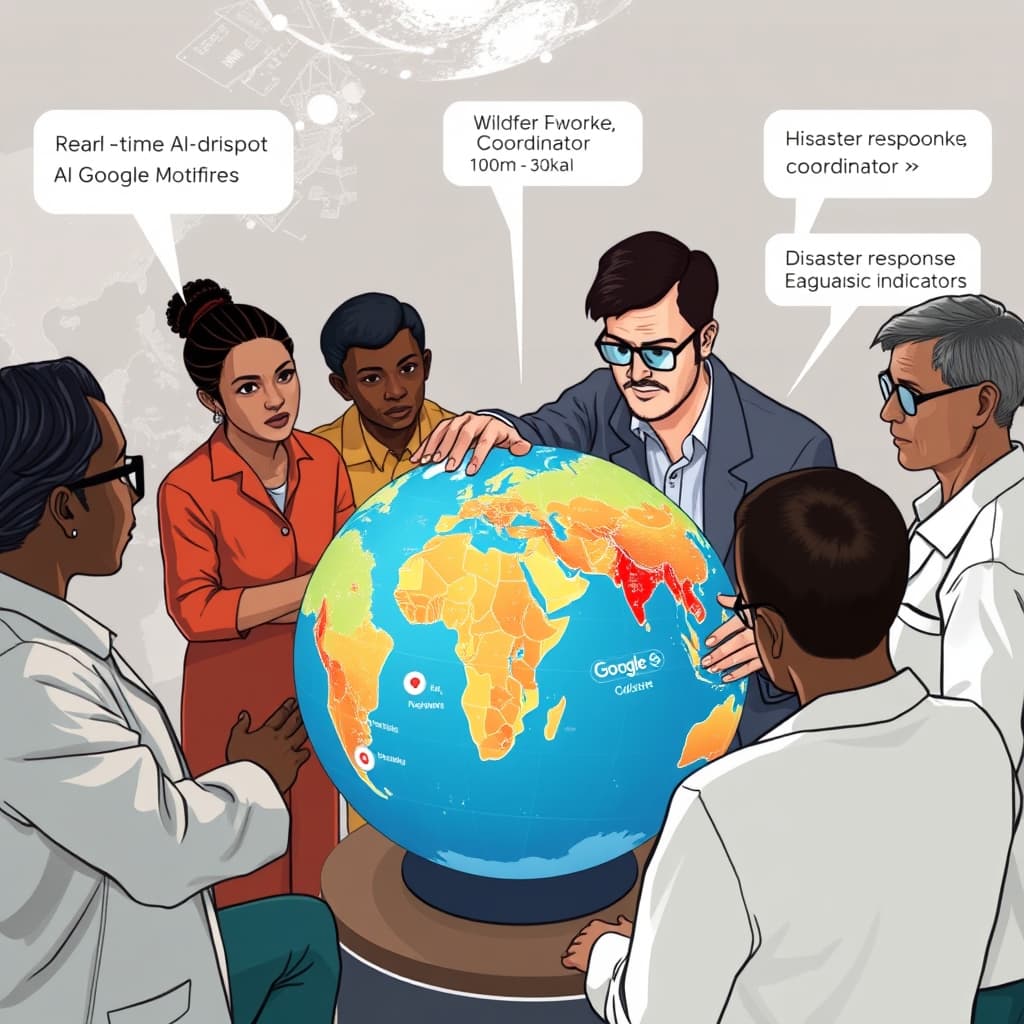
Google Research is testing satellite‑based AI that scans the planet every twenty minutes to spot wildfires the size of a car.
A DeepMind scientist explains that similar AI systems are improving cyclone forecasts, giving communities earlier warnings.
Additional work on flood prediction combines tools such as Flood Hub and Groundsource to model river‑level changes and alert vulnerable populations.
Expanding Learning and Economic Opportunity
The company is developing multilingual models that go beyond simple translation to understand languages as they are naturally expressed.
This effort aims to give speakers of any language access to information and services that were previously limited by language barriers.
Google’s AI & Economy ATLAS project has turned millions of global data points into an open‑access interactive platform for researchers and policymakers.
By making these insights publicly available, ATLAS seeks to inform decisions that can broaden economic participation.
Showcasing Ongoing Work
James Manyika authored a piece titled “AI Building” that outlines how advanced technology can drive extraordinary progress for humanity.
In “AI for everyone in every language,” Manyika discusses the shift toward models that truly comprehend diverse linguistic expressions.
Zanna Iscenko highlighted the ATLAS initiative, emphasizing its role in translating complex data into usable knowledge.
Lindsey Lanquist described the wildfire‑detection project, noting the system’s ability to monitor the globe at high frequency.
Hannah Hunt contributed two articles, one on cyclone prediction and another on flood forecasting, illustrating the breadth of Google’s environmental AI applications.
Collectively, these articles form a curated collection that demonstrates how AI breakthroughs are being turned into tools that benefit a wide range of people.
Google’s messaging underscores the belief that AI should be an inclusive resource, not a niche technology.
The overarching narrative is that AI is now a practical instrument for solving some of humanity’s most complex challenges.
Stakeholders ranging from local health clinics to national disaster agencies are beginning to integrate these AI solutions into everyday workflows.
As the models improve and data becomes richer, the expectation is that outcomes such as earlier disease detection and faster disaster response will become the norm rather than the exception.
Google’s continued investment in open‑access tools like ATLAS suggests a strategic focus on transparency and collaborative progress.
By sharing methodologies and results, the company hopes to accelerate global adoption and inspire further innovation.
In summary, the blog post serves as both a progress report and a call to action for partners to leverage AI in addressing pressing societal needs.
Why This Matters: The shift from experimental AI to widely deployed tools creates new avenues for health, safety, education, and economic growth worldwide.
This digest was compiled from:
Share this digest
People Also Ask
- Fyxer’s AI Executive Assistant Gains Trust by Merging OpenAI Models with Half‑Million Hours of Workflow Data
Fyxer’s AI assistant blends OpenAI models with 500,000+ hours of workflow data, delivering trusted email drafts and high user retention.
- OpenAI Launches ChatGPT Tailored for Financial Services
OpenAI unveiled ChatGPT for Financial Services, a GPT‑6 powered tool with built‑in premium data to streamline banking research and modeling.
- OpenAI Launches ChatGPT Images 2.5 with Sharper Detail and Faster Generation
OpenAI launches ChatGPT Images 2.5, offering sharper details, 50% faster generation, and new editing tools for creators and developers.
Share your thoughts
Reactions, corrections, or insights — all welcome.