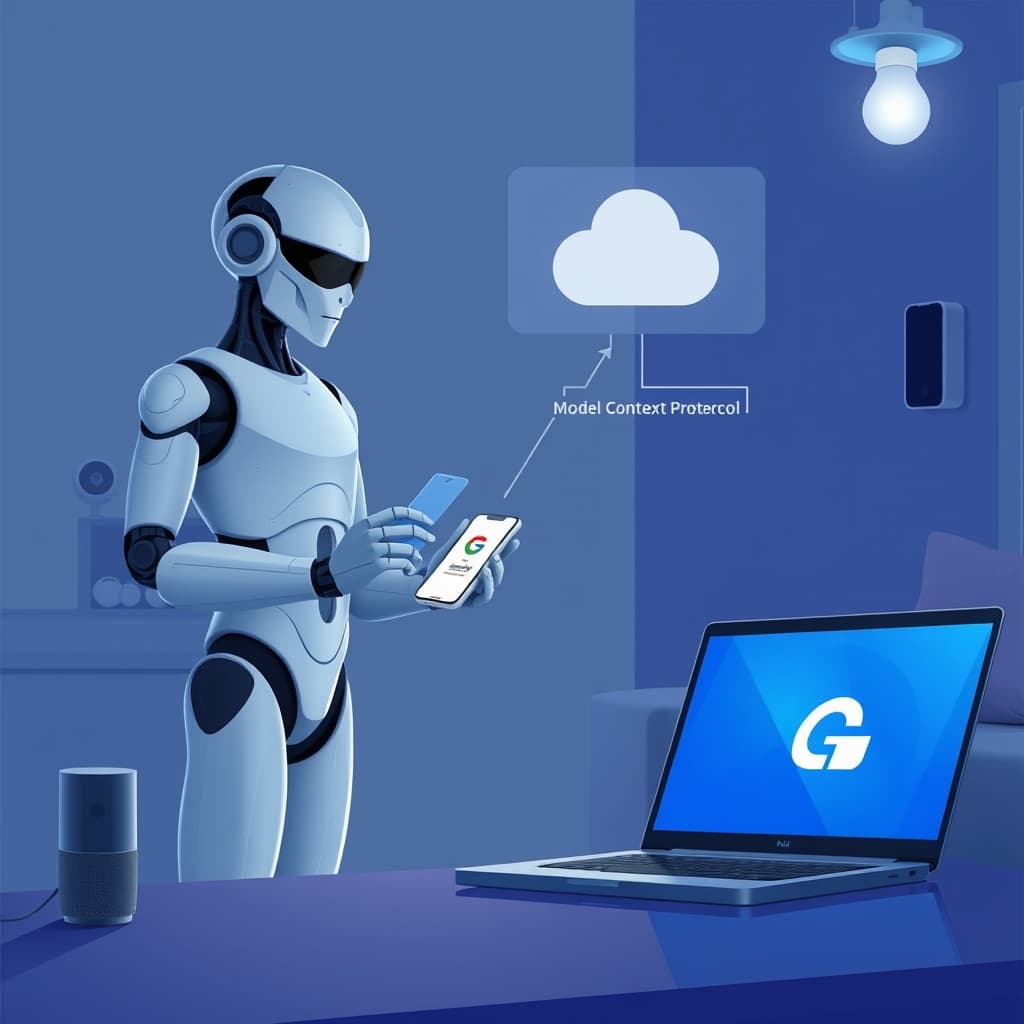
Google opens Model Context Protocol for AI agents to manage Google Home devices
What Google announced
Google began early‑access distribution of its Model Context Protocol (MCP) server for the Google Home ecosystem on Wednesday.
The MCP server will let any AI agent that supports the protocol interact securely with Google Home devices.
Agents already compatible include Claude, Hermes, OpenClaw, ChatGPT and Google Antigravity.
Users will be able to ask these agents to review camera summaries, monitor activity, control appliances and build custom dashboards.
How the Model Context Protocol enables AI agents
To link an agent, a user must first create a Google Cloud project and enable Home MCP within that project.
The user then supplies the MCP configuration details to the chosen AI agent.
The agent prompts the user to sign in and grant the necessary permissions for device access.
Once permission is granted, the agent can retrieve event history and issue commands across the entire Google Home device catalog.
The protocol covers native Google Nest hardware such as doorbells and thermostats.
It also supports “Works with Google Home” devices that comply with the Matter standard, including smart light bulbs.
Google has previously deployed MCP in its Cloud services, data platforms, developer tools and Workspace applications.
Extending MCP to smart‑home hardware aligns the protocol with consumer‑focused AI assistants.
Rollout, pricing and next steps
The rollout starts today and will continue over the next several weeks for U.S. subscribers of Google Home Premium Advanced.
Premium Advanced costs $20 per month and already offers longer video history, descriptive notifications, detailed alerts and searchable video archives.
Google has not confirmed whether MCP will become available to other subscription tiers or international markets.
A setup guide is being published in the Google Home Developer Center to assist early adopters.
Google is gathering feedback through its Smart Home for Developers Community during this early‑access phase.
The company noted that an earlier announcement mistakenly listed Tuesday as the rollout start, correcting it to Wednesday.
Developers who integrate MCP can create bespoke voice or text interfaces that leverage the full range of Google Home capabilities.
Consumers can expect more natural language interactions, reducing the need to remember specific device commands.
Security remains a focus, as MCP requires explicit user consent before any agent can control devices.
Industry observers see the move as part of a broader trend toward interoperable AI assistants across hardware ecosystems.
Future updates may expand MCP support to additional smart‑home standards beyond Matter.
For now, the combination of MCP and popular AI agents offers a concrete path for personalized home automation.
Users who wish to experiment can follow the step‑by‑step instructions on the developer site and monitor community forums for tips.
Google’s statement emphasizes that the early‑access phase is intended to refine the experience based on real‑world usage.
As more agents adopt MCP, the ecosystem could see a proliferation of custom smart‑home dashboards tailored to individual preferences.
Overall, the announcement bridges the gap between conversational AI and tangible device control within the Google Home platform.
Why This Matters
This digest was compiled from:
Share this digest
People Also Ask
- AI CEOs Unite to Demand Government Safeguards After Decades of Warning
Top AI CEOs, from OpenAI to X, joined decades‑old calls for regulation, signaling a unified push for government safeguards.
- Jensen Huang argues AI safety is an engineering issue, not a regulatory one
Nvidia CEO Jensen Huang says AI safety is an engineering issue, not a regulatory one, and argues market forces suffice to ensure safe products.
- OpenAI overtakes Anthropic in OpenRouter spending following Astra rollout
OpenAI’s premium Astra model led dollar spend while its low‑cost Luna model dominated token volume on OpenRouter, signaling a dual‑market strategy that now outpaces Anthropic.
Share your thoughts
Reactions, corrections, or insights — all welcome.