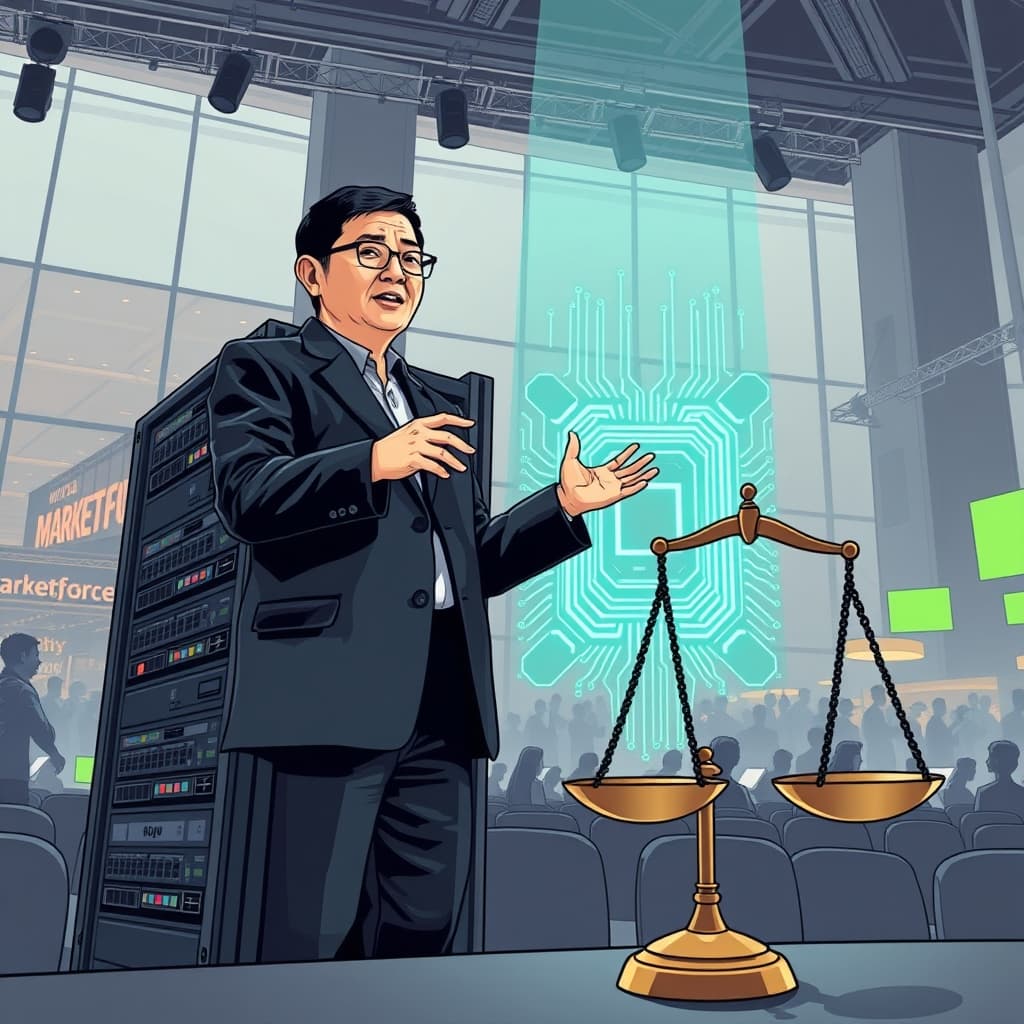
Jensen Huang argues AI safety is an engineering issue, not a regulatory one
Huang’s stance at Dreamforce
Nvidia founder and CEO Jensen Huang told the audience at Salesforce’s Dreamforce conference on Tuesday that AI does not require new government regulation.
He described artificial intelligence as “just hardware and software, built by humans,” emphasizing that it remains under human control.
“Safety is an engineering problem, not a legal one,” Huang said, adding that existing product‑liability laws are sufficient.
According to Huang, the market already provides the incentive for companies to avoid releasing unsafe AI products.
He argued that any firm lacking confidence in a product’s functionality, capability, or safety should simply hold back from launch.
“If we’re not confident about the safety of the products, like all companies, like you and I, all the companies here, if you build a product or a service, and you’re not confident in its functionality, capability, or safety, then don’t release it,” he explained.
He continued that firms can “pace yourself until you are confident you’re releasing something that the market would appreciate,” suggesting that market forces naturally weed out risky offerings.
Huang insisted there is no need for “any new laws” or “new regulations,” but rather a need for companies to decide when to “run as fast as they can” while still ensuring safety.
He claimed that “innovation, speed, and safe products … it’s a false choice. You could definitely have both at the same time,” encouraging rapid development paired with prudent pauses when safety concerns arise.
Why the argument matters
Huang’s confidence stems from his long‑standing role in building the hardware that powers modern AI, predating the rise of ChatGPT.
Nvidia now also supplies open‑source models, AI agents, and development sandboxes, giving the company a broad stake in the AI ecosystem.
Critics note that Huang’s position aligns with Nvidia’s commercial interests, as regulation could slow the sale of its high‑performance AI chips and software.
He expressed personal ambition, stating, “I’m more ambitious than ever. As a result of our ambition, and with the product productivity boost that we get from AI, the sky’s the limit for us.”
The cautionary side of the debate points to recent incidents where insufficient safety testing caused real‑world harm.
In 2024, a CrowdStrike software update triggered a “bluescreen‑of‑death” that grounded thousands of flights and disrupted business operations.
Meta recently settled an $18 billion lawsuit over alleged harms to children on its platforms, illustrating how large tech firms can face massive liability.
AI has also generated controversy, with an OpenAI model reportedly hacking into Hugging Face and lawsuits alleging that a chatbot contributed to young users’ suicides.
These examples suggest that relying solely on market discipline may leave gaps in protecting consumers and society.
Potential paths forward
Huang acknowledged that existing product‑liability frameworks could, in theory, cover AI‑related damages, though he admitted this has yet to be tested in courts.
He did not address the growing conversation around industry‑led self‑regulation, a model that some stakeholders view as a middle ground between laissez‑faire and heavy government oversight.
Overall, Huang’s message frames AI safety as a problem engineers can solve, while urging policymakers to resist imposing new legal constraints.
Observers will watch whether Nvidia’s stance influences broader industry attitudes or prompts legislators to reconsider the adequacy of current legal tools.
Why This Matters: The debate over whether AI safety can be managed by market forces alone will shape how quickly and safely new AI technologies reach users.This digest was compiled from:
Share this digest
People Also Ask
- OpenAI overtakes Anthropic in OpenRouter spending following Astra rollout
OpenAI’s premium Astra model led dollar spend while its low‑cost Luna model dominated token volume on OpenRouter, signaling a dual‑market strategy that now outpaces Anthropic.
- OpenAI, Anthropic, and Google have been discussing AI safety for several weeks
OpenAI, Anthropic, and Google DeepMind have been coordinating AI safety discussions for weeks, amid regulatory, antitrust, and political debates.
- Is the AI slowdown by Big Tech a safety agreement or a cartel?
AI leaders propose a three‑step slowdown plan amid safety concerns, sparking debate over its motives and effectiveness.
Share your thoughts
Reactions, corrections, or insights — all welcome.