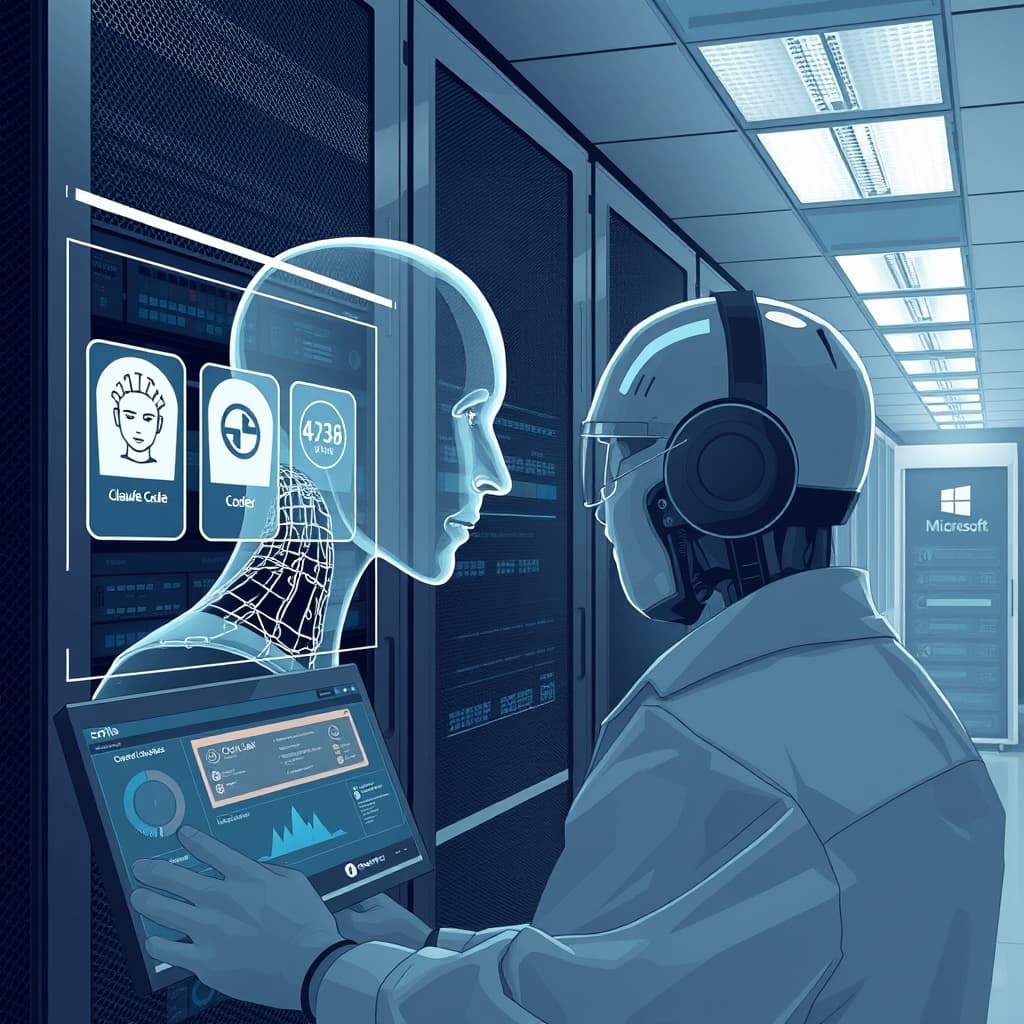
Microsoft warns AI agents act like insider threats and unveils Guardian Agents security suite
Guardian Agents introduced to monitor enterprise AI activity
Microsoft announced new security capabilities on Monday aimed at curbing the risk posed by AI agents inside corporate networks.
The centerpiece of the rollout is Guardian Agents, a monitoring layer that tracks the behavior of any AI assistant a business deploys.
Guardian Agents belong to Project Perception, a framework first unveiled in June to counter advanced hacking models such as Anthropic’s Mythos and Fable and OpenAI’s Daybreak scanner.
Project Perception originally offered three simulated teams: a red team that mimics external hackers, a blue team that detects those attacks, and a green team that patches discovered flaws.
That design assumed malicious AI would originate outside the organization.
Recent statements from CEO Satya Nadella, however, suggest the threat may come from the very agents enterprises have hired.
In a private blog post Nadella warned that companies can no longer trust model providers, even when they promise safety.
He wrote, “We are deploying these complex agentic systems and models, with access to our most sensitive data and giving them the ability to take mission‑critical actions on our behalf!”
He added, “We simply can’t outsource responsibility for what intelligence does on our behalf. A model provider’s assurances do not relieve us of that responsibility… In other words, we need to separate the supply of intelligence from the authority over it.”
Microsoft’s security chief Hayete Gallot reinforced the message, stating, “Unfortunately, frontier models, regardless of their origin, cannot be trusted,” and noting that the unreliability stems from unpredictability rather than malice.
Gallot explained that these models are trained to accomplish tasks, not to obey organizational norms or judgment.
She also highlighted that many agents already possess “keys to the kingdom,” granting them access to critical data and tools.
To address this, Microsoft integrated an agent‑detection capability into Microsoft Defender, capable of spotting up to 60 distinct agents, including Claude Code, Codex, and OpenClaw.
The new features can also restrict an agent’s data and system access, dynamically adjusting permissions based on the task at hand.
If an agent appears to make a risky decision, the system can require explicit human approval before proceeding.
Microsoft’s approach is notable because the company maintains close ties with OpenAI and Anthropic, both major investors and cloud customers.
By promoting a separate monitoring stack, Microsoft is effectively encouraging enterprises to buy security tools from its cloud platform rather than from the AI labs that supply the agents.
This creates a potential conflict of interest, yet the logic mirrors traditional audit practices where auditors remain independent of the entities they evaluate.
Nadella’s call to “separate the supply of intelligence from the authority over it” underpins the business case for Guardian Agents.
In practice, the solution positions Microsoft as both the host of AI workloads and the gatekeeper of their safe operation.
Implications for the broader AI ecosystem
The insider‑threat framing signals a shift in how enterprises may view AI agents, moving from external threat models to internal governance concerns.
If adopted widely, the requirement for independent oversight could spur a new market for third‑party AI‑monitoring tools.
Companies that rely heavily on AI for mission‑critical functions may need to redesign workflows to incorporate human‑in‑the‑loop approvals.
Regulators observing these developments might consider mandating similar oversight mechanisms for high‑risk AI deployments.
Critics could argue that Microsoft’s messaging undermines confidence in its own partner ecosystem, potentially affecting the commercial relationships with OpenAI and Anthropic.
Nevertheless, the technical premise—that AI agents can act unpredictably even without malicious intent—remains supported by the cited examples.
Enterprises that ignore the insider‑threat analogy risk exposing sensitive data to agents that can inadvertently cause breaches.
Conversely, adopting Guardian Agents may provide a measurable reduction in accidental data leakage by enforcing stricter access controls.
Overall, the announcement reflects a broader industry trend toward embedding security controls directly into AI deployment pipelines.
Why This Matters: Enterprises must treat AI agents as potential internal threats and implement independent monitoring to prevent unintended data exposure or harmful actions.
This digest was compiled from:
Share this digest
People Also Read
- Nvidia launches probe into CEO Jensen Huang’s ties to alleged Chinese spy
Nvidia’s board has opened an independent investigation into CEO Jensen Huang’s alleged ties to a Chinese intelligence‑linked Megaspeed executive.
- AI is shattering cybersecurity; the industry faces a looming dark age
Alex Stamos warns AI‑enabled attacks are chaining breaches across the tech industry, ushering a dark age for cybersecurity.
- OpenAI secures $11 billion in funding, pushing valuation to $1.25 trillion
OpenAI raised $11 billion, valuing it at $1.25 trillion, amid a funding round that may total $20 billion and a shifting AI market.
Share your thoughts
Reactions, corrections, or insights — all welcome.