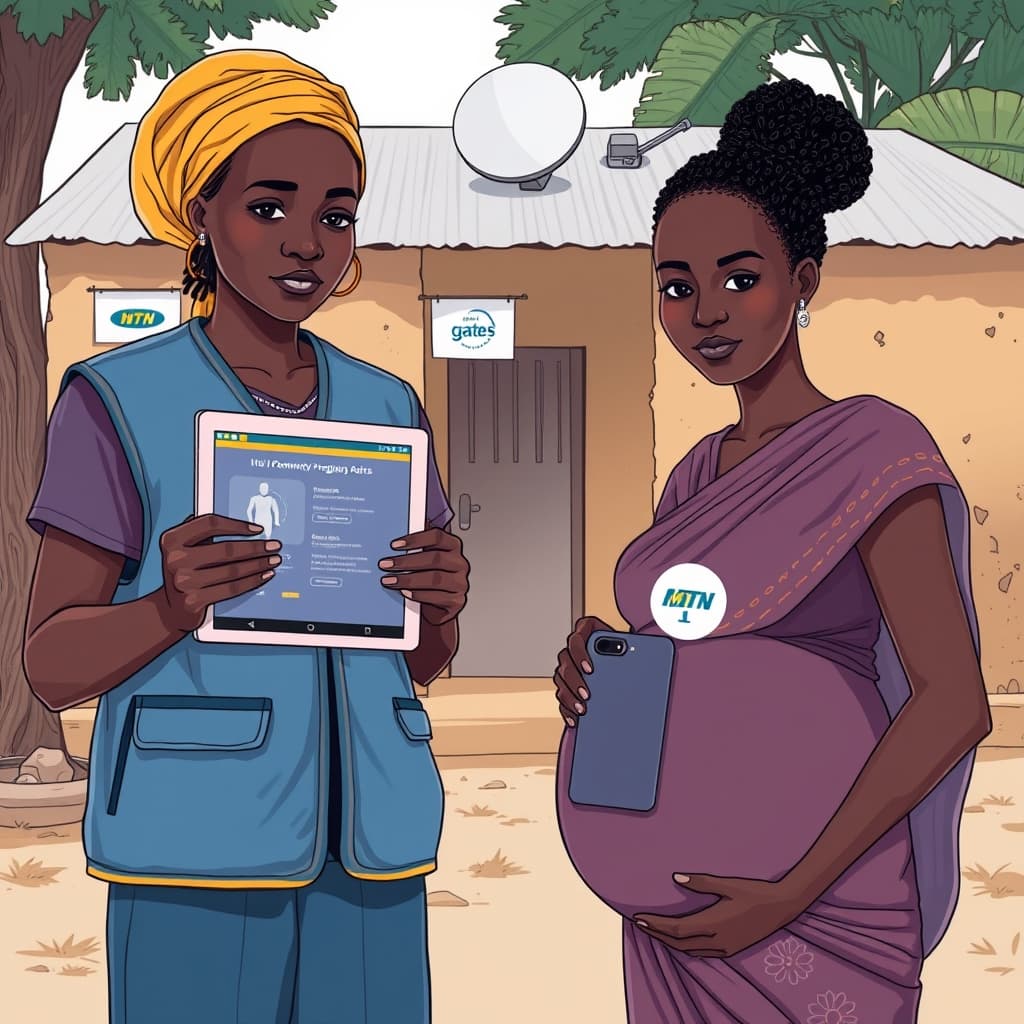
MTN Group Foundation and Gates Foundation unveil Nigeria Maternal Health Multiplier to broaden AI‑driven maternal care
Partnership launches a digital ecosystem for maternal health
MTN Group Foundation and the Gates Foundation announced a strategic partnership to create the Nigeria Maternal Health Multiplier, a first‑of‑its‑kind digital platform aimed at improving maternal health outcomes.
The initiative seeks to connect pregnant women, frontline health workers, and primary health‑care facilities through an integrated ecosystem.
By 2030 the programme targets 500,000 women, equips 5,000 frontline health workers with early‑warning tools, and supports 500 health facilities to deliver more consistent care.
Core components of the platform
The platform combines AI‑enabled, phone‑based decision‑support tools for both mothers and health workers, providing real‑time guidance on pregnancy complications.
It also supplies affordable smartphones and mobile data to pregnant women, removing cost barriers to accessing digital health services.
Improved connectivity at primary health‑care facilities ensures that care delivery does not depend on a woman’s geographic location.
These three pillars are designed to complement Nigeria’s existing maternal and child‑health reforms, particularly the Maternal and Neonatal Mortality Reduction Innovation Initiative (MAMII) under the Federal Ministry of Health.
Scale, context and expected impact
Globally, maternal deaths have fallen 40 % since 2000, yet progress has stalled and disparities remain stark.
In sub‑Saharan Africa a woman’s risk of dying in childbirth is roughly 250 times higher than in Western Europe.
Nigeria accounts for nearly 30 % of worldwide maternal deaths, making it a critical focus for intervention.
Only 59 % of Nigerian women complete four or more antenatal visits, leaving many warning signs undetected.
The Multiplier’s digital tools aim to raise that completion rate by delivering trusted health guidance directly to women’s phones.
Frontline health workers will receive connected devices that alert them to potential complications, enabling earlier referrals.
Health facilities will benefit from reliable internet access, allowing consistent use of the AI‑driven decision support across the care continuum.
“For too long, the biggest barrier to improving service delivery in Nigeria, whether in health, agriculture, or education, has not been a lack of innovations, but a lack of focus on the foundational systems necessary to drive adoption,” said Dr. Bosun Tijani, Nigeria’s minister of communications, innovation, and digital economy.
He added that partnerships like this “reflect the kind of collaboration we want to see more of in Nigeria—one that puts the country’s digital transformation to work for the people who need it most.”
Dr. Muhammad Ali Pate, Nigeria’s coordinating minister of health and social welfare, emphasized that strengthening primary health care and empowering frontline workers are central to health‑sector reforms.
He noted that “partnerships that work with our existing health systems, rather than around them, are exactly what’s needed to reach mothers who are still falling through the cracks.”
The four‑year partnership was unveiled at Semafor’s Next 3 Billion event during the 81st United Nations General Assembly session in New York.
It begins with an initial investment of approximately US$25 million between 2026 and 2030.
Through coordinated digital tools, affordable connectivity, and government alignment, the Multiplier seeks to reduce preventable maternal deaths in Nigeria’s underserved communities.
Why This Matters
This digest was compiled from:
Share this digest
People Also Ask
- Anthropic unveils Claude Opus 5.5 with enhanced cybersecurity safeguards
Anthropic’s Claude Opus 5.5 adds stronger sandbox safeguards, cuts operating costs by 40 percent, and aims to curb AI‑driven security breaches.
- Meta releases hotfix for Muse zero‑day that let attackers commandeer the AI assistant
Meta patched a zero‑day in its Muse macOS app that let local attackers hijack the AI assistant, highlighting security trade‑offs in cloud‑based AI agents.
- Six Generative AI Platforms Capable of Processing Nigerian Pidgin, Yoruba, Igbo, and Hausa
AI tools for Yoruba, Igbo, Hausa and Pidgin are emerging, but each has strengths and cultural limits that users must consider.
Share your thoughts
Reactions, corrections, or insights — all welcome.