NVIDIA and Meta broaden AI alliance to boost Muse models and agent capabilities
Expanding the Muse Ecosystem
Meta’s Muse family of models and associated AI agents have achieved frontier‑level benchmark results since their launch.
The models have attracted a rapidly growing user base across consumer and enterprise applications.
Both companies announced an expanded partnership aimed at accelerating development, deployment, and performance of Muse‑powered agents.
The collaboration focuses on improving inference speed and training efficiency for these agents.
“NVIDIA and @Meta will expand our partnership on @Muse models to improve inference and training performance. Together, we’re exploring NVIDIA OpenShell for safe AI agent deployment and NVIDIA Sentry for monitoring agent behavior.
Meta plans broader deployments of NVIDIA Vera… https://pic. twitter.
This tweet from NVIDIA’s newsroom underscores the joint intent to enhance safety, monitoring, and scalability of AI agents.
Deepening Infrastructure Collaboration
The partners will work across the entire AI workflow, from model training to real‑time inference.
NVIDIA’s computing platforms will be leveraged to increase efficiency, scalability, and cost‑effectiveness of Muse applications.
Key hardware components include the NVIDIA Vera Rubin architecture, designed for next‑generation AI workloads.
Meta plans to deploy NVIDIA Vera CPUs to support increasingly sophisticated reasoning models.
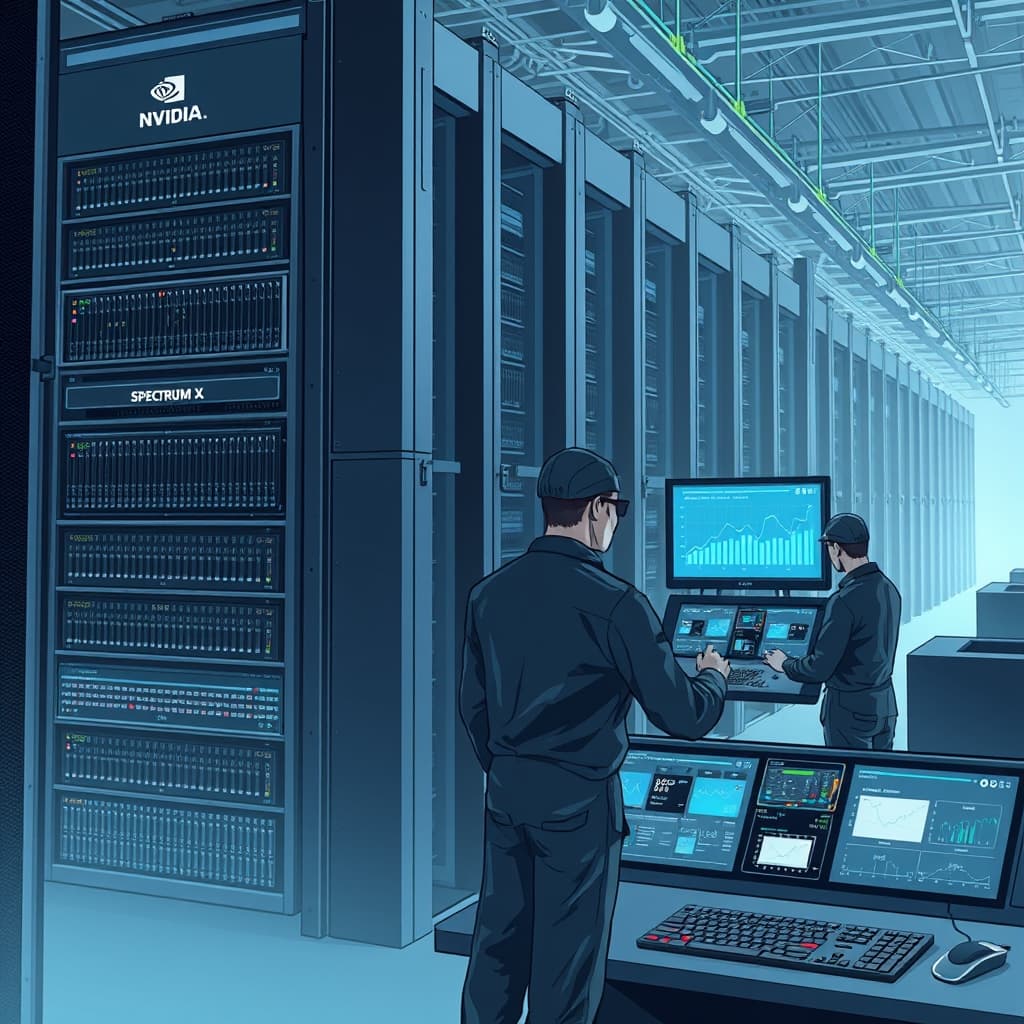
NVIDIA Spectrum‑X Ethernet networking will improve throughput and efficiency in large AI clusters.
BlueField‑4 data processing units will optimize data movement, networking, and security within Meta’s AI infrastructure.
By integrating these technologies, Meta aims to boost performance per watt, a critical metric as AI workloads grow more demanding.
The companies will also explore NVIDIA OpenShell™ as a reference architecture for secure agent deployment.
NVIDIA Sentry, a monitoring and governance platform, will be used to track agent behavior and ensure reliability.
The joint effort seeks to lower total cost of ownership while delivering advanced AI services to billions of users.
Strategic Investment and Future Outlook
In addition to the technical collaboration, NVIDIA announced a $3 billion equity investment in Meta.
The investment signals confidence in Meta’s long‑term AI strategy and the convergence of hardware and application providers.
Jensen Huang, founder and CEO of NVIDIA, stated that “AI Agents Represent the Next Computing Revolution.”
Huang’s comment highlights the view that intelligent agents will become a core computing paradigm.
Meta’s roadmap includes expanding NVIDIA hardware across its data centers to support future AI services.
The partnership positions both firms to meet rising demand for autonomous, capable digital assistants.
Industry observers note that the collaboration could set a benchmark for AI‑hardware alliances.
Future monitoring will focus on how effectively the joint technologies improve latency, energy use, and safety of AI agents.
Stakeholders will watch for broader deployments of Muse models powered by the new infrastructure.
The alliance demonstrates a deepening synergy between leading AI software developers and the hardware platforms that enable them.
Why This Matters: The $3 billion investment and hardware rollout give Meta the resources to scale Muse agents efficiently, directly influencing the availability of high‑performance AI assistants for billions of users.This digest was compiled from:
Share this digest
People Also Read
- Nvidia launches probe into CEO Jensen Huang’s ties to alleged Chinese spy
Nvidia’s board has opened an independent investigation into CEO Jensen Huang’s alleged ties to a Chinese intelligence‑linked Megaspeed executive.
- AI is shattering cybersecurity; the industry faces a looming dark age
Alex Stamos warns AI‑enabled attacks are chaining breaches across the tech industry, ushering a dark age for cybersecurity.
- OpenAI secures $11 billion in funding, pushing valuation to $1.25 trillion
OpenAI raised $11 billion, valuing it at $1.25 trillion, amid a funding round that may total $20 billion and a shifting AI market.
Share your thoughts
Reactions, corrections, or insights — all welcome.