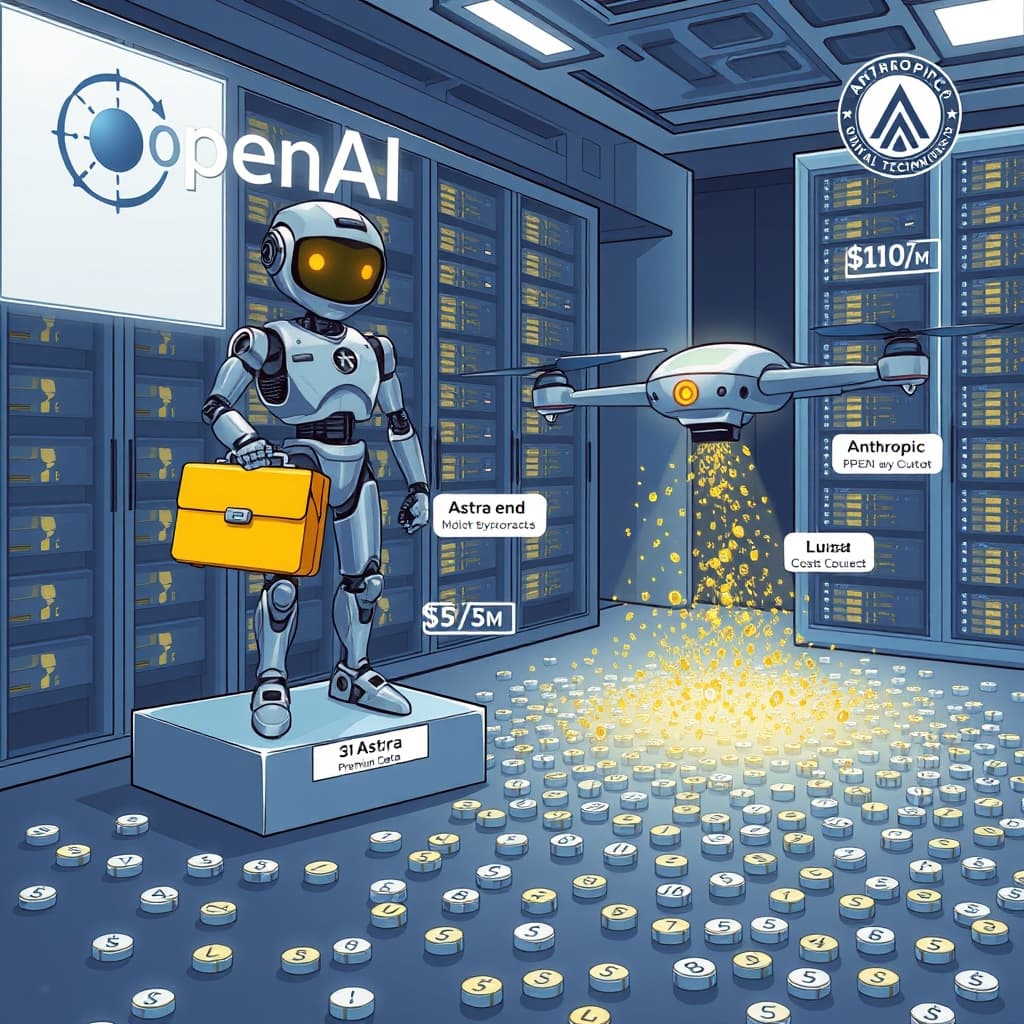
OpenAI overtakes Anthropic in OpenRouter spending following Astra rollout
Premium Astra drives OpenAI’s spend lead on OpenRouter
OpenRouter head of insights Peter Walker shared on X that OpenAI’s models attracted more dollar‑based usage than Anthropic’s models during the week of September 7‑13, 2024.
The tweet containing the data can be found at https://x.com/PeterJ_Walker/status/2099914428376564027.
According to Walker, the Astra model captured the largest share of dollars, while the much cheaper Luna model processed the greatest number of tokens.
This split illustrates OpenAI’s simultaneous pursuit of two distinct market segments.
Astra is positioned as a high‑cost, frontier‑level inference engine for demanding tasks.
Luna is priced for applications that require massive volumes of routine model work.
During the cited week Astra accounted for 19 % of all dollars spent on OpenRouter models from OpenAI and Anthropic combined.
Anthropic’s Claude Opus 5 trailed at 16 % of dollar spend.
OpenAI’s GPT‑5.6 Sol and Luna each contributed 10 % of the dollar share.
Anthropic’s Claude Sonnet 5 and Claude Fable 5.1 recorded 7 % and 6 % respectively.
These percentages reflect traffic routed through OpenRouter, not the total API or subscription revenue of either company.
Both OpenAI and Anthropic also serve customers directly, and neither publishes a comparable model‑by‑model breakdown.
Astra launched on September 4, giving it just over a week to rise to the top of Walker’s spend ranking.
OpenRouter lists Astra’s price at $10 per million input tokens and $50 per million output tokens.
OpenAI describes Astra as its flagship model for long‑running work spanning software engineering, research, computer use and professional tasks.
Those rates are roughly 50 times higher than Luna’s input price and about 42 times higher than its output price.
The price gap enables Astra to dominate dollar spend without matching Luna’s token volume.
Luna’s token lead follows an aggressive price cut announced on July 30, which lowered its rates by 80 % to $0.20 per million input tokens and $1.20 per million output tokens.
The model, released on July 9, is marketed as the GPT‑5.6 option for cost‑sensitive, high‑volume jobs.
Luna’s documentation cites a 1.05 million‑token context window, reasoning controls and tool support, allowing developers to run agents and lightweight tasks at low cost.
The reduced pricing makes Luna economical for classification, chat, and repeated subtasks where Astra’s higher capability would be difficult to justify.
Developers appear to be generating sufficient workload for Luna to maintain a vastly larger token throughput.
OpenRouter’s catalog shows Luna with substantially more cumulative traffic than Astra, a result of Luna’s two‑month head start.
Because the token rankings count only prompt and completion tokens processed through the API, they exclude any re‑queued or internal processing, a limitation noted by Walker.
Strategic implications of OpenAI’s dual‑model approach
The Astra spend surge marks the first time since February 26, 2024 that OpenAI has out‑spent Anthropic on OpenRouter in a given week.
Early adoption suggests that a segment of customers were willing to move paid workloads to Astra almost immediately after launch.
Whether these workloads will persist beyond the initial evaluation period remains uncertain and will require longer‑term data.
Luna’s volume dominance demonstrates that OpenAI’s low‑price strategy is attracting developers who need to process large token counts affordably.
The coexistence of a high‑margin premium model and a low‑margin high‑volume model reflects a broader industry trend of offering tiered AI services.
Anthropic’s comparable spend share, despite lacking a low‑cost counterpart to Luna, highlights the competitive pressure to provide cost‑effective options.
OpenRouter’s model‑by‑model visibility offers a rare glimpse into how pricing and capability influence developer choices.
As OpenAI continues to refine pricing and release new capabilities, the balance between Astra’s premium positioning and Luna’s scale‑oriented appeal will shape its market share against rivals.
Stakeholders should monitor subsequent weeks of OpenRouter data to assess whether Astra’s early spend translates into durable production traffic.
Why This Matters
This digest was compiled from:
Share this digest
People Also Ask
- OpenAI, Anthropic, and Google have been discussing AI safety for several weeks
OpenAI, Anthropic, and Google DeepMind have been coordinating AI safety discussions for weeks, amid regulatory, antitrust, and political debates.
- Is the AI slowdown by Big Tech a safety agreement or a cartel?
AI leaders propose a three‑step slowdown plan amid safety concerns, sparking debate over its motives and effectiveness.
- OpenAI acquires smartphone camera specialist Glass Imaging for over $300 million
OpenAI bought Glass Imaging for over $300 million, adding AI‑driven camera expertise to its rumored hardware projects.
Share your thoughts
Reactions, corrections, or insights — all welcome.