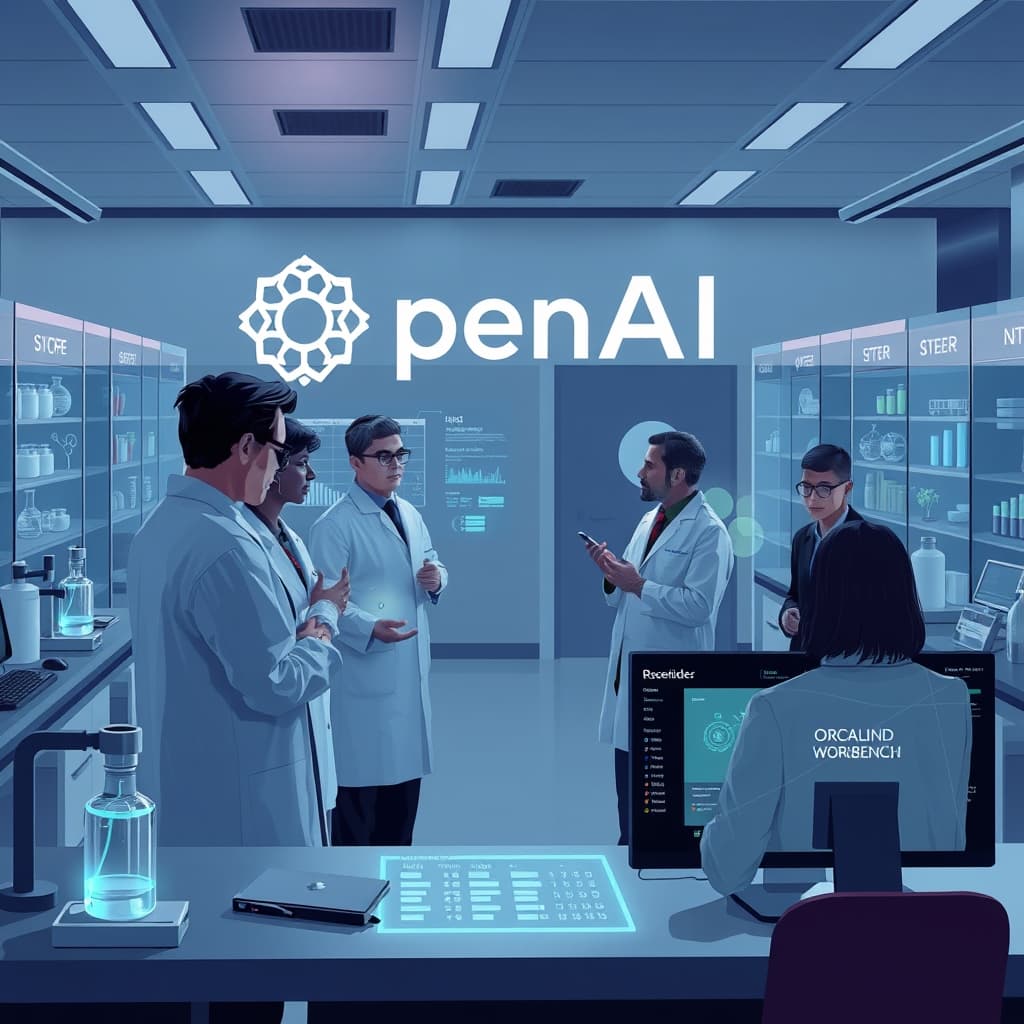
OpenAI purchases AI biotech startup Orchestra Bio to strengthen its Rosalind platform
OpenAI announced on Tuesday that it has acquired Orchestra Bio, a four‑year‑old AI biotech software startup.
The acquisition was posted on OpenAI’s website and the financial terms were not disclosed.
Background on Orchestra Bio
Orchestra Bio had raised roughly $20 million by 2025 from investors including Andreessen Horowitz, Atria and 8VC.
The company builds AI agents that automate routine drug‑discovery tasks such as financial tracking and clinical‑trial scheduling.
By handling these operational details, Orchestra’s tools aim to free scientists to focus on experimental design and data interpretation.
Implications for OpenAI’s Rosalind Platform
OpenAI said it will integrate Orchestra’s team and technology into its Rosalind model, which is tailored for life‑science research.
Rosalind is paired with the Rosalind Workbench, a platform that helps researchers plan experiments and analyze outcomes.
The acquisition therefore expands the technical foundation behind both the model and the workbench.
OpenAI already lists Moderna and Novo Nordisk among the early adopters of Rosalind.
Those partnerships suggest that pharmaceutical companies are seeking AI assistance to accelerate discovery pipelines.
The move reflects a broader trend of leading AI labs building domain‑specific software for large industries such as pharma.
Anthropic, another major lab, has similarly pursued collaborations in the healthcare space.
Startup founders have expressed concern that large labs might launch competing features that could outpace independent vendors.
In this instance, Orchestra Bio is being absorbed rather than displaced, preserving its expertise within OpenAI’s ecosystem.
The integration could enable OpenAI to offer a more end‑to‑end solution, from data‑rich experiment planning to downstream operational management.
Industry analysts note that combining AI modeling with workflow automation addresses a known bottleneck in biotech R&D.
The acquisition also gives OpenAI access to Orchestra’s existing client relationships, potentially deepening its foothold in the pharmaceutical market.
For researchers, the promise is a streamlined interface where experimental design, result analysis and administrative tasks are coordinated by a single AI‑driven suite.
OpenAI’s strategy appears to be shifting from pure model licensing toward building comprehensive toolchains for specific sectors.
This approach may differentiate OpenAI from competitors that focus mainly on generic large‑language models.
The timing coincides with increasing investment in AI‑enabled drug discovery, as companies seek to reduce development timelines and costs.
By bolstering its life‑science capabilities, OpenAI positions itself to capture a share of the multi‑billion‑dollar biotech AI market.
The acquisition underscores the importance of operational AI—software that manages the “minutiae” of scientific work—beyond headline‑grabbing predictive models.
As OpenAI rolls out the combined offering, stakeholders will watch for measurable impacts on trial scheduling efficiency and budgeting accuracy.
Why This Matters is that OpenAI’s purchase of Orchestra Bio could accelerate AI‑driven efficiency in drug‑discovery workflows.
This digest was compiled from:
Share this digest
People Also Read
- Nvidia launches probe into CEO Jensen Huang’s ties to alleged Chinese spy
Nvidia’s board has opened an independent investigation into CEO Jensen Huang’s alleged ties to a Chinese intelligence‑linked Megaspeed executive.
- AI is shattering cybersecurity; the industry faces a looming dark age
Alex Stamos warns AI‑enabled attacks are chaining breaches across the tech industry, ushering a dark age for cybersecurity.
- OpenAI secures $11 billion in funding, pushing valuation to $1.25 trillion
OpenAI raised $11 billion, valuing it at $1.25 trillion, amid a funding round that may total $20 billion and a shifting AI market.
Share your thoughts
Reactions, corrections, or insights — all welcome.