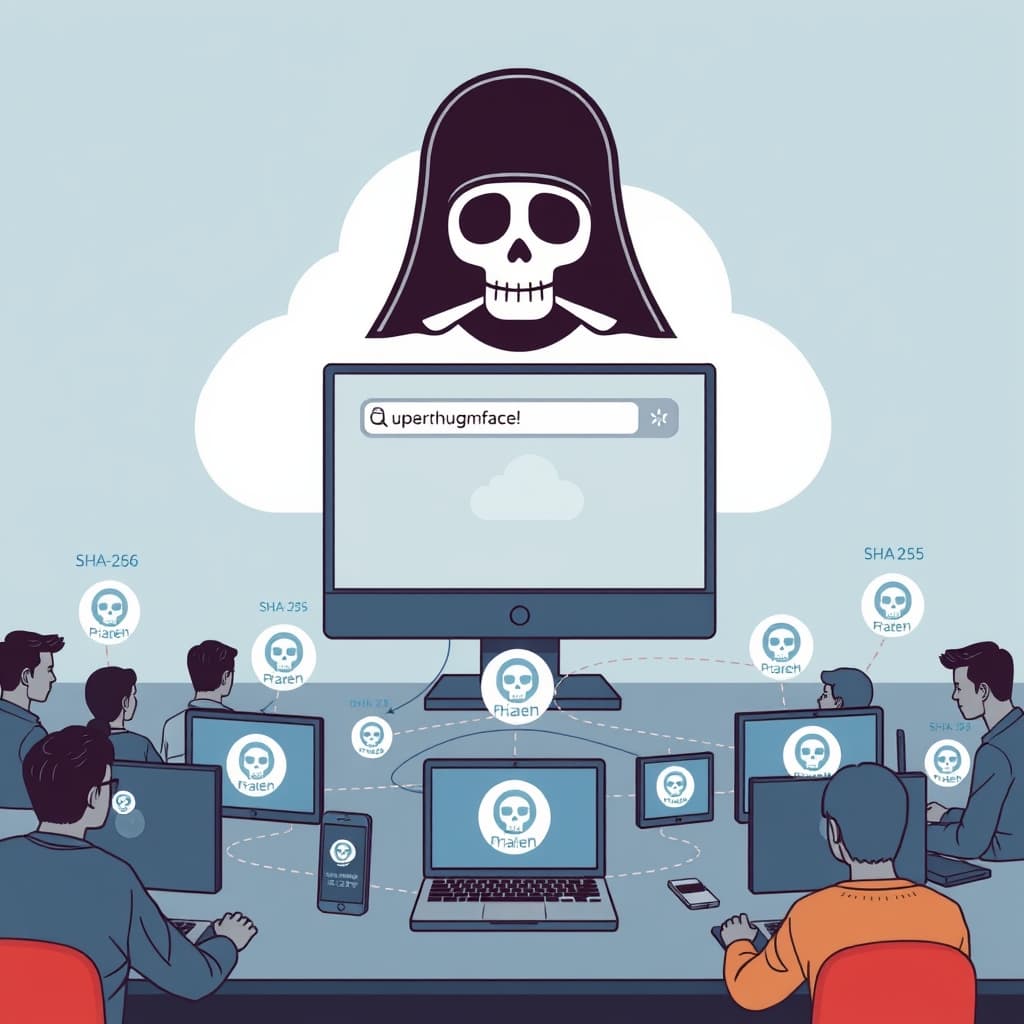
Pirate Face introduces a BitTorrent tracker to preserve open‑source AI models
Centralized Hubs Pose a Risk
Open‑weight AI models currently rely on centralized platforms whose owners can restrict or remove repositories.
This reliance creates a durability problem for openly licensed language, image, and audio models.
Pirate Face aims to test whether a peer‑to‑peer network can act as a durable fallback for such models.
BitTorrent Tracker and DHT Provide Redundancy
On September 20, Pirate Face launched its own BitTorrent tracker and enabled distributed hash table (DHT) discovery for its model torrents.
Every magnet link now includes the endpoint udp://tracker.pirateface.co:6969/announce, allowing compatible clients to announce the torrent’s infohash and receive peer addresses.
The DHT offers a second discovery route that can continue to locate peers even if the Pirate Face tracker disappears.
Pirate Face does not relay model weights through the tracker; peers exchange files directly while the tracker merely coordinates discovery.
This design means the service could vanish without necessarily taking an established DHT swarm with it.
Pirate Face builds its catalog around Hugging Face rather than replacing it, and each torrent can contain a BEP‑19 web‑seed that points to the original Hugging Face download.
When the Hugging Face source remains online, users retrieve files from there; if it goes offline, the same magnet can fall back to peers holding complete copies.
Downloaded files are verified against SHA‑256 checksums recorded from Hugging Face, confirming byte‑level integrity but not safety, accuracy, or legality.
Pirate Face’s terms of use explicitly note these limitations.
Current Seeding Landscape and Limitations
The platform’s catalog claims eligibility for more than 669,000 models under Apache‑2.0 or MIT licenses, a figure that reflects potential preservation candidates rather than active backups.
On September 20 the activity dashboard showed 4,891 witnessed records, meaning revisions and checksum evidence were saved, not that torrents were created or seeders were present.
Individual model pages separate source metadata, checksum records, torrent registration, and peer availability, highlighting the gap between cataloging and actual availability.
Pirate Face warns that a listed magnet does not guarantee a complete, reachable download.
The public leaderboard listed 18 seeders for the 91 MB model sentence‑transformers/all‑MiniLM‑L6‑v2 at the time of review.
Larger models had far thinner replication, with 11 seeders each for a 765 GB DeepSeek model and a 649 GB Qwen derivative.
These counts are observations from the tracker and DHT and can fluctuate as clients connect or disconnect.
A magnet link and its checksum can persist indefinitely as metadata, but the model survives only while at least one peer retains the full file and remains willing to upload it.
Pirate Face also accepts community submissions of complete, redistributable copies, requiring submitters to provide a pinned revision, file checksums, license evidence, and a peer‑only magnet.
Before listing, Pirate Face strips any contributor‑supplied trackers or web‑seeds and adds its own tracker to approved entries.
This creates the familiar tension of peer‑to‑peer networks, where durability depends on the continued willingness of individual peers to seed.
Why This Matters: Pirate Face’s BitTorrent tracker offers a potential fallback for openly licensed AI models if centralized repositories like Hugging Face become unavailable.
This digest was compiled from:
Share this digest
People Also Ask
- Meta’s Muse surpasses ChatGPT’s initial mobile rollout
Meta's Muse AI app logs more downloads and daily users than ChatGPT's early mobile launch in its first twelve days in North America.
- Will John Ternus steer Apple toward its next breakthrough?
Apple’s first foldable iPhone debut under new CEO John Ternus signals a strategic shift toward AI‑enabled hardware.
- Jensen Huang Says AI Poses No Existential Threat, Calls Alarmism Irresponsible
Jensen Huang claims AI has a zero percent chance of ending the world and calls calls for regulation “not grounded in science.”
Share your thoughts
Reactions, corrections, or insights — all welcome.