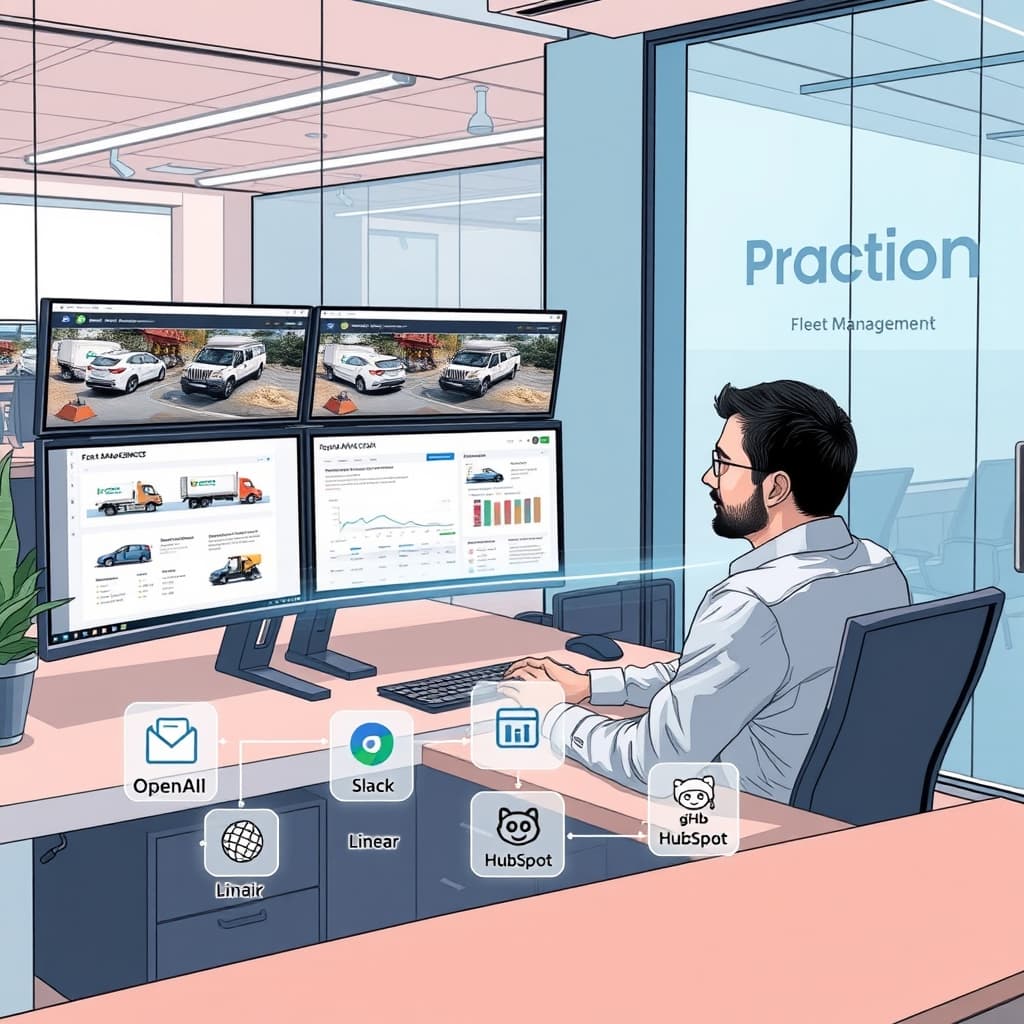
Proaction lifts sales by 60% and cuts over 75 hours of work using Codex
In fleet‑management software, convincing prospects often hinges on showing a solution that mirrors their own vehicles and workflows.
Proaction, a North‑American startup that builds platforms for managing cars, trucks, and construction machinery, faced a bottleneck in delivering such personalized demos.
Because each fleet operates differently, the sales team needed custom interactive demos for every interested prospect.
Codex Enables Non‑Engineers to Build Demos
Founders originally relied on conversations and slide decks because engineering capacity was insufficient for one‑off demos.
“As a non‑technical person, I used to have to loop engineers in if I wanted a demo,” says Colin Knudsen, co‑founder and COO of Proaction.
“Now I do it myself in Codex.”
Codex, an OpenAI model, let Colin generate a functional HTML demo environment without writing code.
He now creates four to six customized demos each month, spending only 30 to 45 minutes per demo.
He estimates that this workflow avoids 40 to 60 engineering hours per month.
By contrast, Proaction’s engineers would need roughly ten hours to build a comparable demo.
Saving 40–60 hours translates to more than 33 founder‑hours freed each month, according to the company’s reported results.
Impact on Sales and Operations
Using Codex‑generated demos, the percentage of deals that move from initial contact into solution development has risen by 50 % to 60 %.
The company also reports a 60 % increase in overall sales after adopting the Codex workflow.
After a sales call, Colin feeds Codex with the Granola recording, prospect email threads, and any shared spreadsheets.
Codex then assembles an HTML demo that mirrors the prospect’s fleet, displaying their specific cars, trucks, or equipment.
Prospects can point to elements that need adjustment, effectively co‑creating the final solution without engineering involvement.
“You work together to generate the end solution without getting engineering involved at all,” Colin says.
When a prospect converts to a customer, the customized demo serves as a visual reference that reduces back‑and‑forth questions for engineers.
Engineers receive a concrete picture of the required features, lowering the time spent clarifying requirements.
Codex also powered a customer solution center where prospects log in to explore tailored workflows and review sales material.
This portal empowers non‑technical team members to translate conversations into clearer product specifications.
Colin’s daily responsibilities now span sales, customer support, and product management, all coordinated through Codex plugins.
Integrations include Granola, Gmail, Slack, Linear, GitHub, and HubSpot, allowing him to pull call transcripts and email histories directly into the workflow.
He uses Codex to create Linear issues, update HubSpot opportunities, and schedule automations that review recent calls and draft sales updates.
Previously, Colin had to switch between multiple tabs and manually copy information, a process that consumed significant time.
Now he can describe the desired outcome in natural language and let Codex gather context and execute the next step.
This consolidation of tools and data streams accelerates follow‑ups and keeps the sales pipeline moving efficiently.
Overall, Codex has become a central hub that bridges sales conversations, technical requirements, and product delivery for Proaction.
Why This Matters
This digest was compiled from:
Share this digest
People Also Read
- Enhancing Private AI Compute via Secure Server‑Side Memory
Google DeepMind adds secure server‑side memory to Private AI Compute, enabling encrypted, cross‑device AI context while keeping data under user control.
- Google adds Gemini 3.8 Flash and Flash‑Lite text‑to‑speech models
Google adds Gemini 3.8 Flash and Flash‑Lite TTS models, delivering expressive custom voices, scalable audio generation, and built‑in safety tools.
- Parallel Halves Research Time and Cost Using GPT‑6 Astra
Parallel cut research time and cost by 50% using OpenAI’s GPT‑6 Astra, enabling faster, cheaper web‑grounded AI agents.
Share your thoughts
Reactions, corrections, or insights — all welcome.