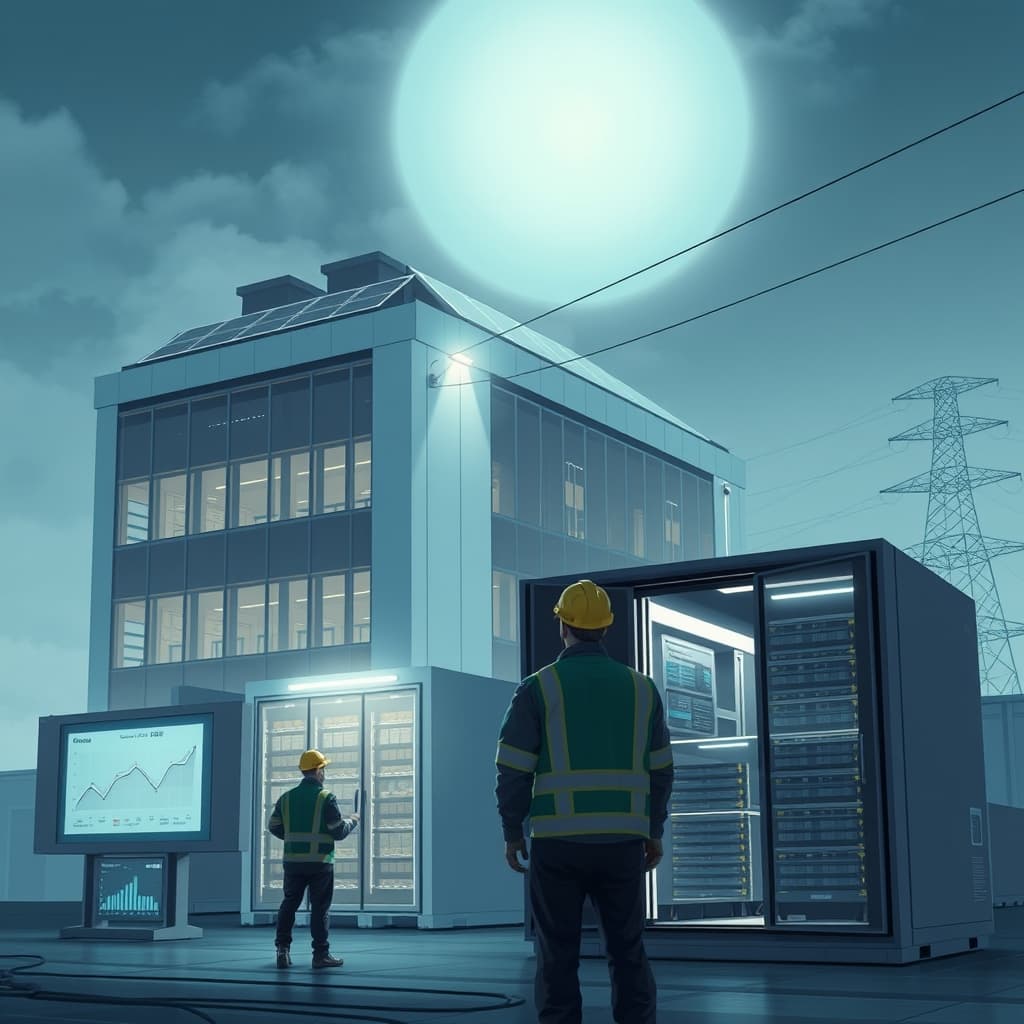
Rising Power Needs Are Redefining Data‑Centre Investment Strategies
Power Demand Redefines Data‑Centre Planning
For decades data‑centre developers prioritized site selection, customer contracts and hardware deployment.
Today artificial‑intelligence training clusters and high‑density GPU racks are consuming far more electricity than traditional enterprise workloads.
Because AI workloads can double or triple the power draw of a typical rack, reliable electricity has become a decisive factor in where new facilities can be built.
At the same time, delays in securing grid connections are slowing the rollout of fresh capacity.
These twin pressures are moving power generation, storage and intelligent management from secondary concerns to core elements of infrastructure planning.
Polaris Market Research valued the global data‑centre power and energy‑management market at US$35.95 billion in 2025.
The firm projects the market will reach US$107.06 billion by 2034, implying a compound annual growth rate of 12.9 percent.
This growth reflects a broader shift in digital‑infrastructure economics, where securing and controlling electricity rivals the importance of deploying compute.
Developers now often design facilities around electricity availability before finalising computing specifications.
Traditional distribution systems may lack the capacity to feed ultra‑dense GPU racks without upgrades to uninterruptible power supplies, switchgear and rack‑level power distribution units.
Advanced monitoring tools are also gaining prominence as operators seek to avoid overloads, balance demand and keep expensive AI hardware productive.
Emerging On‑Site Generation Strategies
When utility connections lag, operators are turning to gas‑powered generators, solar farms, fuel cells, battery storage and microgrids.
These on‑site solutions can act as backup, supplement grid power or, in some cases, serve as the primary source while awaiting utility upgrades.
The role of on‑site generation is therefore shifting from pure redundancy to a strategic component of capacity planning.
Polaris forecasts that energy‑generation solutions will be the fastest‑growing segment of the market, expanding at a 13.5 percent CAGR through 2034.
Battery storage is expected to smooth the sharp demand spikes typical of AI training cycles.
Microgrid controllers can coordinate multiple sources, allowing operators to switch between solar, fuel cells and grid power as conditions change.
Fuel‑cell adoption depends on local fuel availability, cost structures and site‑specific power requirements.
Despite these alternatives, grid infrastructure remains essential because the commercial viability of on‑site solutions hinges on electricity pricing and reliability.
Market Outlook and Investment Implications
The rising importance of power architecture creates new opportunities for equipment manufacturers and energy‑management software firms.
At the same time, the need to future‑proof power distribution adds cost and complexity to data‑centre projects.
Investors must now evaluate generation options, storage capacity and distribution design alongside traditional metrics such as latency and compute density.
Failure to address power constraints early can lead to expensive retrofits or delayed commissioning.
Conversely, operators that embed flexible power solutions can accelerate time‑to‑market for AI‑intensive services.
Overall, the data‑centre ecosystem is evolving from a compute‑first mindset to a balanced approach where electricity supply is a strategic asset.
Why This Matters: securing reliable, controllable electricity has become as decisive as computing power for data‑centre viability, shaping where and how new AI‑driven facilities are built.
This digest was compiled from:
Share this digest
People Also Read
- Nvidia launches probe into CEO Jensen Huang’s ties to alleged Chinese spy
Nvidia’s board has opened an independent investigation into CEO Jensen Huang’s alleged ties to a Chinese intelligence‑linked Megaspeed executive.
- AI is shattering cybersecurity; the industry faces a looming dark age
Alex Stamos warns AI‑enabled attacks are chaining breaches across the tech industry, ushering a dark age for cybersecurity.
- OpenAI secures $11 billion in funding, pushing valuation to $1.25 trillion
OpenAI raised $11 billion, valuing it at $1.25 trillion, amid a funding round that may total $20 billion and a shifting AI market.
Share your thoughts
Reactions, corrections, or insights — all welcome.