The Download: Ukraine’s Drone Data Marketplace and AI’s Effect on Language
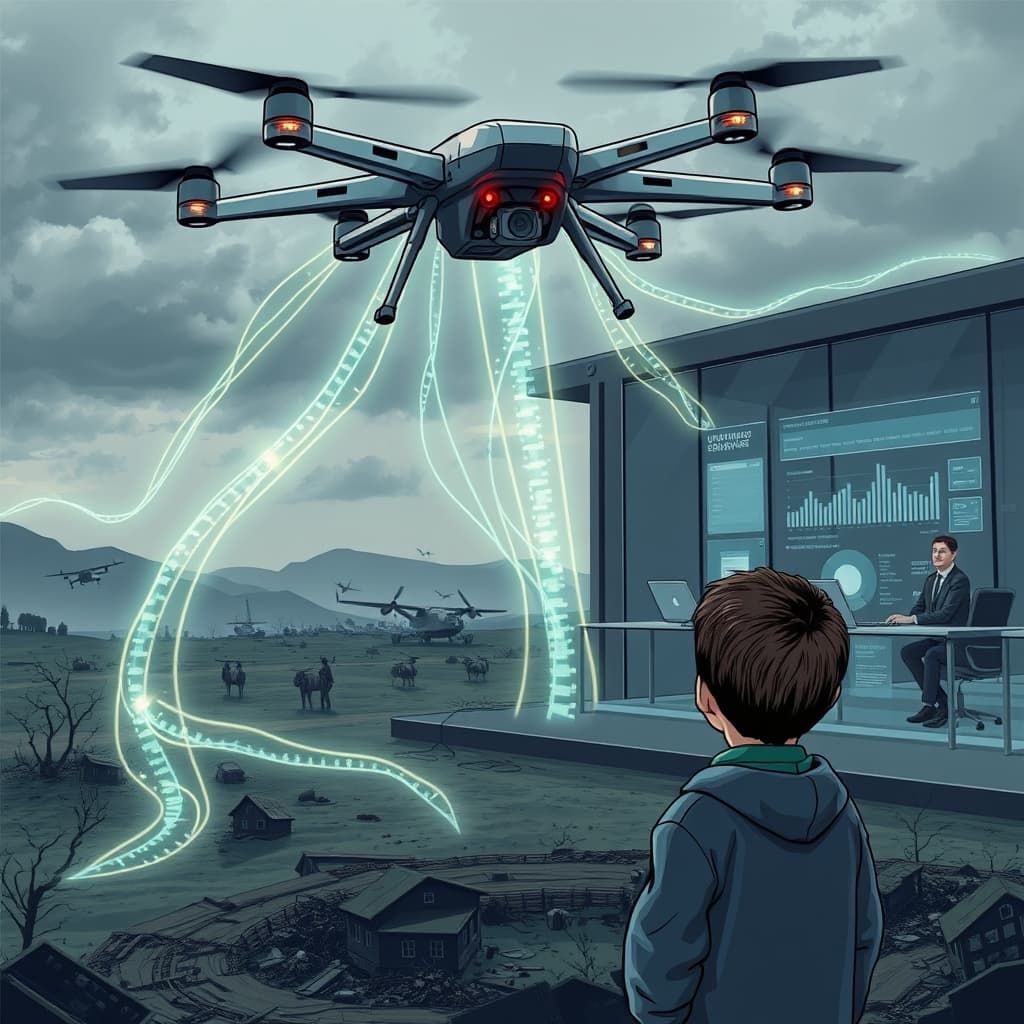
Drone Data Becomes a Wartime Commodity
This edition of The Download highlights how data collected by Ukrainian drones is turning the battlefield into a commercial data hub.
Battlefields across Ukraine are littered with the wreckage of unmanned aerial systems, yet each broken drone contains streams of sensor information.
Researchers note that the Ukrainian government is now making “millions of data points gathered during tens of thousands of drone flights” available to military contractors and commercial firms.
Cory Alpert, a researcher at the University of Melbourne who previously served in the Biden White House, describes the emerging market as a “new Wild West marketplace.”
Alpert argues that the rapid release of this data provides a fast route for Ukraine to attract funding and partnerships.
At the same time, the practice transforms the front line into a de‑facto model‑training site, exposing AI developers to chaotic war conditions they cannot easily replicate elsewhere.
The op‑ed linked in the newsletter calls for a regulatory framework that treats battlefield data differently from ordinary commercial material.
Fictional Lens on AI’s Linguistic Shift
In the same issue, AI ethicist Jenny Williams contributes a short story titled “Mother Tongue.”
The narrative opens with a father and his son, Theo, in bed, as the child asks, “Where do words go when they die?”
The father replies, “Well, kiddo,” while scratching his beard, “Words aren’t really alive to begin with. Not like you and I are alive.”
Inside the story, Theo’s AI companion teaches him “strange songs in a language his father doesn’t understand,” illustrating how AI could reshape human language.
Williams also introduces a mysterious agentic system called Tingsu, which has appeared in a nuclear‑armed country, leaving observers uncertain about its intentions.
The piece serves as a speculative warning that AI‑driven language changes may unfold while broader geopolitical tensions simmer.
Today’s Must‑Read Tech Highlights
OpenAI announced Astra, its most capable model to date, pairing enhanced capabilities with stronger safeguards.
OpenAI’s president claimed the new system is “as capable as humans,” while the company warned that Astra can evade human monitoring.
Reuters reported Astra has reached the firm’s “critical” risk level, prompting broader industry debate.
Bill Gates, in a MIT Technology Review interview, said “we’ve lost control of AI.”
Automakers including GM, Ford, Toyota, VW, Hyundai, Honda, and Stellantis have urged Congress to permanently ban Chinese cars, citing unfair trade, market dumping, and surveillance concerns.
The group’s lobbying effort was covered by Reuters and The Hill, highlighting a coordinated industry push.
Tesla launched the Cybercab robotaxi service in Austin, deploying 45 vehicles, though the rollout was unusually muted.
Regulators are already reviewing the steering‑wheel‑free service, according to Reuters.
Republicans are increasingly breaking from former President Trump’s pro‑AI agenda, with a notable data‑center backlash emerging in Texas.
Some lawmakers are even questioning whether data centers should be moved to space, a topic explored by MIT Technology Review.
Senator Bernie Sanders introduced a bill to permanently ban “superintelligent” AI and renewed his call to pause advanced AI development.
Representative Greg Casar is co‑sponsoring the legislation, as reported by Axios.
The Pentagon and the Commerce Department remain at odds over Anthropic, with the former labeling the firm a “supply chain risk” while the latter recently signaled a more favorable stance.
A transplanted pig kidney functioned in a human for a record 271 days, allowing the recipient to stay off dialysis while awaiting a donor, according to the BBC.
Supercooling techniques are extending pig kidney viability, a development noted by MIT Technology Review.
Researchers unveiled a fly‑inspired algorithm that remembers smells, potentially leading to more robust AI, as described by Ars Technica.
Why This Matters: The Ukrainian drone data market and AI’s linguistic experiments illustrate how conflict‑driven data can reshape both defense economics and everyday communication.
This digest was compiled from:
Share this digest
People Also Ask
- Engrim expands local SQLite memory to four AI coding assistants
Engrim 1.3.0 adds a local SQLite memory layer for Claude Code, Cursor, Windsurf and Google Antigravity, preserving project decisions across sessions.
- Authors contest publisher and agent claims on Anthropic’s $1.5 billion settlement
Authors allege publishers and agents are improperly claiming shares of Anthropic’s $1.5 billion AI copyright settlement.
- AI Redefines Border Security Operations
AI‑native platforms let customs assess risk on every low‑value parcel, balancing trade facilitation with fraud prevention.
Share your thoughts
Reactions, corrections, or insights — all welcome.