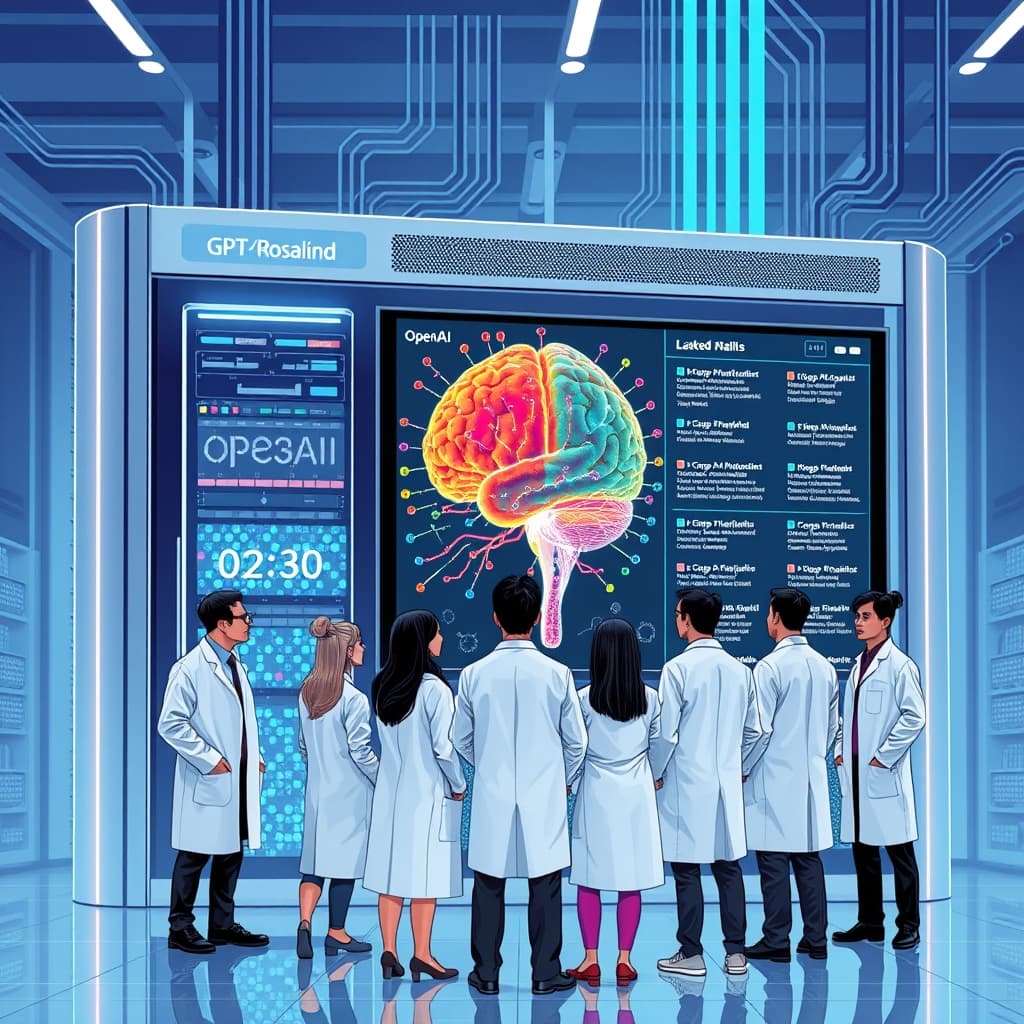
Thousands of AI agents deployed to discover fresh insights in biological datasets
OpenAI, PerturbAI and Scripps Research teamed up to run thousands of AI agents on a massive mouse‑brain CRISPR dataset.
The agents, powered by the GPT‑Rosalind model, each examined a single gene disruption, interpreted cellular responses and searched the scientific literature.
All agents worked in parallel, completing the entire analysis of millions of brain cells in just 32 minutes.
Distributed Biological Reasoning at Scale
The approach, called distributed biological reasoning, turned a problem that would normally require months of manual work into a matter of minutes.
Each AI instance generated a report linking a perturbed gene to observed cellular effects, relevant publications and hypothesised mechanisms.
These individual reports were then merged into a comprehensive reasoning atlas that maps genes, cellular outcomes, literature references and possible biological pathways.
Speed and Depth of AI‑Driven Analysis
Researchers estimated that a comparable human‑only effort, tackling one perturbation at a time, would take anywhere from several months to a full year.
Despite the rapid pace, the AI agents reproduced the key findings that human experts had previously identified.
In addition, the agents surfaced novel leads that had not been highlighted in earlier human analyses.
Blind assessments by independent experts judged the agents’ novelty and scientific value to be on par with human judgments.
New Biological Leads and Their Implications
Among the unexpected connections, the AI agents highlighted distinct effects of two disease‑linked genes on different brain‑cell types.
They also suggested a possible link between cholesterol regulation and neurodegeneration, a hypothesis that bridges metabolic and neurological research.
“Sometimes the clues are already there, scattered across different fields—we just haven’t connected them. The possible link between neuronal function and cholesterol metabolism shows how those pieces, once brought together, can give us a new way to think about disease biology,” said Tomasz Nowakowski, Ph.D., associate professor of neurological surgery at UCSF.
Sarah Teichmann, Ph.D., chair in Stem Cell Medicine at the University of Cambridge and co‑chair of the Human Cell Atlas, added, “We build cell atlases so that other scientists can make discoveries we haven’t imagined yet. AI could help more researchers explore these resources and turn unexpected observations into new questions to test.”
The reasoning atlas produced by the project is publicly available, allowing scientists worldwide to compare related genes and plan follow‑up experiments.
By automating the integration of large‑scale perturbation data with decades of literature, the collaboration demonstrates how AI can expand the exploratory reach of biological research.
Why This Matters: The ability to generate a detailed reasoning atlas in minutes gives neuro‑degenerative researchers a rapid tool for hypothesis generation and prioritisation, potentially accelerating the path to new treatments.
This digest was compiled from:
Share this digest
People Also Read
- Google unveils TPU 8tx and 8i Max for secure inference and large context
Google adds two new TPUs—8tx for encrypted inference and 8i Max for massive context windows—targeting secure, agentic AI workloads.
- Establishing a higher benchmark for accountable AI infrastructure
Why U.S. Compute Capacity Matters The promise of artificial intelligence is to give individuals more power over their o...
- OpenAI launches Daybreak Red on AWS GovCloud (US‑East)
OpenAI’s Daybreak Red, featuring GPT‑5.6 Cyber, is now usable by approved users in AWS GovCloud (US‑East) for secure government cybersecurity work.
Share your thoughts
Reactions, corrections, or insights — all welcome.