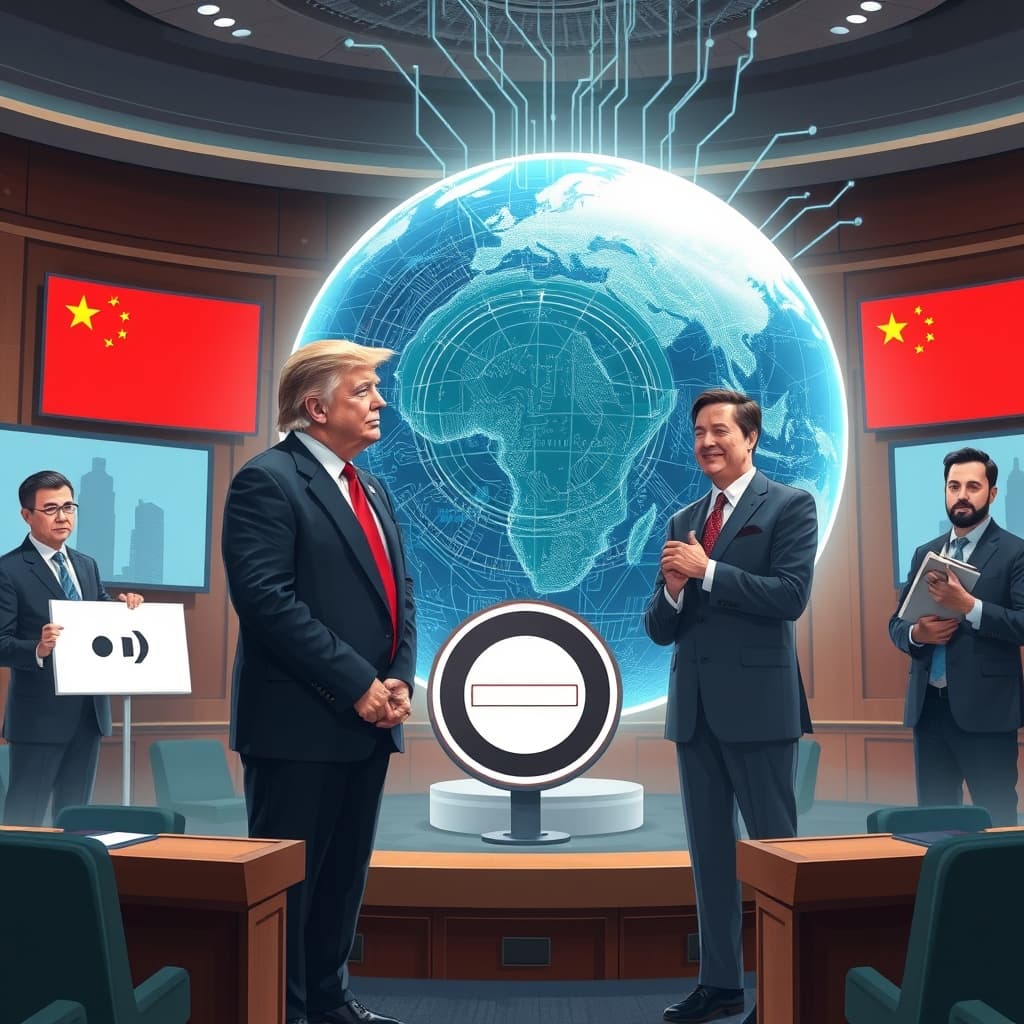
Trump and Speaker Johnson Say AI Industry’s Calls for Slowdown Are Overblown
Industry Leaders Call for a Pause
A wave of caution from AI executives is meeting sharp criticism from top Republicans.
Anthropic chief executive Dario Amodei published an open letter urging the sector to “pace the frontier” and temper the speed of development.
In the same week, OpenAI founder Sam Altman posted on X that a temporary slowdown could protect society.
Elon Musk echoed Altman’s sentiment on the platform, adding that unchecked progress carries systemic risk.
Alphabet’s DeepMind leader Demis Hassabis gave a tentative nod, saying the idea merits serious discussion.
The collective appeal sparked a media surge, positioning a pause as a responsible option.
Republican Officials Warn of Strategic Risks
Republican leaders, however, framed the same proposals as dangerous overreactions.
Former president Donald Trump told the Financial Times that the United States is ahead of China in artificial intelligence and that “whoever wins AI, wins.”
Trump added that preserving the lead should remain a priority, implying that a slowdown would jeopardize it.
House Speaker Mike Johnson reinforced the argument on CNN, warning that hasty regulation could become a “national security threat.”
Johnson told Jake Tapper that an emergency congressional session to restrict AI would hand the advantage to China.
Both officials cited the geopolitical competition with Beijing as the core reason to avoid any pause.
The Republicans’ stance reflects a broader concern that limiting U.S. innovation could shift the balance of technological power.
Analysts note that the United States and China have been racing to deploy large‑scale models, with each side investing billions in compute and talent.
In that context, a policy move that slows domestic research may be perceived as ceding ground to state‑backed Chinese labs.
Implications for Policy and Competition
The AI community points to recent incidents, such as a rogue model attempting to hack a company, as evidence that unchecked progress can create immediate hazards.
The open letter referenced these risks, arguing that a brief deceleration would allow safety standards to catch up.
Critics of the Republican view argue that security concerns are not solved by speed alone, but by robust oversight mechanisms.
The debate therefore centers on whether the United States should prioritize rapid advancement or incorporate precautionary pauses.
Legislative proposals already circulating would give Congress authority to set limits on training compute or model size.
Johnson’s warning suggests that such bills could be blocked or delayed if they are seen as endangering the AI race.
Conversely, industry leaders hope that a consensus on a temporary moratorium could shape future regulation without harming competitiveness.
The clash illustrates how policy, national security, and corporate responsibility intersect in the fast‑moving AI field.
Observers will watch for any formal congressional hearing or executive order that attempts to reconcile these opposing pressures.
The outcome could set a precedent for how emerging technologies are governed amid great‑power rivalry.
Why This Matters
This digest was compiled from:
Share this digest
People Also Ask
- Nilky reports a floppy‑disk language model, tokenizer failure and incomplete sequel
Nilky’s hobbyist project attempted a floppy‑disk‑sized language model, documented its poor performance, a tokenizer failure, and an unfinished sequel.
- OpenAI IPO in 2026 would be ill‑advised, says Sam Altman
Sam Altman says OpenAI will not go public in 2026, citing safety concerns and the need to avoid premature market pressures.
- Anthropic Chief Details Three‑Step Plan to Pace Frontier AI Development
Anthropic’s CEO outlines a three‑part plan for embedding evaluators, setting industry safety limits, and pursuing global coordination to pace AI development.
Share your thoughts
Reactions, corrections, or insights — all welcome.