Understanding What “full‑stack” AI Means
What “full‑stack” AI Means at Google
If you’ve tried your hand at vibe coding — or even full‑blown web development — you’ve probably heard the term “full‑stack.”
Google now uses the same label to describe a comprehensive approach to artificial intelligence.
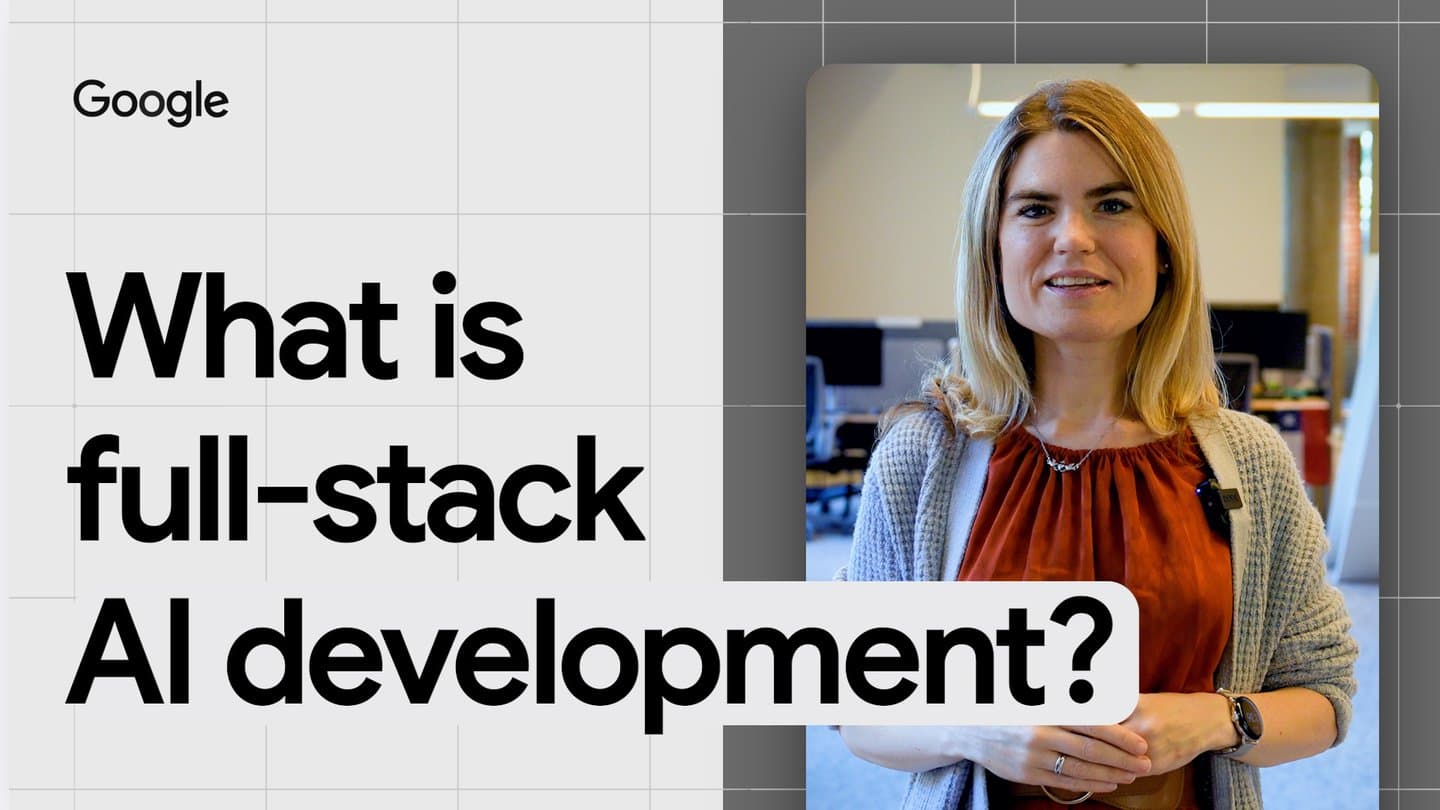
To clarify the meaning, Paige Bailey, an engineering lead at Google DeepMind, broke down the concept into five distinct layers.
Paige helpfully breaks down full‑stack development: infrastructure, security, research, models & tooling, and products.
Each one serves a crucial purpose.
Infrastructure includes the hardware and cloud services that power AI workloads across Google’s ecosystem.
Security covers encryption, authentication, and compliance mechanisms that protect model data.
Research drives the creation of new algorithms, architectures, and scientific insights that advance model capabilities.
Models & tooling comprise the trained neural networks and the APIs, libraries, and development environments that let engineers build on them.
Products are the applications and services that deliver AI functionality to end users.
And all five layers work together to make Google’s AI products faster, more secure, and more helpful for users, developers, and customers.
The Five Layers Explained
The infrastructure layer provides the compute, storage, and networking resources needed for large‑scale AI training and inference.
The security layer ensures data protection, access control, and resilience against threats throughout the AI pipeline.
The research layer fuels continuous improvement by exploring novel model designs and training techniques.
The models & tooling layer offers the Gemini models along with developer‑friendly interfaces that streamline integration.
The products layer translates these capabilities into everyday services such as Search, Assistant, and other Google applications.
Why the Layered Approach Matters
The blog notes that the full‑stack approach shows up in the Google technology that users interact with daily.
By separating concerns into distinct layers, Google can address performance, safety, and usability in a coordinated fashion.
Paige’s full explanation, including live examples of each layer working together, is available in Google’s accompanying video: https://www.youtube.com/watch?v=5JKWW4tX-ns
The video walks through how each of the five layers maps onto the AI features developers rely on daily.
This structured framework gives developers a clearer picture of where improvements in speed, security, or functionality may originate.
It also signals to customers that Google’s AI services are built on a foundation designed for reliability and scalability.
Understanding Google’s full‑stack AI framework helps developers anticipate how future updates may affect integration, security, and performance.
Why This Matters: The five‑layer full‑stack approach makes Google’s AI products faster, more secure, and more helpful for users, developers, and customers.
This digest was compiled from:
Share this digest
People Also Read
- OpenAI Details Its Text Watermarking Strategy to Meet EU AI Act Requirements
OpenAI outlines its optional text watermarking system, textGrain, to meet EU AI Act requirements while noting detection limits and early‑access plans.
- OpenAI Launches Visual Ad Format in ChatGPT with Expanded Measurement Tools
OpenAI introduces a clearly labeled visual ad format in ChatGPT, adds extensive measurement integrations, and enforces guardrails to protect user trust.
- Google AI Model Tops Flu Hospitalization Forecast Rankings
Google’s AI model outperformed 38 competitors in CDC’s FluSight ranking, accurately forecasting flu hospitalizations for the 2025‑26 season.
Share your thoughts
Reactions, corrections, or insights — all welcome.