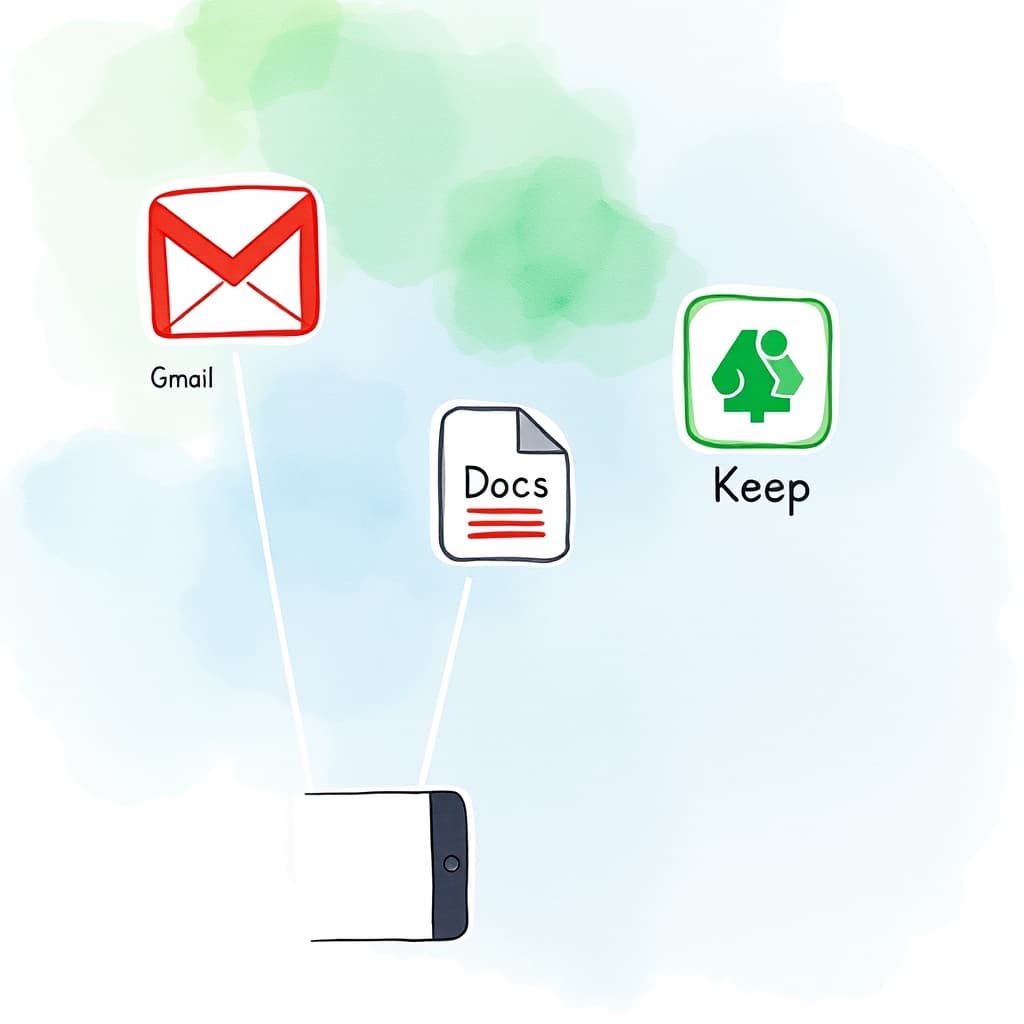
Google Introduces AI‑Powered Voice Tools for Gmail, Docs and Keep
Google embeds voice AI across its core productivity suite
Google is extending conversational AI and voice interaction into its flagship productivity applications.
The rollout enables users to speak directly to their inbox, generate documents using natural‑language prompts, and dictate notes without touching a keyboard.
The company announced three distinct voice‑enabled features: Gmail Live, Docs Live and Keep Live.
Introducing Gmail Live, Docs Live and Keep Live
Gmail Live lets users issue spoken commands to manage email, such as composing, replying, searching or archiving messages.
Docs Live allows creators to describe the content they want and have the system generate or edit text accordingly.
Keep Live provides a hands‑free way to capture ideas, lists or reminders by dictating directly into the note‑taking app.
Google first previewed these capabilities earlier in the year, signalling a broader strategy to embed AI throughout its ecosystem.
By integrating voice controls, Google aims to reduce the friction of typing and make routine tasks faster.
The features are built on Google’s existing large‑language‑model infrastructure, which powers its Gemini AI services.
Users can activate the voice mode by clicking a microphone icon that appears within each app’s interface.
Once active, the system listens for natural‑language instructions and translates them into the appropriate action.
The technology also supports follow‑up queries, enabling a conversational flow rather than isolated commands.
Early testers reported that the voice interface can draft emails in seconds, a task that previously required several minutes of manual typing.
In document creation, users can ask the AI to “add a summary of last quarter sales” and receive a formatted paragraph instantly.
Keep Live’s dictation feature captures spoken text and automatically timestamps the entry, helping users organize thoughts chronologically.
Implications for everyday workflow
Google has positioned these tools as part of its broader effort to make its Workspace suite more accessible on mobile and low‑bandwidth environments.
Voice interaction reduces reliance on visual keyboards, which can be advantageous for users with disabilities or those operating on small screens.
The rollout is initially available to a subset of users, with a wider public release planned later in the year.
Google has not disclosed exact pricing, but the features are expected to be included in existing Workspace subscriptions.
Competitors such as Microsoft have introduced similar voice capabilities in their Office products, indicating a market trend toward hands‑free productivity.
Industry analysts view Google’s move as a response to growing user demand for AI‑driven efficiency tools.
The integration also aligns with Google’s emphasis on “AI first” product development across its portfolio.
Security and privacy considerations remain central, as voice data is processed in compliance with Google’s established data‑handling policies.
Users can delete voice recordings from their account settings, providing control over personal information.
The new features support multiple languages, extending accessibility to a global audience.
Google plans to refine the models based on user feedback, aiming for higher accuracy in interpreting nuanced commands.
The company’s engineering blog notes that continual learning will improve contextual understanding over time.
For enterprises, the voice tools could streamline internal communications and reduce turnaround time on routine documentation.
Small businesses may benefit from faster email handling and note‑taking without additional software investments.
Why This Matters: The new voice‑driven features let users interact with Gmail, Docs and Keep without typing, potentially speeding up everyday productivity.
This digest was compiled from:
Share this digest
People Also Read
- Anthropic reports a decline in junior staff and an increase in meeting hours
Anthropic reports fewer junior hires, more meeting time, and productivity shifts as AI Claude reshapes its workflow.
- UNILAG and Birmingham University to Offer Joint AI and Digital Media Masters Starting 2027
UNILAG and the University of Birmingham unveiled joint AI and digital media master’s programmes to start in Lagos in September 2027.
- NYSC to Deploy AI‑Powered System for Faster Online Registration
NYSC plans to add AI tools to its online registration portal, aiming for a faster, more efficient enrolment process for future corps members.
Share your thoughts
Reactions, corrections, or insights — all welcome.