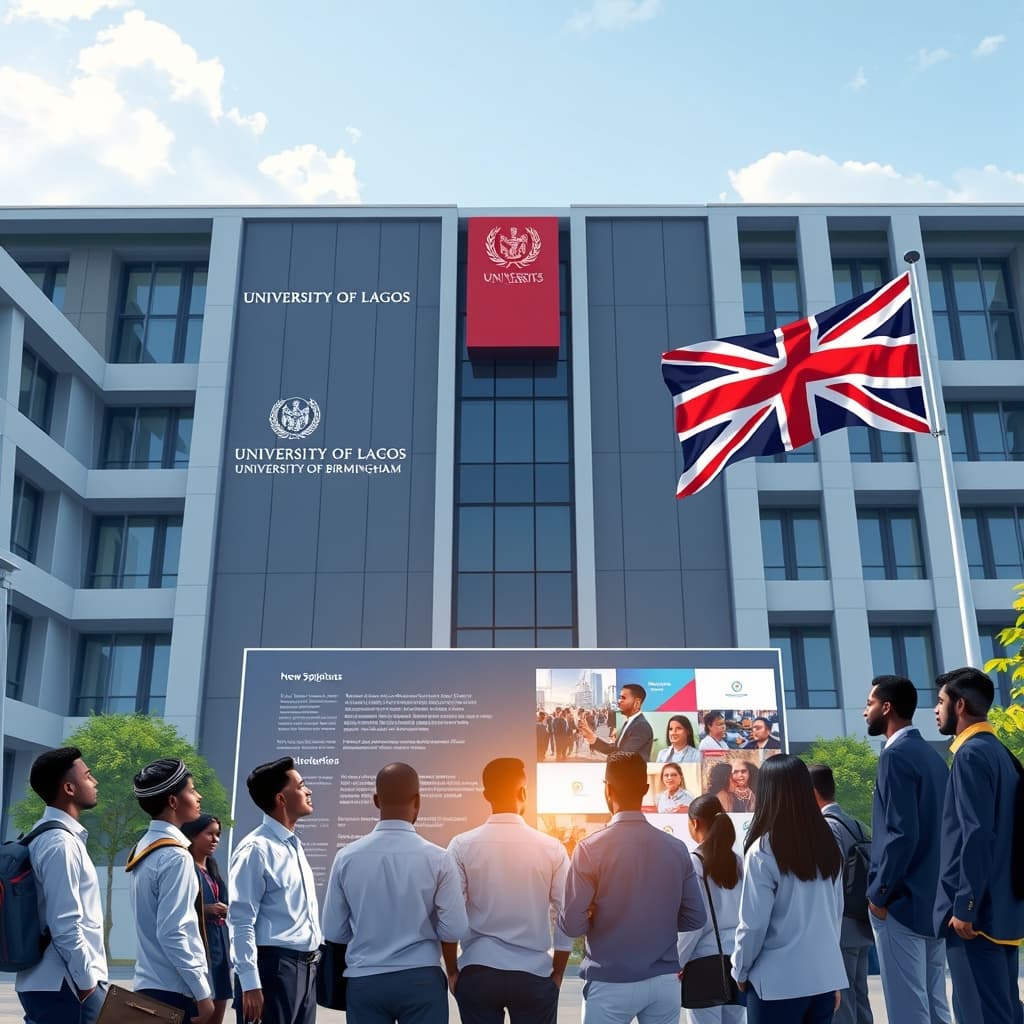
UNILAG and Birmingham University to Offer Joint AI and Digital Media Masters Starting 2027
Joint Postgraduate Degrees Announced
The University of Lagos and the University of Birmingham officially launched two collaborative postgraduate programmes on 15 October 2026 in Lagos.
The programmes, a one‑year MSc in Artificial Intelligence and Data Technologies and an MA in Digital Media and Communications, will begin teaching in September 2027.
Both degrees will be delivered locally in Lagos through a transnational education partnership between the two institutions.
University of Birmingham Provost Professor Nick Vaughan‑Williams, UNILAG Vice‑Chancellor Professor Folasade T. Ogunsola, and Nigeria’s Minister of Education Dr Maruf Tunji Alausa attended the launch ceremony.
Representatives from the British High Commission and the British Council also participated, underscoring diplomatic support for the initiative.
Curriculum Focus and Career Pathways
The MSc curriculum will cover machine learning, deep learning, computer vision, large language models, data management and AI ethics.
According to Birmingham, the programme is designed to give students technical and analytical skills for fintech, healthcare innovation and business analytics.
The MA will explore digital cultures, power dynamics, identity and ethics in digital media, alongside research methods, content creation and broadcasting.
Graduates of the MA are expected to be prepared for roles in journalism, digital communications and related creative industries.
Both programmes aim to equip Nigerian students with specialised knowledge without the need to relocate to the United Kingdom.
Strategic Partnership and National Impact
The collaboration builds on a memorandum of understanding signed on 29 January 2026 to expand transnational education in Nigeria.
The initiative involves coordination with the Federal Ministry of Education and the National Universities Commission.
Professor Vaughan‑Williams said the partnership reflects a commitment to addressing Nigeria’s higher‑education and talent‑development needs.
Professor Ogunsola highlighted that international academic partnerships promote knowledge exchange and strengthen educational opportunities.
Deputy High Commissioner Jonny Baxter noted that such collaborations help develop curricula responsive to evolving economic and technological demands.
University of Birmingham described the programmes as a means to support skills development, entrepreneurship and employment while contributing to Nigeria’s economic growth.
Minister Alausa linked the launch to President Bola Tinubu’s Renewed Hope Agenda and the broader Education Sector Renewal Initiative.
Prospective applicants are advised to await official guidance on admission criteria, tuition fees and application timelines.
The joint degrees will allow eligible students to earn a British‑awarded qualification while studying entirely in Nigeria.
Industry observers see the programmes as a response to rising demand for AI, data technology and digital communication expertise across Nigerian organisations.
By offering locally delivered, internationally recognised postgraduate education, the partnership may help curb brain‑drain and retain talent within the country.
Why This Matters
The launch provides a concrete pathway for Nigerian professionals to gain globally recognised AI and digital media expertise without leaving the country, potentially strengthening the nation’s tech workforce.
This digest was compiled from:
Share this digest
People Also Read
- NYSC to Deploy AI‑Powered System for Faster Online Registration
NYSC plans to add AI tools to its online registration portal, aiming for a faster, more efficient enrolment process for future corps members.
- Meta unveils Muse Spark Open, a massive open‑weight AI model built for Apple Macs
Meta unveiled Muse Spark Open, an 816‑billion‑parameter open‑weight model that runs on high‑end Macs for coding and media tasks.
- Meta deletes over 3.7 million West African accounts in anti‑scam operation
Meta and a coalition of tech firms and law‑enforcement agencies removed over 3.7 million fraudulent accounts and rescued 117 victims in West Africa.
Share your thoughts
Reactions, corrections, or insights — all welcome.