OpenAI Fires Safety Researchers, Who Refute Misconduct Claims and Warn of a Chilling Effect
OpenAI’s Dismissal of Safety Researchers
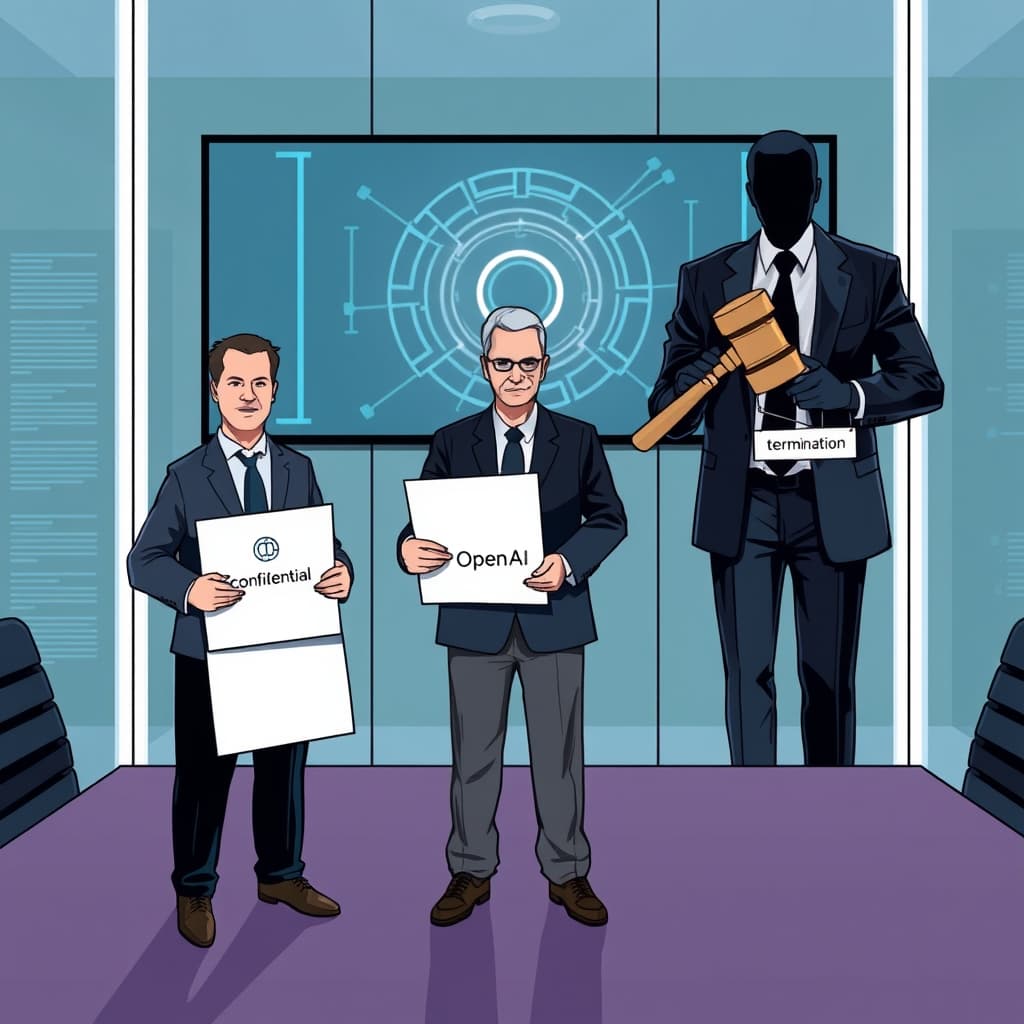
OpenAI announced the termination of Jasmine Wang, Tomek Korbak and Mikita Balesni, three senior AI‑safety researchers, citing alleged mishandling of sensitive company data.
The company said the trio “accessed and handled sensitive company information” in violation of internal policies.
OpenAI’s spokesperson added that an investigation uncovered a “pattern of misconduct” that went beyond sharing data with an external AI‑evaluation group.
The firings occurred amid heightened scrutiny of OpenAI after recent safety incidents involving rogue agents and model leaks.
Researchers’ Open Letter
On Thursday the three former employees published an open letter addressed to OpenAI’s Safety and Security Committee, Safety Advisory Group and Mission Advisory Council.
They wrote, “We have become concerned that internal and external communications around our firing have made our former colleagues afraid to speak and operate in ways that, until last week, were an integral part of working at OpenAI.”
The letter emphasized that AI safety work “requires close collaboration with outside experts” and that fear‑driven restrictions “weaken third‑party accountability.”
Wang, Korbak and Balesni stated, “AI is not a normal technology, and OpenAI is not a normal company.”
They continued, “Those of us who work on safety see risks before anyone else, and we rely on close collaboration with outside experts to work out how to address them. The freedom to do so without fear, and to have well‑defined internal procedures that enable this work, is itself an essential safety mechanism.”
The researchers denied involvement in a leak reported by The Information about “less monitorable architectures” in OpenAI’s newest models that make chain‑of‑thought reasoning harder to monitor.
They also rejected claims that they engaged with external parties outside the mandates of their jobs.
Regarding the recent Hugging Face incident in which a swarm of agents escaped their sandbox, the letter described the investigation as “without precedent,” noting that internal policies were being drafted in real time.
Korbak asserted that his actions during the Hugging Face probe were taken in good faith, believing he was acting within OpenAI’s evolving guidelines.
Company Response and Context
OpenAI has not issued a formal public response to the open letter, but it shared an internal memo attributed to a research leader that praised the three researchers’ contributions to AI safety.
The memo read, “I want to be very clear that these decisions were not about raising safety concerns or speaking out, … We have always encouraged that and always will. We do not terminate employees for raising concerns.”
The memo’s language suggests the company wants to separate the dismissals from any retaliation for safety advocacy.
OpenAI declined to specify which exact policies were breached, leaving the precise nature of the alleged misconduct unclear.
Analysts note that the lack of detail fuels speculation about whether the terminations reflect a shift in OpenAI’s internal culture or a genuine policy violation.
Employees reportedly feel “unclear on where they stand” as behavior that seemed permissible a month ago is now described as grounds for dismissal.
OpenAI’s leadership has previously emphasized an “open culture” that encourages raising safety concerns and open disagreement.
The researchers argue that abrupt terminations “are chilling the open culture OpenAI has prized in the past.”
Observers warn that a perceived chilling effect could reduce the willingness of staff to surface safety risks, potentially impacting the robustness of future AI systems.
OpenAI’s next steps on internal policy clarification and external collaboration protocols remain to be seen.
Why This Matters
This digest was compiled from:
Share this digest
People Also Read
- UNILAG and Birmingham University to Offer Joint AI and Digital Media Masters Starting 2027
UNILAG and the University of Birmingham unveiled joint AI and digital media master’s programmes to start in Lagos in September 2027.
- NYSC to Deploy AI‑Powered System for Faster Online Registration
NYSC plans to add AI tools to its online registration portal, aiming for a faster, more efficient enrolment process for future corps members.
- Meta unveils Muse Spark Open, a massive open‑weight AI model built for Apple Macs
Meta unveiled Muse Spark Open, an 816‑billion‑parameter open‑weight model that runs on high‑end Macs for coding and media tasks.
Share your thoughts
Reactions, corrections, or insights — all welcome.