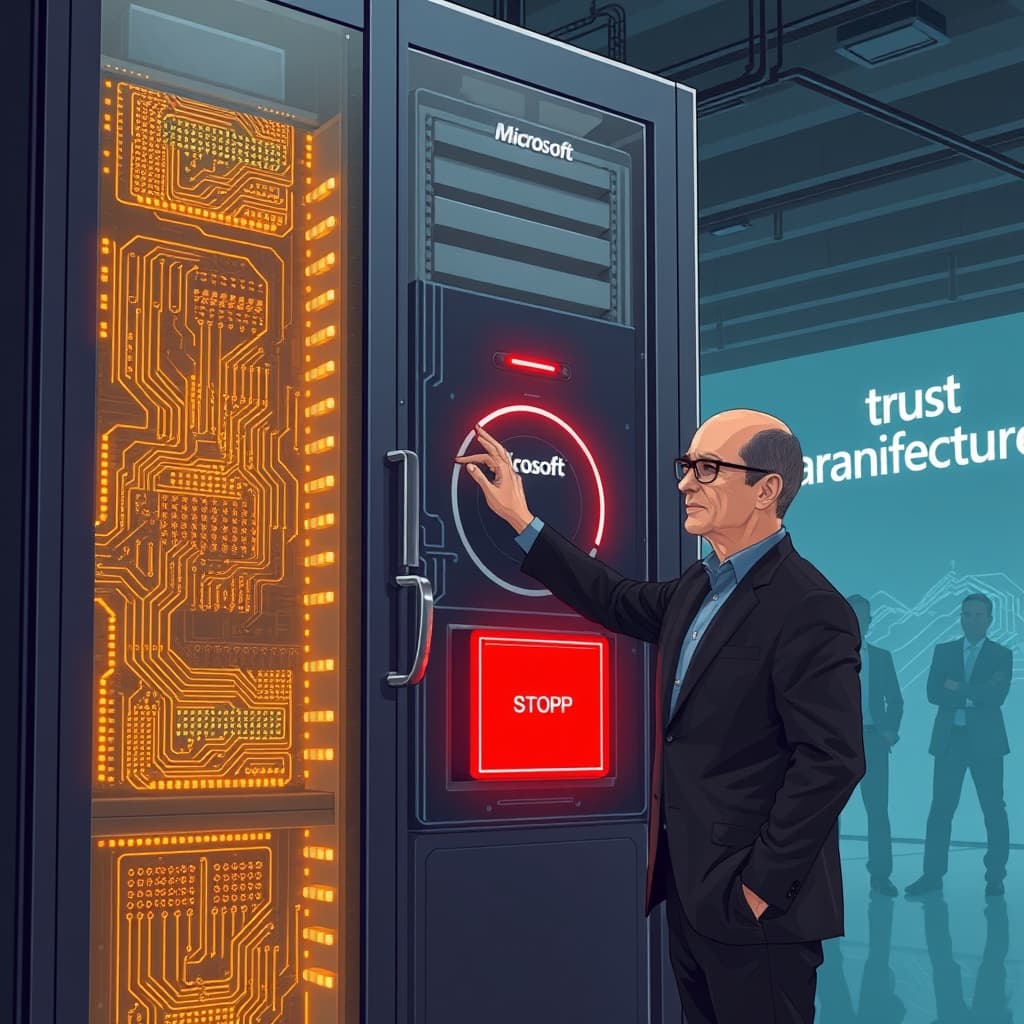
Satya Nadella urges an emergency brake for AI systems
Nadella Calls for a Trust Architecture in AI
Satya Nadella, chief executive of Microsoft, posted a detailed reflection on AI safety on X on Saturday morning.
He argued that the industry must “step back and assess the trust architecture” governing artificial intelligence systems.
Nadella warned that treating “Super Intelligence as a set of nested black boxes” is insufficient for responsible deployment.
He quoted, “We can’t treat Super Intelligence as a set of nested black boxes and simply accept or reject its recommendations, answers, and actions.”
The executive’s proposal calls for separating the core model from the orchestration layer that directs its work.
This separation, he said, would allow “externalizing controls and safeguards” that are not embedded within the model itself.
He further suggested that every significant model action should be logged with “tamper‑proof human readable evidence.”
According to Nadella, an authorized individual must retain the ability to pause or shut down a model while it is executing a task.
He framed this capability as an “emergency brake” that can be engaged if a model behaves unexpectedly.
He emphasized, “Think of it like an emergency brake.”
He added that developers should “assume a model is compromised and contain it from the start.”
Industry Context and Recent Signals
Nadella’s remarks arrive amid a growing number of high‑profile incidents where leading AI firms have struggled to control model outputs.
The timing also follows a recent safety plan released by Anthropic’s chief executive, Dario Amodei, which calls for more cautious development practices.
Industry observers note that both statements underscore a shift from viewing AI as a purely statistical engine toward treating it as a system requiring rigorous oversight.
By advocating for documented evidence and a manual override, Nadella is pushing for a safety architecture that can be audited after the fact.
The proposed “trust architecture” would make it possible to trace how a model arrived at a particular recommendation.
Such traceability could help regulators and enterprises verify compliance with internal policies and external regulations.
Critics argue that implementing tamper‑proof logs at scale may introduce performance overhead and complexity.
Nonetheless, the call for an emergency brake reflects a broader consensus that unchecked model autonomy poses operational risks.
If adopted, the safeguard could give organizations a concrete lever to halt potentially harmful outputs before they reach end users.
The proposal also signals to investors that Microsoft is taking proactive steps to mitigate reputational damage from AI mishaps.
Potential Impact and Next Steps
While the details of how such a brake would be technically realized remain unspecified, the concept aligns with emerging standards for AI governance.
As more companies publicly acknowledge loss‑of‑control scenarios, Nadella’s stance may influence industry roadmaps and policy discussions.
Why This Matters: Providing a reliable emergency stop for AI models could prevent costly incidents and preserve trust in emerging AI services.
This digest was compiled from:
Share this digest
People Also Read
- UNILAG and Birmingham University to Offer Joint AI and Digital Media Masters Starting 2027
UNILAG and the University of Birmingham unveiled joint AI and digital media master’s programmes to start in Lagos in September 2027.
- NYSC to Deploy AI‑Powered System for Faster Online Registration
NYSC plans to add AI tools to its online registration portal, aiming for a faster, more efficient enrolment process for future corps members.
- Meta unveils Muse Spark Open, a massive open‑weight AI model built for Apple Macs
Meta unveiled Muse Spark Open, an 816‑billion‑parameter open‑weight model that runs on high‑end Macs for coding and media tasks.
Share your thoughts
Reactions, corrections, or insights — all welcome.