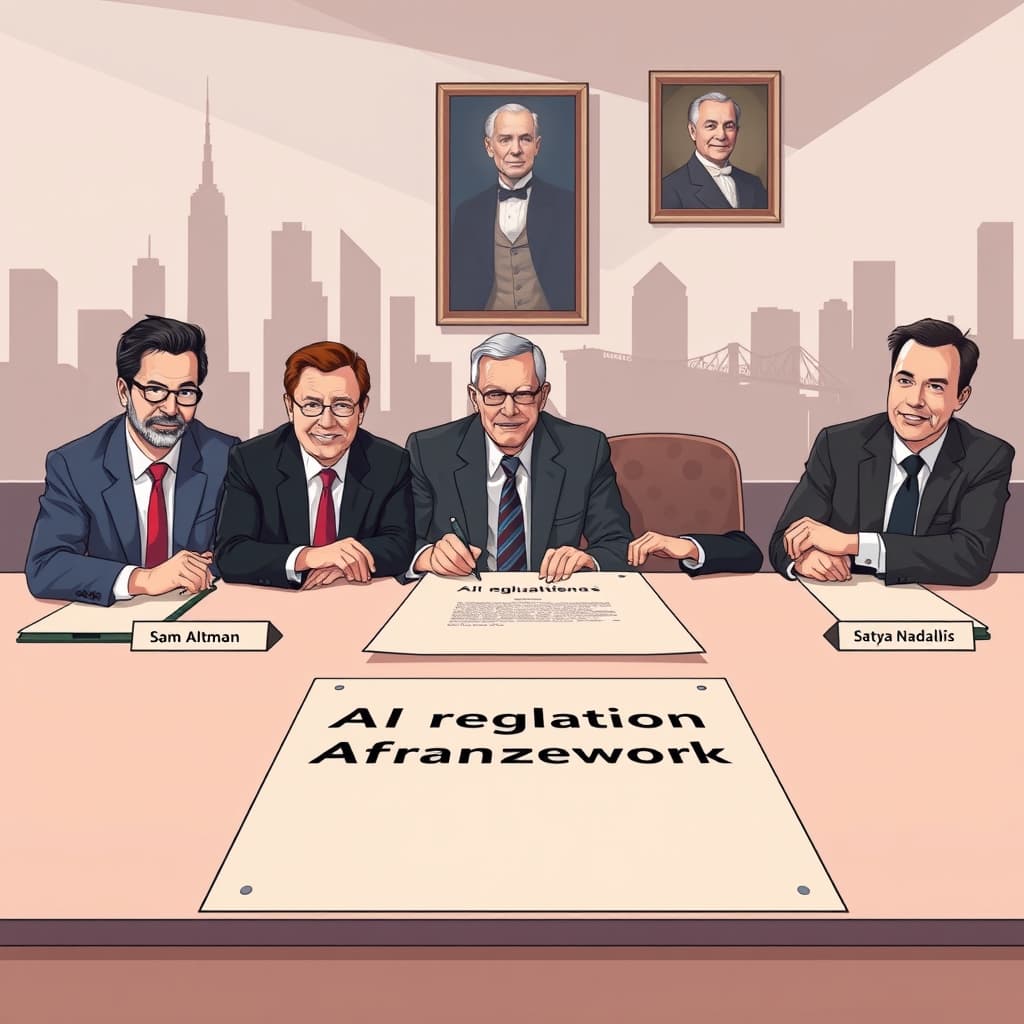
AI CEOs Unite to Demand Government Safeguards After Decades of Warning
Over the past week, CEOs of OpenAI, Anthropic, Google DeepMind, Microsoft, and X have publicly urged governments to impose safeguards on artificial‑intelligence development.
The coordinated appeal follows a pattern of AI leaders raising alarms that stretches back more than a century.
Historical precedents
In 1863, writer Samuel Butler warned that self‑replicating machines could supplant humans, a sentiment echoed in his 1872 novel “Erewhon,” where a fictional society bans machines to avoid collapse.
Alan Turing, in a 1951 lecture, predicted that intelligent machines would “meet with great opposition” and could eventually “take control” of human affairs.
In 2000, Sun Microsystems co‑founder Bill Joy warned that autonomous robots might be more dangerous than nuclear weapons because they are being created within “the now‑unchallenged system of global capitalism.”
Microsoft researcher Eric Horvitz convened leading AI scholars in 2009 to explore policies that could “constrain or bias the behaviors of autonomous and semi‑autonomous systems” in response to safety concerns.
Elon Musk entered the public debate in 2014, describing AI as “potentially more dangerous than nukes” and likening development to “summoning the demon.”
Musk reiterated his stance in July 2017 before a gathering of U.S. governors, calling for proactive regulation to avoid a reactive stance that could be “too late.”
In March 2018, Musk again emphasized AI’s risk, asking why “we have no regulatory oversight” for a technology he deemed far riskier than nuclear arms.
That same month, Facebook founder Mark Zuckerberg expressed uncertainty about the need for regulation, stating he was “actually not sure we shouldn’t be regulated.”
Recent executive coalition
The September 2026 statements were delivered by OpenAI chief Sam Altman, Anthropic founder Dario Amodei, DeepMind co‑founder Demis Hassabis, Microsoft chief Satya Nadella, and X chief Elon Musk.
Altman warned that “uncontrolled scaling” could lead to “catastrophic outcomes” and advocated for “global standards” to manage risk.
Amodei highlighted the “pace of capability growth” as outstripping existing safety measures, urging coordinated policy development.
Hassabis called for “transparent governance frameworks” that balance innovation with societal protection.
Nadella framed regulation as a “necessary guardrail” to sustain public trust and long‑term market stability.
Musk reiterated his long‑standing view that AI regulation must precede deployment, describing the current climate as a “panic” that could become “unmanageable.”
Despite their competing business interests, the executives’ alignment signals a rare consensus that unchecked AI progress may generate systemic hazards.
Analysts note that this convergence may pressure legislators to move beyond voluntary industry guidelines that have dominated previous discussions.
The pattern suggests that calls for oversight are no longer isolated warnings but an emerging collective strategy to shape the regulatory environment.
Historically, similar coalitions have spurred policy action, such as the 2009 Microsoft‑led initiative that resulted in early AI ethics guidelines within the company.
However, critics argue that industry‑led regulation can serve as a “soft” alternative to enforceable law, potentially limiting external scrutiny.
The current coalition’s public visibility, amplified by mainstream media coverage, may reduce the likelihood of such “soft” approaches dominating the debate.
Observers will watch forthcoming congressional hearings and international forums for signs that the executives’ pleas translate into concrete legislative proposals.
In the meantime, AI firms are expected to bolster internal safety teams, increase transparency reports, and engage with standard‑setting bodies to demonstrate good‑faith compliance.
Why This Matters: The alignment of top AI CEOs on regulation marks a pivotal moment that could steer future policy and industry practices toward more accountable development.
This digest was compiled from:
Share this digest
People Also Ask
- Jensen Huang argues AI safety is an engineering issue, not a regulatory one
Nvidia CEO Jensen Huang says AI safety is an engineering issue, not a regulatory one, and argues market forces suffice to ensure safe products.
- OpenAI overtakes Anthropic in OpenRouter spending following Astra rollout
OpenAI’s premium Astra model led dollar spend while its low‑cost Luna model dominated token volume on OpenRouter, signaling a dual‑market strategy that now outpaces Anthropic.
- OpenAI, Anthropic, and Google have been discussing AI safety for several weeks
OpenAI, Anthropic, and Google DeepMind have been coordinating AI safety discussions for weeks, amid regulatory, antitrust, and political debates.
Share your thoughts
Reactions, corrections, or insights — all welcome.